
• Liberty Fund Network
    • Econlib
    • Liberty Fund
    • OLL
    • Adam Smith Works
    • Law & Liberty
  • Submissions
econlib
  • EconLog
    • Blog
    • Browse by Author
    • Browse by Topic
    • Browse by Date
    • Search EconLog
    • RSS
    • Subscribe
  • EconTalk
    • Latest Episodes
    • Browse by Date
    • Browse by Guest
    • Browse by Category
    • Browse Extras
    • Search EconTalk
    • RSS Feeds
  • Articles
    • Latest Articles
    • Liberty Classics
    • Browse by Author
    • Browse by Date
    • Search Articles
  • Books
    • Books
    • Bios
    • Books by Date
    • Books by Author
    • Search Books
  • Encyclopedia
    • Index
    • Browse by Author
    • Browse by Title
    • Biographies
    • Search Encyclopedia
  • Guides
    • Index
    • #ECONLIBREADS
    • College Topics
    • High School Topics
    • Subscribe to QuickPicks
    • Search Guides
  • Videos
    • Index
    • Search Videos
  • Liberty Fund Network
    • Econlib
    • OLL
    • Adam Smith Works
    • Library of Law & Liberty
  • Home  /  

ECONLIB Books

Feb 5 2018

James M. Buchanan

The Demand and Supply of Public Goods

By James M. Buchanan
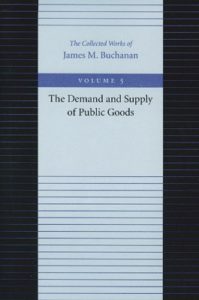
Book Cover
First Pub. Date

1968

Publisher

Indianapolis, IN: Liberty Fund, Inc.

Pub. Date

1999

Comments

First published in 1968 by Rand McNally & Company. Foreword by Geoffrey Brennan.

Copyright

The text of this edition is copyright ©: 1999 Liberty Fund, Inc. Picture of James M. Buchanan: File photo detail, courtesy Liberty Fund, Inc. James M. Buchanan, Charlottesville, Virginia, 1964.

Table of Contents
  1. Foreword
  2. Ch. 1, A Methodological Introduction
  3. Ch. 2, Simple Exchange in a World of Equals
  4. Ch. 3, Simple Exchange in a World of Unequals
  5. Ch. 4, Pure and Impure Public Goods
  6. Ch. 5, Many Private Goods, Many Persons
  7. Ch. 7, The Publicness of Political Decisions
  8. Ch. 8, The Institutions of Fiscal Choice
  9. Ch. 9, Which Goods Should Be Public
  10. Ch. 10, Toward a Positive Theory of Public Finance
  11. Supplementary Reading Materials
FIRST
LAST
FIRST
LAST
Categories: James M. Buchanan

SHARE
POST:
Enter your email address to subscribe to our monthly newsletter:
RELATED CONTENT By Anthony de Jasay
The Failure of Market Failure. Part II. The Public Goods Dilemma
Public goods are freely accessible to all members of a given public, each being able to benefit from it without paying for it. The reason standard theory puts forward for this anomaly is that public goods are by their technical character non-excludable. There is no way to exclude a person from access to such a good if it is produced at all. Examples cited include the defence of the realm, the rule of law, clean air or traffic control. If all can have it without contributing to its cost, nobody w...
Read This Article

COLLECTION: JAMES M. BUCHANAN

The article you’re reading is part of Econlib’s James M. Buchanan collection. Explore other James M. Buchanan articles:
  • Feb 5 2018

    The Reason of Rules: Constitutional Political Economy

    Geoffrey Brennan and James M. Buchanan
  • Feb 5 2018

    The Power to Tax: Analytical Foundations of a Fiscal Constitution

    Geoffrey Brennan and James M. Buchanan
  • Feb 5 2018

    Democracy in Deficit: The Political Legacy of Lord Keynes

    James M. Buchanan and Richard E. Wagner
  • Feb 5 2018

    The Limits of Liberty: Between Anarchy and Leviathan

    James M. Buchanan

Econlib

The Library of Economics and Liberty

Liberty Fund, Inc.

11301 N. Meridian Street

Carmel, IN 46032-4564, USA

econlib@libertyfund.org

About
  • About Us
  • Contact Us
  • Privacy Policy
Publications
  • Books
  • Articles
  • EconTalk
  • EconLog
  • Videos
Resources
  • Quickpicks
  • CEE Encyclopedia
  • College Guides
  • High School Guides
Sign up for our newsletter

Enter your email address to subscribe to the Econlib monthly newsletter.

Liberty Fund, Inc.

11301 N. Meridian Street

Carmel, IN 46032-4564, USA

info@libertyfund.org

© 2024 Econlib, Inc. All Rights Reserved. Part of the Liberty Fund Network.

x
Take our Annual EconTalk Survey

Voting closes February 6th.

Click here.