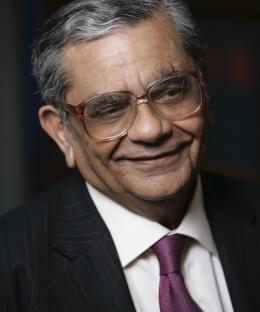
 Jagdish Bhagwati
Introduction
Economist Jagdish Bhagwati has made fundamental contributions to the studies of international trade, tariffs and quotas, and of industrial development. One of his most important contributions on tariffs was to show that when markets suffer from distortions or government policies cause distortions in a domestic economy, tariffs are never the best solution; for any given distortion there is always a domestic policy that is more efficient than tariffs in correcting the distortion. Another important contribution was to show that tariffs and quotas on imports are equivalent only under restrictive assumptions. Bhagwati has written numerous thoughtful defenses of free trade and critiques of protectionist policies. He wrote the entry titled “Protectionism” for this Encyclopedia.
International Trade and Tariffs
One of Bhagwati’s key contributions is his co-authored 1963 article, “Domestic Distortions, Tariffs and the Theory of Optimum Subsidy,” reprinted in his 1969 book Trade, Tariffs, and Growth. This article introduces the targeting principle. Bhagwati and Ramaswami showed that when a domestic distortion exists, policy should address it directly rather than indirectly through trade restrictions. A brief way to summarize their point is that one should fix the problem at its source. The basic idea is that tariffs and quotas distort both production and consumption decisions. For example, if there is a positive production externality, that is best dealt with by subsidizing production, not imposing an import tariff (which combines a production subsidy with a consumption tax). A properly chosen tariff might reduce the domestic distortion but in general tariffs are not the most efficient policy instrument for achieving domestic objectives.
Bhagwati and various coauthors also provided a ranking of policies in terms of the efficiency with which they achieve certain government objectives. Of course, the idea of using domestic policy to correct distortions rests on the questionable assumption that the government will do it well. But that assumption is no more questionable than the assumption that a government will do tariffs or import quotas well.
The only situation in which tariffs are a first-best policy for a country is one where the country has monopoly power in trade: it can use tariffs to drive down the prices of its imports by restraining its residents’ demands for other country’s goods. Even in that case, though, there are two problems. First, governments of other countries might retaliate, causing losses to the initiating country that exceed the gains from the initial tariffs. Second, the initial tariffs cause losses to people in other countries and so tariffs are not a way of increasing global economic wellbeing.
Bhagwati also demonstrated that tariffs and quotas are not always equivalent. If the domestic industry that the tariffs or quotas protect is one in which firms have some market power, those firms can exploit this power more when a quota is used. The reason is that a quota is a fixed quantitative limit on imports. The quota makes the supply of imports perfectly inelastic. No matter how much the domestic firms use their market power to raise prices, those higher prices cannot elicit further imports. So, unrestrained by competition from imports, the domestic firms may actually reduce output. With a tariff, by contrast, the price discipline from foreign imports still exists and so domestic firms will not cut output but will, in response to the tariff-induced price increase, increase output.
India’s Economic Development
One of Bhagwati’s early contributions on economic development, co-authored with Padma Desai, was their 1970 book, India: Planning for Industrialization. It was one of the earliest books in the development literature that criticized the idea that government would do a good job of intervening in the economy to create economic growth. The book examined India’s post-1951 development strategy, focusing on industrial planning, licensing, trade controls, and exchange-rate policy. Bhagwati and Desai showed that India’s system of tariffs and administrative control distorted prices, suppressed competition, and encouraged rent-seeking. The central planners who had a large role in allocating capital suffered from the same problems all central planners have: a lack of local knowledge and a lack of incentive to make good decisions.
The licensing regime replaced the discipline of free markets with political allocation, which, in turn, created profits for the firms that the government favored. Foreign exchange controls effectively taxed exports and subsidized protected domestic industry. The result was high-cost industrialization, weak incentives for efficiency, and misallocation of resources.
One problem with central planning is the amount of time planners take to make decisions. Bhagwati and Desai quoted a report that found that in 1965, of 264 applications for foreign collaboration, 111 were decided in 6 months or more. In addition, they observed that efficiency was never a consideration in the government’s policies.
The authors also noted that government allocations of steel were “often prompted by graft.” Closely related was their finding that cars that were purposely underpriced were allocated to “civil servants and politicians in government on a ‘priority’ basis.”
Directly Unproductive Profit-Seeking
In his 1982 article “Directly Unproductive, Profit-seeking (DUP) Activities,” Bhagwati introduced the term “directly unproductive profit-seeking (DUP). It was similar to Anne Krueger’s concept of rent-seeking but also included revenue-seeking and policy evasion. In the article, he presented a taxonomy of the various ways that DUP can reduce economic output and gave due credit to Krueger and to a 1967 article by Gordon Tullock titled “The Welfare Costs of Tariffs, Monopoly, and Theft.” While his insight applies to much of what he and Desai found in their study of India’s economic development, he, somewhat surprisingly, did not reference their 1970 book.
Bhagwati’s Popular Writing
Bhagwati has written many popular books and articles that make the case for reducing tariffs and for multilateral trade talks to reduce trade barriers.
In Protectionism, Bhagwati took on ways that the policy deck could be stacked against free trade. He noted that government officials often detected unfair trade practices for imports that caused no one to bat an eye when the same practices were used to sell domestic goods. He quoted the statement of the late Fred Smith of the Competitive Enterprise Institute that “if the same anti-dumping laws applies to U.S. companies, every after-Christmas sale would be banned.” He also pointed to one strange case where a country, Poland, was alleged to have dumped golf carts in the United States, selling them for a lower price in America than they were charging in Poland. Bhagwati noted two problems. First, there was “no way in which ‘true’ or ‘fair’ costs can be meaningfully determined for centrally planned economies in the first place.” Second, golf carts weren’t being sold in Poland. So the advocates of protection searched for comparable countries for wages and other costs that could be used to reconstruct Poland’s true costs. They lit on Spain as the ideal candidate.
In Protectionism, Bhagwati also dealt with a flawed argument for having government prop up various industries. In a 1987 book, Manufacturing Matters: The Myth of the Post-Industrial Economy, Stephen Cohen and John Zysman had argued that to have downstream industries, a country’s economy needed to produce the upstream inputs. Cohen and Zysman had given a concrete example: tomatoes and ketchup. They wrote, “Offshore the tomato farm and you close or offshore the ketchup plant. No two ways about it.” Commented Bhagwati wryly, “Now as I read the profound assertion about the tomato farm and the ketchup plant, I was eating my favorite Crabtree & Evelyn vintage marmalade. It surely had not occurred to me that England grew its own oranges.”
In his 2004 book In Defense of Globalization, Bhagwati defined globalization as the integration of national economies into the international economy. He gave a nuanced defense of globalization, pointing out that it is both economically and socially benign. Consider child labor. Bhagwati noted that when poor people’s incomes rise sufficiently, they tend to shift their children out of labor and into schools. And, of course, when poor countries open themselves to trade, incomes tend to increase. Increased globalization, therefore, is likely to reduce child labor. Bhagwati pointed out that when garment makers feared the passage of a U.S. law that would have banned imports of textiles made with child labor, they dismissed approximately fifty thousand children from factories. This actually caused some of the children to shift into prostitution.
In Aggressive Unilateralism, a book he edited with Hugh T. Patrick, Bhagwati argued that American trade policymakers were putting the world trade system at risk by expanding the meaning of unfair trade. He stated, “For, if everything becomes a question of fair trade, the only outcome will be to remove, altogether, the possibility of ever agreeing to a rule-oriented trading system.” [Italics in original.]
Bhagwati often identified arguments for restricting trade that could be misused by advocates of protectionism. For instance, in discussing economist Laura Tyson’s claim that the U.S. government should protect industries that produced positive externalities, Bhagwati wrote, “But the problem with this is that it is very hard for policymakers, and very easy for lobbyists, to decide which industries have the externalities.” Bhagwati quoted Robert Solow’s statement that although he knew there many industries where there were four dollars’ worth of social output to one dollar’s worth of private output, he didn’t know which ones they were.
Bhagwati’s Background
Jagdish Bhagwati is a University Professor of economics and law at Columbia University and a Senior Fellow in international economics with the Council on Foreign Relations.
He earned his Bachelor of Commerce degree from Sydenham College in Mumbai. He earned a second undergraduate degree in economics at Cambridge University in 1956 and a Ph.D. in economics from MIT.
Bhagwati was born in India. His father was an Indian judge named Natwarlal H. Bhagwati, and he is the brother of P.N. Bhagwati, who was former justice of India and also of neurosurgeon S.N. Bhagwati.
Selected Works by Jagdish Bhagwati
1963: (with V.K. Ramaswami, “Domestic Distortions, Tariffs and the Theory of Optimum Subsidy,” Journal of Political Economy 71, no. 1: 44–50.
1969: Trade, Tariffs, and Growth. MIT Press.
1970: (with Padma Desai). India: Planning for Industrialization. Oxford University Press.
1982: “Directly Unproductive Profit-Seeking (DUP) Activities.” Journal of Political Economy, Vol. 90, No. 5: 988-1002.
1988: Protectionism. MIT Press.
1991: The World Trading System at Risk. Princeton University Press.
2004: In Defense of Globalization. Oxford University Press.
2009: (with Alan S. Blinder.) Offshoring of American Jobs. MIT Press.
Footnotes
[1] India: Planning for Industrialization, p. 262
[2] India: Planning for Industrialization, p.275.
[3] India: Planning for Industrialization, p.276.
[4] Protectionism, p. 51.
[5] Protectionism, p. 114.
[6] Jagdish Bhagwati and Hugh T. Patrick, eds., Aggressive Unilateralism, University of Michigan Press, 1990, p. 24.
[7] Offshoring American Jobs, MIT Press, 2009p. 4.
About the Author and Author’s Acknowledgments
David R. Henderson is the editor of The Concise Encyclopedia of Economics. He is also an emeritus professor of economics with the Naval Postgraduate School and a research fellow with the Hoover Institution at Stanford University. He earned his Ph.D. in economics at UCLA.
I thank Doug Irwin for helpful comments on an early draft.
As an Amazon Associate, Econlib earns from qualifying purchases.