
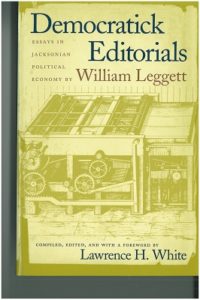
Democratick Editorials: Essays in Jacksonian Political Economy
By William Leggett
Ten years after Thomas Jefferson’s death in 1826, an outspoken young editor in New York City was reformulating and extending the Jeffersonian philosophy of equal rights. William Leggett, articulating his views in the columns of the New York
Evening Post,Examiner, and
Plaindealer, gained widespread recognition as the intellectual leader of the
laissez-faire wing of Jacksonian democracy…. [From the Foreword by Lawrence H. White.]
Translator/Editor
Lawrence H. White, ed.
First Pub. Date
1834
Publisher
Indianapolis: Liberty Fund, Inc. Liberty Press
Pub. Date
1984
Comments
Essays first published 1834-1837.
Copyright
Portions of this edited edition are under copyright. Picture of William Leggett courtesy of United States Library of Congress. Original contains the inscription: "Engraved by Sealey, from a Painting by T. S. Cummings, N A." and includes Leggett's signature below.
- Foreword by Lawrence H. White
- Part I, 1. True Functions of Government
- Part I, 2. The Reserved Rights of the People
- Part I, 3. Objects of the Evening Post
- Part I, 4. Reply to the Charge of Lunacy
- Part I, 5. The Legislation of Congress
- Part I, 6. Religious Intolerance
- Part I, 7. Direct Taxation
- Part I, 8. The Course of the Evening Post
- Part I, 9. Chief Justice Marshall
- Part I, 10. Prefatory Remarks
- Part I, 11. The Sister Doctrines
- Part I, 12. The True Theory of Taxation
- Part I, 13. Strict Construction
- Part I, 14. Legislative Indemnity for Losses from Mobs
- Part I, 15. The Despotism of the Majority
- Part I, 16. Morals of Legislation
- Part I, 17. The Morals of Politics
- Part II, 1. Bank of United States
- Part II, 2. Small Note Circulation
- Part II, 3. The Monopoly Banking System
- Part II, 4. Uncurrent Bank Notes
- Part II, 5. Fancy Cities
- Part II, 6. Causes of Financial Distress
- Part II, 7. Why Is Flour So Dear
- Part II, 8. Thoughts on the Causes of the Present Discontents
- Part II, 9. Strictures on the Late Message
- Part II, 10. The Value of Money
- Part II, 11. The Way to Cheapen Flour
- Part II, 12. The Money Market and Nicholas Biddle
- Part II, 13. The Pressure, the Cause of it, and the Remedy
- Part II, 14. Connexion of State with Banking
- Part II, 15. The Crisis
- Part II, 16. The Bankrupt Banks
- Part II, 17. What We Must Do, and What We Must Not
- Part II, 18. The Foresight of Individual Enterprise
- Part II, 19. The Safety Fund Bubble
- Part II, 20. Separation of Bank and State
- Part II, 21. The Remedy for Broken Banks
- Part II, 22. Blest Paper Credit
- Part II, 23. Questions and Answers
- Part II, 24. The True and Natural System
- Part II, 25. The Bugbear of the Bank Democrats
- Part II, 26. Bank and State
- Part II, 27. Theory and Practice
- Part II, 28. Separation of Bank and State
- Part II, 29. Specie Basis
- Part II, 30. The Natural System
- Part II, 31. The Credit System and the Aristocracy
- Part II, 32. The Divorce of Politicks and Banking
- Part III, 1. Riot at the Chatham-Street Chapel
- Part III, 2. Governor McDuffie's Message
- Part III, 3. The Abolitionists
- Part III, 4. Reward for Arthur Tappan
- Part III, 5. The Anti-Slavery Society
- Part III, 6. Abolitionists
- Part III, 7. Slavery No Evil
- Part III, 8. Progress of Fanaticism
- Part III, 9. An Argument Against Abolition Refuted
- Part III, 10. Commencement of the Administration of Martin Van Buren
- Part III, 11. The Question of Slavery Narrowed to a Point
- Part III, 12. Abolition Insolence
- Part IV, 1. Despotism of Andrew Jackson
- Part IV, 2. The Division of Parties
- Part IV, 3. Rich and Poor
- Part IV, 4. The Street of the Palaces
- Part IV, 5. American Nobility
- Part IV, 6. The Inequality of Human Condition
- Part IV, 7. A Bad Beginning
- Part IV, 8. The Whig Embassy to Washington, and Its Result
- Part IV, 9. Right Views Among the Right Sort of People
- Part IV, 10. Newspaper Nominations
- Part IV, 11. Foreign Paupers
- Part V, 1. Monopolies: I
- Part V, 2. A Little Free-Trade Crazy
- Part V, 3. Asylum for Insane Paupers
- Part V, 4. Monopolies: II
- Part V, 5. Revolutionary Pensioners
- Part V, 6. Joint-Stock Partnership Law
- Part V, 7. The Ferry Monopoly
- Part V, 8. Free Trade Post Office
- Part V, 9. Stock Gambling
- Part V, 10. Weighmaster General
- Part V, 11. State Prison Monopoly
- Part V, 12. Corporation Property
- Part V, 13. Regulation of Coal
- Part V, 14. Free Ferries and an Agrarian Law
- Part V, 15. Thanksgiving Day
- Part V, 16. Municipal Docks
- Part V, 17. Associated Effort
- Part V, 18. The Coal Question
- Part V, 19. The Corporation Question
- Part V, 20. Free Trade Weights and Measures
- Part V, 21. Associated Effort
- Part V, 22. Sale of Publick Lands
- Part V, 23. Manacles Instead of Gyves
- Part V, 24. The Meaning of Free Trade
- Part V, 25. Gambling Laws
- Part V, 26. Free Trade Post Office
- Part V, 27. Free Trade, Taxes, and Subsidies
- Part V, 28. Meek and Gentle with These Butchers
- Part V, 29. The Cause of High Prices, and the Rights of Combination
- Part V, 30. Omnipotence of the Legislature
- Part VI, 1. Rights of Authors
- Part VI, 2. The Rights of Authors
- Part VI, 3. Right of Property in the Fruits of Intellectual Labour
by Lawrence H. White
Foreword
Ten years after Thomas Jefferson’s death in 1826, an outspoken young editor in New York City was reformulating and extending the Jeffersonian philosophy of equal rights. William Leggett, articulating his views in the columns of the New York
Evening Post, Examiner, and
Plaindealer, gained widespread recognition as the intellectual leader of the
laissez-faire wing of Jacksonian democracy.
Leggett’s Life
William Leggett was born April 30, 1801, in Savannah, Georgia. His father, Abraham, a revolutionary war veteran, had moved the family shortly after the war from Westchester County, New York, first to Charleston, South Carolina, then to Savannah. When William was about four years old, the family returned to New York.
*1 At the young age of fourteen he entered Georgetown College but was forced to withdraw the following year when his father’s business failed. In 1819 he moved with his family to the Illinois frontier, where his first writings—poems—appeared in the columns of a local newspaper.
In the fall of 1822 Leggett returned east to enter the United States Navy as a midshipman. During a tour of duty he contracted yellow fever, from which his health evidently never completely recovered. He also disagreed with his commander, leading to a court-martial trial. As a result Leggett resigned his commission in 1826. While in the Navy he had continued his efforts at poetry, publishing a volume of works in 1825. He now undertook to support himself with literary contributions to New York newspapers and magazines and with some acting roles. The combination of the two pursuits soon led him to regular work as a theatrical and literary critic for two periodicals. In 1828 Leggett began his own weekly,
The Critic, which ran for eight months. On its demise, William Cullen Bryant of the New York
Evening Post took Leggett on as a critic.
*2
Leggett had no taste for politics when he joined the
Evening Post in 1829. In fact, he accepted the job on the condition that he not be asked to write on the subject.
*3 He achieved some importance as a theatrical critic, particularly in championing the Shakespearean actor Edwin Forrest. For our purposes, however, the important phase of Leggett’s career had just begun. Within a year he had adopted wholesale Bryant’s free-trade Jacksonian position and had begun authoring his own political editorials. In 1831 he became a partner. In June 1834 he assumed sole editorship of the paper upon Bryant’s departure for Europe. Leggett soon brought financial difficulties upon the paper. His editorials antagonized heads of government agencies, who withdrew their patronage advertising. He later mused over the financial fate of the uncompromising newspaper editor: “He who strives to be a reformer, and to discharge his high trust with strict and single reference to the responsibilities of his vocation, will be sadly admonished by his dwindled receipts that he has not chosen the path of profit, however much he may be consoled by knowing it is that of honour.”
*4
After the fall of 1835, ill health forced Leggett to resign his duties for a year. Shortly after returning to work in the fall of 1836, he dissolved his partnership with Bryant to establish two periodicals of his own. The
Plaindealer, begun in December, was a weekly sixteen-page journal of politics, news, and the arts. The
Examiner, begun in May 1837, was a daily four-page newspaper with a similar mix of contents. The
Plaindealer was modeled after, and the
Examiner named after, the London
Examiner, which Leggett much admired. Both papers were composed and written by Leggett front to back. Both ceased publication in September, 1837. Though the papers evidently failed for financial reasons,
*5 sickness again had caught up with the editor. Given the volume of his weekly word output during this period, it is no surprise that overwork should have taken its toll. The later numbers of the
Plaindealer, with their tendency toward copious extracting from other publications, clearly show the strain. Yet in this journal, particularly in its early numbers, are to be found Leggett’s best and most passionate writings.
After the failure of his papers Leggett lived in New Rochelle, New York, on the charity of his friend Edwin Forrest. An attempt was made to revive the
Plaindealer, but Leggett’s ill health caused the plan to be abandoned. Friends were eventually able to secure from President Van Buren—though he had been the target of sharp editorial attacks by Leggett—an appointment for Leggett as diplomatic agent to Guatemala in 1839. The voyage promised a healthful change of climate, but death came while he prepared to depart.
*6
The Loco-Foco Movement
The political currents of the Jacksonian era can hardly be detailed here, but William Leggett’s important role should be indicated. He was not directly involved in party politics but, through his editorials, exerted a notable influence on the causes taken up by the democratic-republican followers of Andrew Jackson. Much of this impact was felt after his death. John Greenleaf Whittier in 1850 remarked of Leggett’s pioneering efforts: “No one has labored more perseveringly or, in the end, more successfully, to bring the practice of American democracy into conformity with its professions.”
*7
Leggett’s editorials directly provided inspiration to the radical young democrats of New York. Among them, “the coming forth of his paper was looked for daily with the most eager desire” to see “upon whom or what the bolt [of his invective] had fallen.” When his illness prevented his writing editorials, “the
Evening Post was bereft of the mighty spirit which gave it power over men’s minds, and it seemed as if the sun was standing still in the political world.”
*8
When the radicals split off from the regular democrats to form their own party in 1835, Leggett’s writings were themselves among the divisive issues. In September, 1835, Leggett was effectively excommunicated by the semi-official organ of the Jackson administration, the Washington
Globe, for his criticism of federal officials and his defense of the rights of abolitionists. Early in October the Democratic Republican General Committee of New York, meeting in Tammany Hall, similarly censured the
Evening Post for discussing the slavery issue and resolved to end the patronage of publishing its proceedings in Leggett’s newspaper.
*9
At the Tammany Hall meeting of October 29, the radical wing unfurled banners emblazoned with various slogans and gave “heartfelt cheers” to a banner expressing support for Leggett’s
Evening Post as against the regular-democratic New York
Times. The regulars unceremoniously sought to end the meeting by stomping out of the hall, shutting off the gas lamps as they departed, leaving the radicals to meet among themselves in the dark. Those remaining formed the splinter Equal Rights Party, more commonly known as the “Loco-Focos” after the brand of matches they used to light that first meeting. During the match-lit meeting the Loco-Focos adopted a resolution pledging support for the
Evening Post and “the efforts of its talented editors.”
*10
Leggett himself discouraged the formation of a separate party, urging the young radicals to seek reform within the existing party organization. In 1836 the party offered Leggett its mayoral nomination, but he declined it on grounds of poor health, financial troubles, and commitment to the paper in Bryant’s absence. In the two-year lifespan of their party, Loco-Foco candidates never received more than five thousand votes in city elections. But the doctrines of the group—Leggett’s doctrines—spread throughout the Democratic party of the northern states for the next two decades. To his followers Leggett was a martyr who had raised the banner of anti-monopoly reform. Among their tangible accomplishments may be counted the New York State Free Banking Act of 1838, the provision for a general incorporation law in the state’s 1846 constitution, and, on the national level, the removal of federal government deposits from state banks by the Independent Treasury Act.
*11
The Doctrine of Equal Rights
With the noteworthy exception of his late-blooming abolitionism, Leggett’s views on questions of political economy underwent little or no fundamental change during his brief career. This is not surprising: he had become convinced of a powerful and consistent doctrine
ab ovo, as it were, and had written his last editorial only eight years later.
The doctrine, from beginning to end, was one of equal rights—equal human rights to liberty and property. From these rights Leggett carefully derived his position on any given topic. For the most part Leggett spoke of these equal rights as natural rights, anterior to society and limiting the legitimate province of government. In his most systematic statement of political principles he grounded the legitimacy of government in a Lockean social compact whereby strictly limited powers—only those necessary for the protection of person and property—were delegated to government.
*12 Yet Leggett was unwilling to extend the natural rights principle to cover every question. In a discussion of copyright law he explicitly founded his argument on a very different principle, the Benthamite principle of “the greatest good of the greatest number.”
*13
These two strains of thought—natural rights and utilitarianism—coexist throughout Leggett’s writings. His affinity for the English utilitarian Jeremy Bentham is evident from numerous quotations of his maxims, one of which appeared just below the masthead as the motto of the
Plaindealer: “The immediate cause of all the mischief of misrule is, that the men acting as the representatives of the people have a private and sinister interest, producing a constant sacrifice of the interest of the people.” Leggett shared with Bentham a concern for the welfare of the many, what Bentham called the “universal interest,” as opposed to that of their rulers, the special interest. Both advocated free markets, universal suffrage, and economy in government.
*14
Leggett cited several British economists besides Bentham, most importantly Adam Smith. Political economy and Jacksonian democracy were to Leggett “sister doctrines,” both fundamentally libertarian in import.
*15 The deepest roots of Leggett’s thought lay not in British political economy, however, but in the natural rights tradition of American founding fathers Thomas Jefferson and John Taylor of Caroline. He quoted at length on one occasion from Taylor’s
Inquiry into the Principles of the Government of the United States (1814
), lauding it as “one of the most democratic and at the same time most eloquent books ever written in this country.”
*16 He proudly claimed to be guided strictly by Jeffersonian principles: “The principles we maintain are those which were maintained by Jefferson. We profess to be a disciple of that great apostle of liberty, and if any article of faith is heterodox as tried by the standard he has furnished, let it be pointed out, and we promise to renounce it at once.”
*17 Leggett was fond of citing Jefferson to the effect that government’s sole duty is to restrain men from injuring one another.
The equal rights principle meant to Leggett that the law may not discriminate among citizens, benefiting some at the expense of others. Few government programs could pass through this filter. Strict application of the equal rights principle thus led Leggett naturally to favor minimization of government powers. In his view, every extension of the sphere of government action beyond the Jeffersonian night-watchman duties created a privileged aristocratic class at the expense of the productive laboring class.
This Volume
The editorials in this volume are organized under headings of those topics to which Leggett devoted the greatest attention. In putting together this collection, I have attempted to combine the best of the editorials that appeared in
A Collection of the Political Writings of William Leggett (1840) with the best of his
Plaindealer pieces that did not make that collection. Though there is fairly clear external evidence concerning the dates on which Leggett presumably wrote the
Evening Post editorials, Bryant being in Europe, I have included only two
Evening Post editorials that did not appear in the 1840 collection.
*18 I have not included anything from the
Examiner, since Leggett wrote virtually nothing of importance there that he did not later include in the
Plaindealer.
In choosing among Leggett’s political writings, I have rejected pieces dealing primarily with party disputes or personalities of the day. Other pieces from the 1840 collection have been omitted in the interest of avoiding repetition. The repetition that remains usefully indicates what Leggett most wanted to emphasize. Ellipses appearing in the editorials following indicate where deletions have been made of partisan invective or, more commonly, of long extracts from other publications. The content of those deleted extracts should be clear from Leggett’s replies to them.
My foremost debt is to Walter E. Grinder of the Institute for Humane Studies, who years ago first suggested William Leggett to me as a figure deserving study. His guidance and encouragement since then have been invaluable. I also wish to thank Axel Leijonhufvud, Joseph R. Peden, Linda Bandy-White, David D. Boaz, and D. Alexander Puig for their help, and Steve Wylie for his useful comments on a paper on Leggett I wrote several years back.
Department of Economics
New York University
Early Settlers of West Farms, with additions by A. Hatfield, Jr. (New York: n.p., 1913), pp. 51-52; Abraham Leggett,
The Narrative of Abraham Leggett, introduction and notes by Charles I. Bushnell (New York: privately printed, 1865), pp. v-vi. The area of West Farms has since been annexed from Westchester by the Bronx.
Papers of the Bibliographical Society of America 44 (July-September 1950), pp. 241-243; Richard Hofstadter, “William Leggett, Spokesman of Jacksonian Democracy,”
Political Science Quarterly 58 (December 1943), pp. 582-584; [William Cullen Bryant,] “William Leggett,”
The United States Magazine and Democratic Review 6 (July 1839), pp. 20-22.
William Cullen Bryant (New York: Chelsea House, 1980), pp. 326-327.
A Collection of the Political Writings of Willam Leggett, selected and arranged by Theodore Sedgwick, Jr. (New York: Taylor & Dodd, 1840), vol. II, p. 199.
Authors, Publishers and Politicians (London: Routledge & Kegan Paul, 1974), p. 267 n. 8.
Old Portraits and Modern Sketches (Boston: Ticknor, Reed, and Fields, 1840), p. 232.
The History of the Loco-Foco or Equal Rights Party (New York: Burt Franklin, 1967 [Reprint of 1842 edition]), pp. 15, 22-23.
Political Writings, vol. II, pp. 70-76, 76-80.
op. cit., pp. 26-27.
American Historical Review 24 (April 1919), pp. 399-400, 416;
Idem, “The Social Philosophy of the Loco-Foco Democracy,”
American Journal of Sociology 26 (May 1921), pp. 705-708; Hofstadter,
op. cit., pp. 593-594.
Bentham’s Political Thought, edited by Bhikhu Parekh (New York: Barnes & Noble Books, 1973), pp. 195-206. This first appeared in
The Pamphleteer 44 (1823).
Plaindealer 39 (August 26, 1837), pp. 610-612.
Plaindealer 38 (August 19, 1837), pp. 593-595.
op. cit., pp. 252-253.
TRUE FUNCTIONS OF GOVERNMENT