

Thomas Robert Malthus
1766-1834
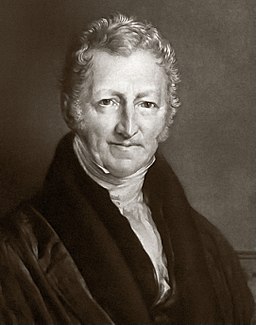
Malthus was interested in everything about populations. He accumulated figures on births, deaths, age of marriage and childbearing, and economic factors contributing to longevity. His main contribution was to highlight the relationship between food supply and population. Humans do not overpopulate to the point of starvation, he contended, only because people change their behavior in the face of economic incentives.
Noting that while food production tends to increase arithmetically, population tends to increase naturally at a (faster) geometric rate, Malthus argued that it is no surprise that people thus choose to reduce (or “check”) population growth. People can increase food production, Malthus thought, only by slow, difficult methods such as reclaiming unused land or intensive farming; but they can check population growth more effectively by marrying late, using contraceptives, emigrating, or, in more extreme circumstances, resorting to reduced health care, tolerating vicious social diseases or impoverished living conditions, warfare, or even infanticide. Malthus was fascinated not with the inevitability of human demise, but with why humans do not die off in the face of such overwhelming odds. As an economist, he studied responses to incentives.
Malthus is arguably the most misunderstood and misrepresented economist of all time. The adjective “Malthusian” is used today to describe a pessimistic prediction of the lock-step demise of a humanity doomed to starvation via overpopulation. When his hypothesis was first stated in his best-selling An Essay on the Principle of Population (1798), the uproar it caused among noneconomists overshadowed the instant respect it inspired among his fellow economists. So irrefutable and simple was his illustrative side-by-side comparison of an arithmetic and a geometric series—food increases more slowly than population—that it was often taken out of context and highlighted as his main observation. The observation is, indeed, so stark that it is still easy to lose sight of Malthus’s actual conclusion: that because humans have not all starved, economic choices must be at work, and it is the job of an economist to study those choices.
Malthus addressed many other issues. His Principles of Political Economy (1820) was the first text to describe a demand schedule as separate from the quantity demanded at a given price. His exposition of demand curves clarified the debate on Say’s law and gluts (to which he objected in the long run on the grounds that markets self-adjust). His work centered on contrasting the long run, as exemplified by population growth, with the short run, reflected by cyclical events such as those affecting agriculture. Writing before the industrial revolution, Malthus did not fully appreciate the impact of technology (i.e., pesticides, refrigeration, mechanized farm equipment, and increased crop yields) on food production.
Malthus died in 1834, before seeing economics characterized as the “dismal science.” That phrase, coined by Thomas Carlyle in 1849 to demean John Stuart Mill, is often erroneously thought to refer to Malthus’s contributions to the economics of population growth.
About the Author
Lauren F. Landsburg is a private computer consultant. She is the editor of the Library of Economics and Liberty. Previously, she taught economics at the University of Rochester and was a senior economist with President Ronald Reagan’s Council of Economic Advisers.
Selected Works
Related Entries
Standards of Living and Modern Economic Growth
Related Links
Thomas Robert Malthus and Nassau William Senior, Two Lectures on Population (1829), at the Online Library of Liberty.
Thomas Robert Malthus, Principles of Political Economy (1820), at the Online Library of Liberty.
Thomas Robert Malthus, Definitions in Political Economy (1827), at the Online Library of Liberty.
Ross Emmett, “Adam Smith and T. Robert Malthus,” at AdamSmithWorks, January 8, 2020.
Morgan Rose, “In Defense of Malthus,” at Econlib. September 16, 2002.
Morgan Rose, “What Malthus Missed, and Attacks on Individualists,” at Econlib, October 28, 2002.
George R. Boyer, “Politics and Welfare: The Political Economy of the English Poor Laws,” at Econlib, December 2, 2002.
David M. Levy and Sandra J. Peart, “The Secret History of the Dismal Science. Part I. Economics, Religion, and Race in the 91th Century,” at Econlib, January 22, 2001.
Paul Sabin on Ehrlich, Simon and the Bet, an EconTalk podcast, February 10, 2014.
Andrew McAfee on More from Less, an EconTalk podcast, October 14, 2019.