
Business Cycles
A High School Economics Guide
Definitions and Basics
Business Cycles, from the Concise Encyclopedia of Economics
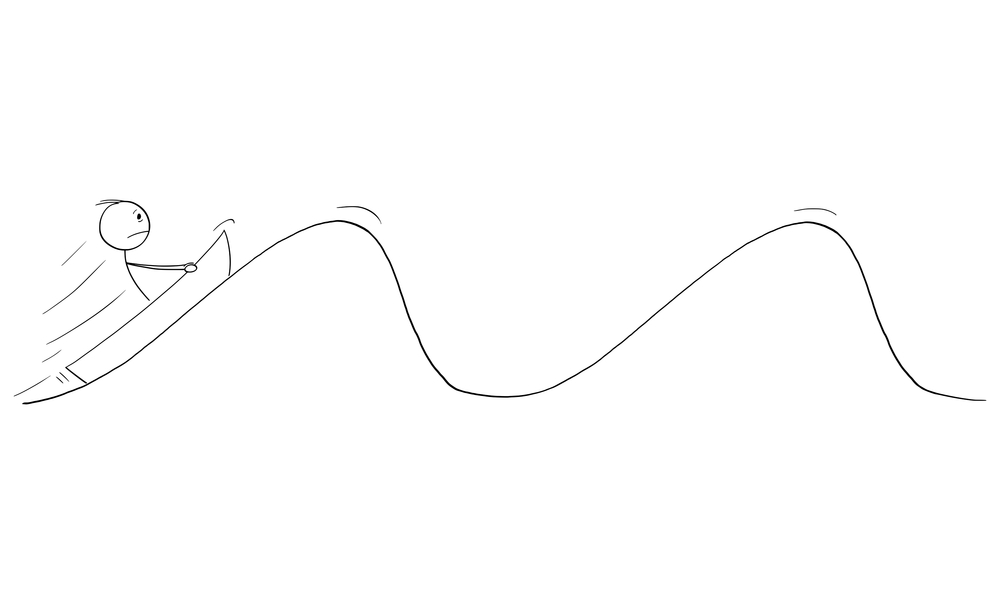
The United States and all other modern industrial economies experience significant swings in economic activity. In some years most industries are booming and unemployment is low; in other years most industries are operating well below capacity and unemployment is high. Periods of economic expansion are typically called booms; periods of economic decline are called recessions or depressions. The combination of booms and recessions, the ebb and flow of economic activity, is called the business cycle….
Intro to Business Fluctuations at Marginal Revolution University
The business cycle at Khan Academy
Recessions, from the Concise Encyclopedia of Economics
One of the most popular definitions of recessions is that they are periods when real gross national product (GNP) has declined for at least two consecutive quarters. In 1990, real GNP declined between the third and fourth quarters and again between the fourth quarter of 1990 and the first quarter of 1991. Hence, there is general agreement that a recession did occur….
In the News and Examples
The Business Cycle Video and Quiz, at EconEdLink.
This video teaches the concept of the business cycle. The pattern in which economies have periods of recession and then also periods of economic expansion or recovery is known as the business cycle. Play the Kahoot! game to test your skills! This multi-player quiz game reviews the concepts discussed in the video.
Cathy O’Neil on Wall St and Occupy Wall Street. EconTalk podcast episode, February 2013.
Cathy O’Neil, data scientist and blogger at mathbabe.org, talks with EconTalk host Russ Roberts about her journey from Wall Street to Occupy Wall Street. She talks about her experiences on Wall Street that ultimately led her to join the Occupy Wall Street movement. Along the way, the conversation includes a look at the reliability of financial modeling, the role financial models played in the crisis, and the potential for shame to limit dishonest behavior in the financial sector and elsewhere….
John Papola on the Keynes Hayek Rap Videos. EconTalk podcast episode, May 2011.
John Papola of Emergent Order talks with EconTalk host Russ Roberts about their collaboration creating rap videos based on the ideas of John Maynard Keynes and F. A. Hayek. Their first was “Fear the Boom and Bust” which was released January 25, 2010. This past week they released “Fight of the Century.” The latest video discusses the overarching differences between the philosophies of Keynes and Hayek and their views on whether government spending promotes recovery from an economic downturn and whether it leads to prosperity. In this conversation, Papola and Roberts discuss some of the underlying ideas in the video–whether the military spending of World War II ended the Great Depression, the debate between Malthus and Say and their influence on Keynes and Hayek, and the fundamental differences between Keynes and Hayek in how economic prosperity is created….
John Maynard Keynes, biography from the Concise Encyclopedia of Economics
Keynes’s General Theory revolutionized the way economists think about economics. It was pathbreaking in several ways, in particular because it introduced the notion of aggregate demand as the sum of consumption, investment, and government spending; and because it showed (or purported to show) that full employment could be maintained only with the help of government spending. Economists still argue about what Keynes thought caused high unemployment. Some think he attributed it to wages that take a long time to fall. But Keynes actually wanted wages not to fall, and in fact advocated in the General Theory that wages be kept stable. A general cut in wages, he argued, would decrease income, consumption, and aggregate demand. This would offset any benefits to output that the lower price of labor might have contributed.
Jeffrey Sachs on the Crisis, the Recovery, and the Future. EconTalk podcast episode, April 2013.
Jeffrey Sachs of Columbia University and author of The Price of Civilization talks with EconTalk host Russ Roberts about the state of the American economy. Sachs sees the current malaise as a chronic problem rather than a short-term challenge caused by the business cycle. He lists a whole host of issues he thinks policymakers need to deal with including the environment, inequality, and infrastructure. He disagrees with the Keynesian prescriptions for stimulating the economy and believes that the federal government budget deficits are a serious problem. The conversation closes with a discussion of the state of economics….
Lee Ohanian on the Great Recession and the Labor Market. EconTalk podcast episode, August 2012.
Lee Ohanian of UCLA talks with EconTalk host Russ Roberts about the recession, the recovery, and the state of labor market. Ohanian describes the unusual aspects of this recession and recovery in the United States as shown by the labor market and the unusual performance of hours worked, productivity, and wages. He also discusses the behavior of business investment and speculates as to why this recession and the recovery has been so different in the United States. The conversation closes with a discussion of the role of the foreclosure process in encouraging unemployment….
William Cohan on the Life and Death of Bear Stearns. EconTalk podcast episode, September 2009.
William Cohan, author of House of Cards: A Tale of Hubris and Wretched Excess on Wall Steet, talks with EconTalk host Russ Roberts about the life and death of Bear Stearns. The discussion starts with how Bear Stearns and other Wall Street firms made money and how they financed their operations. The conversation then turns to the collapse of Bear Stearns’s hedge funds in the summer of 2007 and how that collapse and the firm’s investments in subprime mortgages led to the death of the firm in March of 2008. Cohan explains the role of borrowed money in the financial crisis and Bear Stearns in particular. The conversation concludes with the incentives facing Wall Street executives and the price they paid or didn’t pay for the gambles they made with other people’s money. …
Russ Roberts on the Crisis. EconTalk podcast episode, May 2010.
Russ Roberts, host of EconTalk, discusses his paper, “Gambling with Other People’s Money: How Perverted Incentives Created the Financial Crisis.” Roberts reflects on the past eighteen months of podcasts on the crisis, and then turns to his own take, a narrative that emphasizes the role of government rescues of creditors and the incentives this created for imprudent lending. He also discusses U.S. housing policy, particularly the Government Sponsored Enterprises (GSEs), Fannie Mae and Freddie Mac and how the government’s implicit guarantee of lenders to the GSE’s interacted with housing policy to increase housing prices. This in turn, Roberts argues, helped create the subprime market, created mainly by private investors. The episode closes with some of Roberts’s doubts about his narrative….
A Little History: Primary Sources and References
Great Depression, from the Concise Encyclopedia of Economics
The Great Depression of the thirties remains the most important economic event in American history. It caused enormous hardship for tens of millions of people and the failure of a large fraction of the nation’s banks, businesses, and farms….
It is hard for those who did not live through it to grasp the full force of the worldwide depression. Between 1930 and 1939 U.S. unemployment averaged 18.2 percent. The economy’s output of goods and services (gross national product) declined 30 percent between 1929 and 1933 and recovered to the 1929 level only in 1939. Prices of almost everything (farm products, raw materials, industrial goods, stocks) fell dramatically. Farm prices, for instance, dropped 51 percent from 1929 to 1933. World trade shriveled: between 1929 and 1933 it shrank 65 percent in dollar value and 25 percent in unit volume. Most nations suffered. In 1932 Britain’s unemployment was 17.6 percent. Germany’s depression hastened the rise of Hitler and, thereby, contributed to World War II.
Shlaes on The Great Depression. EconTalk podcast episode, June 4, 2007.
Amity Shlaes, Bloomberg columnist and visiting senior fellow at the Council on Foreign Relations, talks about her new book, The Forgotten Man: A New History of the Great Depression. She and EconTalk host Russ Roberts discuss Herbert Hoover, Franklin Delano Roosevelt, the economics of the New Deal and the class warfare of the 1930s….
Eric Rauchway on the Great Depression and the New Deal. EconTalk podcast episode, December 2008.
Eric Rauchway of the University of California at Davis and the author of The Great Depression and the New Deal: A Very Short Introduction, talks with EconTalk host Russ Roberts about the 1920s and the lead-up to the Great Depression, Hoover’s policies, and the New Deal. They discuss which policies remained after the recovery and what we might learn today from the policies of the past. …
Robert Higgs on the Great Depression. EconTalk podcast episode, December 2008.
Robert Higgs, of the Independent Institute, talks with EconTalk host Russ Roberts about the Great Depression, the New Deal, and the effect of World War II on the American economy. Using survey results, financial data, and the pattern of investment in the 1930s, Higgs argues that New Deal policies created a climate of uncertainty that prolonged the Great Depression. Using consumption data, he argues that prosperity did not return during wartime, but rather after the war when government intervention in the economy subsided….
Hoover’s Economic Policies, from the Concise Encyclopedia of Economics
One of the most popular definitions of recessions is that they are periods when real gross national product (GNP) has declined for at least two consecutive quarters. In 1990, real GNP declined between the third and fourth quarters and again between the fourth quarter of 1990 and the first quarter of 1991. Hence, there is general agreement that a recession did occur….
David Kennedy on the Great Depression and the New Deal. EconTalk podcast episode, August 2010.
David Kennedy of Stanford University and the author of Freedom from Fear talks with EconTalk host Russ Roberts about the Great Depression and its political and economic relevance. Kennedy talks about the economic policies of Hoover and Roosevelt, and how the historical narrative was shaped and evolved over the decades. The conversation concludes with Kennedy’s thoughts on the nature and value of history….
Douglas Irwin on the Great Depression and the Gold Standard. EconTalk podcast episode, October 2010.
Douglas Irwin of Dartmouth College talks with EconTalk host Russ Roberts about the role the gold standard played in the Great Depression. Irwin argues that France systematically accumulated large amounts of gold in the late 1920s and 1930s, imposing massive deflation on the rest of the world. Drawing on a recent paper of his, Irwin argues that France’s role in worldwide deflation was greater than that of the United States and played a significant role in the economic contraction that followed….
Thomas Rustici on Smoot-Hawley and the Great Depression. EconTalk podcast episode, January 2010.
Thomas Rustici of George Mason University and author of Lessons from the Great Depression talks with EconTalk host Russ Roberts about the impact of the Smoot-Hawley Act on the economy. The standard view is that the decrease in trade that followed Smoot-Hawley was not big enough to be a significant contributor to the Great Depression. Rustici argues that this Keynesian approach that looks at aggregate spending misses a crucial mechanism for understanding the impact of Smoot-Hawley. Rustici focuses on the impact of Smoot Hawley on bank closings and the money supply. Smoot-Hawley launched an international trade war that reduced world trade dramatically. This had large concentrated regional effects in the United States and around the world in areas that depended on trade. Those were the areas where the first banks collapsed, contracting the money supply via the fractional reserve banking system. Rustici argues that the Keynesian indictment of the price system ignores the policy failures that destroyed the institutions that make the price system work….
John Nye on the Great Depression, Political Economy, and the Evolution of the State. EconTalk podcast episode, September 2009.
John Nye of George Mason University talks with EconTalk host Russ Roberts about the Great Depression, the evolution of the State, and attitudes people have toward free markets. Nye argues that support for modern capitalism is fragile because people have trouble trusting the market process which is based on anonymous exchange with strangers. So when a crisis comes, it leads to demands for a larger role for top-down decision making. Nye sees the Great Depression as part of a larger public disillusionment beginning in World War I….
Advanced Resources
Milton Friedman on Money. EconTalk podcast episode, August 28, 2006.
Russ Roberts talks with Milton Friedman about his research and views on inflation, the Federal Reserve, Alan Greenspan and Ben Bernanke, and what the future holds….
Robert P. Murphy. The Importance of Capital in Economic Theory. Econlib, May 5, 2014.
Although capital plays a central role in economic theory and in the world, many economists have historically given it insufficient attention. Even economist Piketty’s bestselling book explicitly devoted to capital still relies on a very simplistic conception of capital as a single aggregate. A proper appreciation of the heterogeneous structure of capital shows the weakness in standard theoretical approaches, which employ “simplifications for analytical convenience” that actually obscure the economic reality.
Richard Fisher on Too Big to Fail and the Fed. EconTalk podcast episode, December 2013.
Richard Fisher, President of the Federal Reserve Bank of Dallas, talks with EconTalk host Russ Roberts about the problems with “too big to fail”–the policy idea that certain financial institutions are too large to face the bankruptcy or failure and need to be rescued or bailed-out. Fisher argues that “too big to fail” remains a serious problem despite claims that recent financial regulation has eliminated it. Fisher discusses various ways to deal with too-big-to-fail, including his own preferred policy. The last part of the conversation deals with quantitative easing and monetary policy during the crisis….
John Taylor on Rules, Discretion, and First Principles. EconTalk podcast episode, April 2012.
John Taylor of Stanford University’s Hoover Institution talks with EconTalk host Russ Roberts about his new book, First Principles: Five Keys to Restoring America’s Prosperity. Taylor argues that when economic policy adhere to the right basic principles such as keeping rules rather than using discretion, then the economy thrives. Ignoring these principles, Taylor argues, leads to bad economic outcomes such as recessions, inflation, or high unemployment. Taylor illustrates these ideas with a whirlwind tour of the last half century of American economic policy and history. The focus is on monetary and fiscal policy but Taylor also discusses health care reform and other policy areas. The conversation closes with a look at the likelihood that economic policy will change dramatically after 2012….
Scott Sumner on Monetary Policy. EconTalk podcast episode, November 2009.
Scott Sumner of Bentley University and the blog The Money Illusion talks with host Russ Roberts about monetary policy and the state of the economy. Sumner argues that tight money in late 2008 precipitated the recession. He argues that the standard measures of monetary policy–growth in reserves or the Federal Funds rate–are misleading. Sumner suggests focusing instead on nominal GDP. He argues that the failure of the Fed to counter the drop in nominal GDP in late 2008 intensified the recession and points to the growth in unemployment. Along the way he discusses the Taylor Rule and other monetary prescriptions….
Charles Calomiris on Capital Requirements, Leverage, and Financial Regulation. EconTalk podcast episode, March 2012.
Charles Calomiris of Columbia University talks with EconTalk host Russ Roberts about corporate debt, capital requirements, and financial regulation. This is an in-depth conversation about how debt works on a firm’s balance sheet and the risks that debt vs. equity pose for the survival of the firm. Calomiris applies these insights to financial regulation–how it works in practice and the firm’s choices in responding to various interventions including bailouts and capital requirements. The conversation closes with a discussion of some of the government interventions in the financial crisis….
Nassim Nicholas Taleb on Black Swans, Fragility, and Mistakes. EconTalk podcast episode, May 2010.
Nassim Taleb, author of The Black Swan and Fooled by Randomness, talks with EconTalk host Russ Roberts about his latest thoughts on robustness, fragility, debt, insurance, uncertainty, exercise, moral hazard, knowledge, and the challenges of fame and fortune….
Vincent Reinhart on Bear Stearns, Lehman Brothers, and the Financial Crisis. EconTalk podcast episode, March 2011.
Vincent Reinhart of the American Enterprise Institute talks with EconTalk host Russ Roberts about the government interventions and non-interventions into financial markets in 2008. Conventional wisdom holds that the failure to intervene in the collapse of Lehman Brothers precipitated the crisis. Reinhart argues that the key event occurred months earlier when the government engineered a shotgun marriage of Bear Stearns to JP Morgan Chase by guaranteeing billion of Bear’s assets and sending a signal to creditors that risky lending might come without a cost. Reinhart argues that there is a wider menu of choices available to policy makers than simply rescue or no rescue, and that it is important to take action before the crisis comes to a head….
Robert Shiller on Housing and Bubbles. EconTalk podcast episode, September 2008.
Robert Shiller of Yale University talks with EconTalk host Russ Roberts about the current housing mess and related financial market problems. Shiller argues that the decade-long run up in housing prices was a bubble where speculative fervor outweighed any economic fundamentals. He also discusses the genesis of the Case-Shiller housing price index and his idea for how it might be used to reduce risk in the mortgage market.
Note: This podcast was recorded on September 5, 2008, days before Secretary of the Treasury Paulson put Fannie Mae and Freddie Mac into conservatorship. Upcoming in the next two weeks is a podcast with Arnold Kling focusing on the role of Fannie and Freddie and the mortgage market….
Arnold Kling on Credit Default Swaps, Counterparty Risk, and the Political Economy of Financial Regulation. EconTalk podcast episode, November 2008.
Arnold Kling of EconLog talks with EconTalk host Russ Roberts about the role of credit default swaps and counterparty risks in the current financial mess. The conversation opens with the logistics of credit default swaps and counterparty risks and moves on to their role in the financial collapse. The conversation closes with a discussion of the political economy of pending financial regulation….