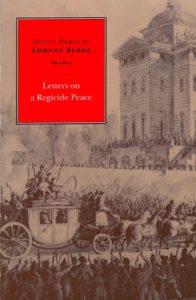
Two Letters Addressed to A Member of the Present Parliament, on the Proposals for Peace with the Regicide Directory of France by the right honourable Edmund Burke
[Second Edition. Rivingtons, 1796.]
Letter I
On the Overtures of Peace
[Argument
INTRODUCTION, pp. 62-78. Difficulties of the “philosophy of history,” p. 62. Rise and successes of the Regicide Republic, p. 64. England often at her strongest when she believes herself to be weakest, as in 1757, p. 67. The nation to be awakened, p. 68. Double aspect of the Wealth of England, p. 69. England cannot act apart
[2] from Europe, p. 70. Discreditable issue of the war hitherto, p. 72. Disaster abroad reflected in distemper at home, p. 73, which is explained by the want of high-principled leaders, p. 75. The peculiar character of a war with a Regicide State, p. 76. This leads the author (Part I) to review the history of the Overtures for Peace already made by the English Government, and to show from them that no Peace is seriously contemplated by France. Thence (Part II) to show that these Overtures cannot accord with the sentiments of the English nation, and lastly (Part III) to show that the nature of the Regicide Republic is such that no Peace could be made with it.PART I, pp. 78-101
History of the Overtures for Peace
Indications of French temper. Bird’s mission, p. 79; Hamburg declaration, p. 81.1st OVERTURES. Speech from the Throne, Oct. 29, 1795, and reply of 5th Pluviose (Jan. 25, 1796), p. 82.2nd OVERTURES. Note of March 8, 1796, from Mr. Wickham to M. Barthélémy, and answer of the latter, March 26, p. 86. Downing Street Note of April 10, p. 91. Disasters of the Summer, and failure of rumoured Prussian mediation, p. 92.PRESENT OVERTURES. Lord Grenville’s request, through the Danish Minister, for a passport for an English plenipotentiary, Sept. 6, 1796, p. 93. Refusal of the French Government, Sept. 19, p. 94. Lord Grenville applies directly, by the note of Sept. 19, and the passport is despatched on the 11th of Vendémiaire. The first manifesto, issued at the same time as the passport, proves the futility of going on with the negotiations, p. 96. These views confirmed by the second manifesto of Oct. 5, p. 98. Burke mournfully contrasts the present with the former attitude of the Government, and quotes the famous Whitehall Declaration of Oct. 29, 1793, p. 99.PART II, pp. 101-22
The Overtures do not represent the feeling of the British Nation
They are contrary to the policy of England, p. 101, and to the disposition of the nation, p. 102. The Jacobins a minority, p. 105. Dulness and inaction of the sound part of the nation, p. 106. A popular war, such as the Spanish War of 1739, is produced by superficial causes: the deep causes of the present war require to be explained and
[3] enforced, p. 108. Power of the British nation under a great leader fully illustrated by the history of the great war with France, 1689-1713, pp. 110-22. Weakness of England then as a military power, p. 112, an isolated nation, with little commerce, p. 113. In spite of all this, Unanimous Address of a factious House of Commons in 1697 against the Enemy’s Overtures for Peace, p. 114. Continuation of William’s Great War, p. 115. He carries it on against the Ministry and People, and converts the Lords to his views, p. 117, and ultimately the Commons, p. 118. Conclusion drawn from this, p. 119. If the war against Louis XIV was thus heroically carried on, how much more should the present war be fought out, p. 122.PART III, pp. 122-52
Why no Peace possible with France
A state based on the principles of Regicide, Jacobinism, and Atheism (p. 124), and fortified by the propagation of a corresponding system of manners and morals (pp. 126-32), is a standing menace to Europe. Europe is a moral and social unity (p. 132) in which France has violently isolated herself, and taken up a position of hostility, p. 134. Position of Europe and France illustrated from the Civil Law, p. 135, and the war upon France justified by the principles of the
Law of Vicinage, p. 138. The condition of France transferred for the sake of argument to England, p. 139. The case of Algiers distinguished, p. 143.CONCLUSION, pp. 147-52. Popular opinion no safe guide: the decision must rest with Ministers, p. 147. Scheme of future letters, arranged in six heads, p. 148. Personal explanation, p. 149.]
My Dear Sir,Our last conversation, though not in the tone of absolute despondency, was far from chearful. We could not easily account for some
unpleasant appearances. They were represented to us as indicating the state of the popular mind; and they were not at all what we should have expected from our old ideas even of the faults and vices of the English character. The
disastrous events, which
[4] have followed one upon another in a long unbroken funereal train, moving in a procession that seemed to have no end—these were not the principal causes of our dejection. We feared more from what threatened to fail within, than what menaced to oppress us from abroad. To a people who have once been proud and great, and great because they were proud, a change in the national spirit is the most terrible of all revolutions.I shall not live to behold the unravelling of the intricate plot, which saddens and perplexes the awful drama of Providence, now acting on the moral theatre of the world. Whether for thought or for action, I am at the end of my career. You are in the middle of yours. In what part of it’s orbit the nation, with which we are carried along, moves at this instant, it is not easy to conjecture. It may, perhaps, be far advanced
in its aphelion. But when to return?Not to lose ourselves in the infinite void of the conjectural world, our business is with what is likely to be affected for the better or the worse by the wisdom or weakness of our plans. In all speculations upon men and human affairs, it is of no small moment to distinguish things of accident from permanent causes, and from effects that cannot be altered. It is not every irregularity in our movement that is a total deviation from our course. I am not quite of the mind of those speculators, who seem assured, that necessarily, and by the constitution of things, all States have the
same periods of infancy, manhood, and decrepitude, that are found in the individuals who compose them. Parallels of this sort rather furnish
similitudes to illustrate or to adorn, than supply analogies from whence to reason. The objects which are attempted to be forced into an analogy are not found in the same classes of existence. Individuals are physical beings, subject to laws
[5] universal and invariable. The immediate cause acting in these laws may be obscure: the general results are subjects of certain calculation. But commonwealths are not physical but
moral essences. They are artificial combinations; and, in their proximate efficient cause, the arbitrary productions of the human mind. We are not yet acquainted with the laws which necessarily influence the stability of that kind of work made by that kind of agent.
There is not in the physical order (with which they do not appear to hold any assignable connexion) a distinct cause by which any of those fabrics must necessarily grow, flourish, or decay; nor, in my opinion, does the moral world produce any thing more determinate on that subject, than what may serve as an amusement (liberal indeed, and ingenious, but still only an amusement) for speculative men. I doubt whether the history of mankind is yet complete enough, if ever it can be so, to furnish grounds for a sure theory on the internal causes which necessarily affect the fortune of a State. I am far from denying the operation of such causes: but they are infinitely uncertain, and much more obscure, and much more difficult to trace, than the foreign causes that tend to raise, to depress, and sometimes to overwhelm a community.It is often impossible, in these political enquiries, to find any proportion between the apparent force of any moral causes we may assign, and their known operation. We are therefore obliged to deliver up that operation to mere chance; or, more piously (perhaps more rationally), to the occasional interposition and the irresistible hand of the Great Disposer. We have seen States of considerable duration, which for ages have
remained nearly as they have begun, and could hardly be said to ebb or flow. Some appear to have
spent their vigour at their commencement. Some have
blazed out in their glory a little before
[6] their extinction. The
meridian of some has been the most splendid. Others, and they the greatest number, have fluctuated, and experienced at different periods of their existence a great variety of fortune. At the very moment when some of them seemed
plunged in unfathomable abysses of disgrace and disaster, they have suddenly emerged. They have begun a new course, and opened a new reckoning; and even in the depths of their calamity, and on the very ruins of their country, have laid the foundations of a towering and durable greatness. All this has happened without any apparent previous change in the general circumstances which had brought on their distress. The
death of a man at a critical juncture,
his disgust,
his retreat,
his disgrace, have brought innumerable calamities on a whole nation.
A common soldier,
a child,
a girl at the door of an inn, have changed the face of fortune, and almost of Nature.
Such, and often influenced by such causes, has commonly been the fate of Monarchies of long duration. They have their ebbs and their flows. This has been eminently the fate of the Monarchy of France. There have been times in which no Power has ever been brought so low. Few have ever flourished in greater glory. By turns elevated and depressed, that Power had been, on the whole, rather on the encrease; and it continued not only powerful but formidable to the hour of the total ruin of the Monarchy. This fall of the Monarchy was far from being preceded by any exterior symptoms of decline. The interior were not visible to every eye; and a thousand accidents might have prevented the operation of what the most clear-sighted were not able to discern, nor the most provident to divine. A very little time before its dreadful catastrophe, there was a kind of exterior splendour in the situation of the Crown,
[7] which usually adds to Government strength and authority at home. The Crown seemed then to have obtained some of the most splendid objects of state ambition. None of the Continental Powers of Europe were the enemies of France. They were all either tacitly disposed to her or publickly connected with her; and in those who kept the most aloof, there was little appearance of jealousy; of animosity there was no appearance at all. The British Nation, her great preponderating rival, she had
humbled; to all appearance she had weakened; certainly had endangered, by cutting off a very large, and by far the most growing part of her empire. In that it’s acmé of human prosperity and greatness, in the
high and palmy state of the Monarchy of France, it fell to the ground without a struggle. It fell without any of those vices in the Monarch, which have sometimes been the causes of the fall of kingdoms, but which existed, without any visible effect on the state, in the highest degree in many other Princes; and, far from destroying their power, had only left some slight stains on their character. The financial difficulties were only pretexts and instruments of those who accomplished the ruin of that Monarchy. They were not the causes of it.Deprived of the old Government, deprived in a manner of all Government, France, fallen as a Monarchy, to common speculators might have appeared more likely to be an object of pity or insult, according to the disposition of the circumjacent powers, than to be the scourge and terror of them all. But out of the tomb of the murdered Monarchy in France, has arisen
a vast, tremendous, unformed spectre, in a far more terrific guise than any which ever yet have overpowered the imagination and subdued the fortitude of man. Going straight forward to its end, unappalled by peril, unchecked by remorse, despising all
[8] common maxims and all common means, that hideous phantom overpowered those who could not believe it was possible she could at all exist, except on the principles, which habit rather than nature had persuaded them were necessary to their own particular welfare and to their own ordinary modes of action. But the constitution of any political being, as well as that of any physical being, ought to be known, before one can venture to say what is fit for its conservation, or what is the proper means for its power. The
poison of other States is the food of the new Republick. That bankruptcy, the very apprehension of which is one of the causes assigned for the fall of the Monarchy, was the capital on which she opened her traffick with the world.The Republick of Regicide, with an annihilated revenue, with defaced manufactures, with a ruined commerce, with an uncultivated and half depopulated country, with a discontented, distressed, enslaved, and famished people, passing with a rapid, eccentrick, incalculable course from the wildest anarchy to the sternest despotism, has actually conquered the
finest parts of Europe, has distressed, disunited, deranged, and broke to pieces all the rest; and so subdued the minds of the rulers in every nation, that hardly any resource presents itself to them, except that of entitling themselves to a contemptuous mercy by a display of their imbecility and meanness. Even in their greatest military efforts and the greatest display of their fortitude, they seem not to hope, they do not even appear to wish, the extinction of what subsists to their certain ruin. Their ambition is only to be admitted to a more favoured class in the order of servitude under that domineering power.This seems the temper of the day.
At first the French force was too much despised. Now it is too much
[9] dreaded. As inconsiderate courage has given way to irrational fear, so it may be hoped, that through the medium of deliberate sober apprehension, we may arrive at steady fortitude. Who knows whether indignation may not succeed to terror, and the revival of high sentiment, spurning away the delusion of a safety purchased at the expence of glory, may not yet drive us to that generous despair, which has often subdued distempers in the State for which no remedy could be found in the wisest counsels?
Other great States having been without any regular certain course of elevation or decline, we may hope that the British fortune may fluctuate also; because the public mind, which greatly influences that fortune, may have it’s changes. We are therefore never authorized to abandon our country to it’s fate, or to act or advise as if it had no resource. There is no reason to apprehend, because ordinary means threaten to fail, that no others can spring up. Whilst our heart is whole, it will find means, or make them. The heart of the citizen is a perennial spring of energy to the State. Because the pulse seems to intermit, we must not presume that it will cease instantly to beat. The
publick must never be regarded as incurable. I remember in the beginning of what has lately been called the Seven Years’ War, that an eloquent writer and ingenious speculator,
Dr. Brown, upon some reverses which happened in the beginning of that war, published an elaborate philosophical discourse to prove that the distinguishing features of the people of England had been totally changed, and that a frivolous effeminacy was become the national character. Nothing could be more popular than that work. It was thought a great consolation to us, the light people of this country, (who were and are light, but who were not and are not effeminate,) that we had found the causes of our
[10] misfortunes in our vices.
Pythagoras could not be more pleased with his leading discovery. But whilst, in that splenetick mood, we amused ourselves in a sour critical speculation, of which we were ourselves the objects, and in which every man lost his particular sense of the publick disgrace in the epidemic nature of the distemper; whilst,
as in the Alps,
goitre kept
goitre in countenance; whilst we were thus abandoning ourselves to a direct confession of our inferiority to France, and whilst many, very many, were ready to act upon a sense of that inferiority, a few months effected a total change in our variable minds. We emerged from the gulph of that speculative despondency, and were buoyed up to the highest point of practical vigour.
Never did the masculine spirit of England display itself with more energy, nor ever did it’s genius soar with a prouder pre-eminence over France, than at the time when frivolity and effeminacy had been at least tacitly acknowledged as their national character, by the good people of this kingdom.
For one (if they be properly treated) I despair neither of the publick fortune nor of the publick mind. There is much to be done undoubtedly, and much to be retrieved. We must walk in new ways, or we can never encounter our enemy in his devious march. We are not at an end of our struggle, nor near it. Let us not deceive ourselves: we are at the beginning of great troubles. I readily acknowledge that the state of publick affairs is infinitely more unpromising than at the period I have just now alluded to; and the position of all the Powers of Europe, in relation to us, and in relation to each other, is more intricate and critical beyond all comparison. Difficult indeed is our situation. In all situations of difficulty men will be influenced in the part they take, not only by the reason of the case, but by the
[11] peculiar turn of their own character. The same ways to safety do not present themselves to all men, nor to the same men in different tempers. There is a courageous wisdom: there is also a false reptile prudence, the result not of caution but of fear. Under misfortunes it often happens that the nerves of the understanding are so relaxed, the pressing peril of the hour so completely confounds all the faculties, that no future danger can be properly provided for, can be justly estimated, can be so much as fully seen. The
eye of the mind is dazzled and vanquished. An abject distrust of ourselves, an extravagant admiration of the enemy, present us with no hope but in a compromise with his pride, by a submission to his will. This short plan of policy is the only counsel which will obtain a hearing. We plunge into a dark gulph with all the rash precipitation of fear. The nature of courage is, without a question, to be conversant with danger; but in the
palpable night of their terrors, men under consternation suppose, not that it is the danger, which, by a sure instinct, calls out the courage to resist it, but that it is the courage which produces the danger. They therefore seek for a refuge from their fears in the fears themselves, and consider a temporizing meanness as the only source of safety.The rules and definitions of prudence can rarely be exact; never universal. I do not deny that in small truckling states a timely compromise with power has often been the means, and the only means, of drawling out their puny existence. But a great state is too much envied, too much dreaded, to find safety in humiliation. To be secure, it must be respected. Power, and eminence, and consideration, are things not to be begged. They must be commanded: and they who supplicate for mercy from others can never hope for justice thro’ themselves. What justice they are to obtain, as the alms of an enemy, depends upon his character;
[12] and that they ought well to know before they implicitly confide.
Much controversy there has been in Parliament, and not a little amongst us out of doors, about the instrumental means of this nation towards the maintenance of her dignity, and the assertion of her rights. On the most elaborate and correct detail of facts, the result seems to be that
at no time has the wealth and power of Great Britain been so considerable as it is at this very perilous moment. We have a
vast interest to preserve, and we possess great means of preserving it. But it is to be remembered that the artificer may be incumbered by his tools, and that resources may be among impediments. If wealth is the obedient and laborious slave of virtue and of publick honour, then wealth is in it’s place, and has it’s use. But if this order is changed, and honor is to be sacrificed to the conservation of riches, riches, which have neither eyes nor hands, nor any thing truly vital in them, cannot long survive the being of their vivifying powers, their legitimate masters, and their potent protectors. If we command our wealth, we shall be rich and free.
If our wealth commands us, we are
poor indeed. We are bought by the enemy with the treasure from our own coffers. Too great a sense of the value of a subordinate interest may be the very source of it’s danger, as well as the certain ruin of interests of a superiour order. Often has a man lost his all because he would not submit to hazard all in defending it. A display of our wealth before robbers is not the way to restrain their boldness, or to lessen their rapacity. This display is made, I know, to persuade the people of England that thereby we shall awe the enemy, and improve the terms of our capitulation: it is made, not that we should fight with more animation, but that we should supplicate with better hopes. We are mistaken. We have an enemy to deal with
[13] who never regarded our contest as a measuring and weighing of purses.
He is the Gaul that puts his
sword into the scale. He is more tempted with our wealth as booty, than terrified with it as power. But let us be rich or poor, let us be either in what proportion we may, nature is false or this is true, that where the essential publick force (of which money is but a part) is in any degree upon a par in a conflict between nations,
that state which is resolved to hazard it’s existence rather than to abandon it’s objects, must have an infinite advantage over that which is resolved to yield rather than to carry it’s resistance beyond a certain point. Humanly speaking, that people which bounds it’s efforts only with it’s being, must give the law to that nation which will not push its opposition beyond its convenience.
If we look to nothing but our domestick condition, the state of the nation is full even to plethory; but if we imagine that this country can long maintain it’s blood and it’s food, as disjoined from the community of mankind, such an opinion does not deserve refutation as absurd, but pity as insane.I do not know that such an improvident and stupid selfishness deserves the discussion, which, perhaps, I may bestow upon it hereafter. We cannot arrange with our enemy in the present conjuncture, without abandoning the interest of mankind. If we look only to our own
petty peculium in the war, we have had some advantages; advantages
ambiguous in their nature, and dearly bought. We have not in the slightest degree impaired the strength of the common enemy in
any one of those points in which his particular force consists: at the same time that new enemies to ourselves, new allies to the Regicide Republick, have been made out of the wrecks and fragments of the general confederacy. So far as to the selfish part. As composing a
[14] part of the community of Europe, and interested in it’s fate, it is not easy to conceive a state of things more doubtful and perplexing.
When Louis the Fourteenth had made himself master of one of the largest and most important provinces of Spain; when he had in a manner over-run Lombardy, and was thundering at the gates of Turin; when he had mastered almost all Germany on this side the Rhine; when he was on the point of ruining the august fabrick of the Empire; when, with the Elector of Bavaria in his alliance, hardly any thing interposed between him and Vienna; when the Turk hung with a mighty force over the Empire on the other side; I do not know, that in the beginning of 1704 (that is in the third year of the renovated war with Louis the Fourteenth) the state of Europe was so truly alarming. To England it certainly was not. Holland (and Holland is a matter to England of value inestimable) was then powerful, was then independent, and though greatly endangered, was then full of energy and spirit. But the great resource of Europe was in England. Not in a sort of England detached from the rest of the world, and amusing herself with the
puppet shew of a naval power (it can be no better, whilst all the sources of that power, and of every sort of power, are precarious), but in that sort of England, who considered herself as embodied with Europe; in that sort of England, who, sympathetick with the adversity or the happiness of mankind, felt that
nothing in human affairs was foreign to her. We may consider it as a sure axiom that, as on the one hand, no confederacy of the least effect or duration can exist against France, of which England is not only a part, but the head, so neither can England pretend to cope with France but as connected with the body of Christendom.
Our account of the war,
as a war of communion, to the very point in which we began to throw out lures, oglings,
[15] and glances for peace, was a war of disaster and of little else. The independant advantages obtained by us at the beginning of the war, and which were made at the expence of that common cause, if they deceive us about our largest and our surest interest, are to be reckoned amongst our heaviest losses.The allies, and Great Britain amongst the rest (perhaps amongst the foremost), have been miserably deluded by this great fundamental error; that it was in our power to make peace with this monster of a State, whenever we chose to forget the crimes that made it great, and the designs that made it formidable. People imagined that their ceasing to resist was the sure way to be secure. This ”
pale cast of thought sicklied over all their enterprizes and turned all their politicks awry.” They could not, or rather they would not read, in the most unequivocal declarations of the enemy, and in his uniform conduct, that more safety was to be found in the most arduous war, than in the friendship of that kind of being. It’s hostile amity can be obtained on no terms that do not imply an inability hereafter to resist it’s designs. This great
prolific error (I mean that peace was always in our power) has been the cause that rendered the allies indifferent about the
direction of the war; and persuaded them that they might always risque a choice, and even a change in it’s objects. They seldom improved any advantage; hoping that the enemy, affected by it, would make a proffer of peace. Hence it was that all their
early victories have been followed almost immediately with the usual effects of a defeat; whilst all the advantages obtained by the Regicides, have been followed by the consequences that were natural. The discomfitures, which the Republick of Assassins has suffered, have uniformly called forth new exertions, which not only repaired old losses, but prepared new conquests. The losses of the allies, on the contrary, (no provision having been made on the speculation of such an event) have been followed by
[16]desertion, by dismay, by disunion, by a dereliction of their policy, by a flight from their principles, by an admiration of the enemy, by
mutual accusations, by a distrust in every member of the alliance of it’s fellow, of it’s cause, it’s power, and it’s courage.
Great difficulties in consequence of our erroneous policy, as I have said, press upon every side of us. Far from desiring to conceal or even to palliate the evil in the representation, I wish to lay it down as my foundation, that never greater existed. In a moment when sudden panick is apprehended, it may be wise, for a while to conceal some great publick disaster, or to reveal it by degrees, until the minds of the people have time to be re-collected, that their understanding may have leisure to rally, and that more steady counsels may prevent their doing something desperate under the first impressions of rage or terror. But with regard to a
general state of things, growing out of events and causes already known in the gross, there is no piety in the fraud that covers it’s true nature; because nothing but erroneous resolutions can be the result of false representations. Those measures which in common distress might be available, in greater, are no better than playing with the evil. That the effort may bear a proportion to the exigence, it is fit it should be known; known in it’s quality, in it’s extent, and in all the circumstances which attend it. Great reverses of fortune there have been, and great embarrassments in counsel: a principled Regicide enemy possessed of the most important part of Europe, and struggling for the rest: within ourselves, a total relaxation of all authority, whilst a
cry is raised against it, as if it were the most ferocious of all despotism. A worse phaenomenon—our government disowned by the
most efficient member of it’s tribunals; ill supported by any of their constituent parts; and the
highest tribunal of all (from causes not for our present
[17] purpose to examine) deprived of all that dignity and all that efficiency which might enforce, or regulate, or if the case required it, might supply the want of every other court. Public prosecutions are become little better than schools for treason; of no use but to improve the dexterity of criminals in the mystery of evasion; or to shew with what compleat impunity men may conspire against the Commonwealth; with what safety assassins may attempt it’s awful head. Every thing is secure, except what the laws have made sacred; every thing is tameness and languor that is not fury and faction. Whilst the distempers of a relaxed fibre prognosticate and prepare all the morbid force of convulsion in the body of the State, the steadiness of the physician is overpowered by the very aspect of the disease.
The doctor of the Constitution, pretending to under-rate what he is not able to contend with, shrinks from his own operation. He doubts and questions the salutary but critical terrors of the cautery and the knife. He takes a poor credit even from his defeat; and covers impotence under the mask of lenity. He praises the moderation of the laws, as, in his hands, he sees them baffled and despised. Is all this, because in our day the statutes of the kingdom are not engrossed in as firm a character, and imprinted in as black and legible a type as ever? No! the law is a clear, but it is a dead letter. Dead and putrid, it is insufficient to save the State, but potent to infect and to kill. Living law, full of reason, and of equity and justice, (as it is, or it should not exist) ought to be severe and awful too; or the words of menace, whether written on the parchment roll of England, or cut into the brazen tablet of Rome, will excite nothing but contempt. How comes it, that in all the State prosecutions of magnitude, from the Revolution to within these two or three years, the Crown has scarcely ever retired disgraced and defeated from it’s Courts? Whence
[18] this alarming change? By a connexion easily felt, and not impossible to be traced to it’s cause, all the parts of the State have their correspondence and consent. They who bow to the enemy abroad will not be of power to subdue the conspirator at home. It is impossible not to observe, that in proportion as we approximate to the
poisonous jaws of anarchy, the fascination grows irresistible. In proportion as we are attracted towards the focus of illegality, irreligion, and desperate enterprize, all the venomous and blighting insects of the State are awakened into life. The promise of the year is blasted, and shrivelled, and burned up before them. Our most salutary and most beautiful institutions yield nothing but dust and smut: the harvest of our law is no more than stubble.
It is in the nature of these eruptive diseases in the State to sink in by fits, and re-appear. But the fuel of the malady remains; and in my opinion is not in the smallest degree mitigated in it’s malignity, though it waits the favourable moment of a freer communication with the source of Regicide to exert and to encrease it’s force.
Is it that the people are changed, that the Commonwealth cannot be protected by its laws? I hardly think it. On the contrary, I conceive, that these things happen because men are not changed, but remain always what they always were; they remain
what the bulk of us must ever be, when abandoned to our vulgar propensities, without guide, leader or controul. That is, made to be full of a blind elevation in prosperity; to despise untried dangers; to be overpowered with unexpected reverses; to find no clue in a labyrinth of difficulties; to get out of a present inconvenience, with any risque of future ruin; to follow and to bow to fortune; to admire successful though wicked enterprize, and to imitate what we admire; to contemn the government which announces
[19] danger from sacrilege and regicide, whilst they are only in their infancy and their struggle, but which finds nothing that can alarm in their adult state, and in the power and triumph of those destructive principles. In a mass we cannot be left to ourselves. We must have leaders. If none will undertake to lead us right, we shall find guides who will contrive to conduct us to shame and ruin.We are in a war of a peculiar nature. It is not with an ordinary community, which is hostile or friendly as passion or as interest may veer about; not with a State which makes war through wantonness, and abandons it through lassitude. We are at war with
a system, which, by it’s essence, is inimical to all other Governments, and which makes peace or war, as peace and war may best contribute to their subversion. It is with an
armed doctrine that we are at war. It has, by it’s essence, a faction of opinion, and of interest, and of enthusiasm,
in every country. To us it is
a Colossus which bestrides our channel. It has one foot on a foreign shore, the other upon the British soil. Thus advantaged, if it can at all exist, it must finally prevail. Nothing can so compleatly ruin any of the old Governments, ours in particular, as the acknowledgment, directly or by implication, of any kind of superiority in this new power. This acknowledgment we make, if in a bad or doubtful situation of our affairs, we solicit peace; or if we yield to the modes of new humiliation, in which alone she is content to give us an hearing. By that means the terms cannot be of our choosing; no, not in any part.It is laid in the unalterable constitution of things—none can aspire to act greatly, but those who are of force greatly to suffer. They who make their arrangements in the first run of misadventure, and in a temper of mind the common fruit of disappointment and dismay, put a seal on their calamities.
To their power they take a security against any
[20] favours which they might hope from the usual inconstancy of fortune. I am therefore, my dear friend, invariably of your opinion (though full of respect for those who think differently) that neither the time chosen for it, nor the manner of soliciting a negotiation, were properly considered; even though I had allowed (I hardly shall allow) that with the horde of
Regicides we could by any selection of time, or use of means, obtain any thing at all deserving the name of peace.
Page 62, line 2.Our last conversation. Burke assumes for his correspondent the same point of view as his own. Cp. post, p. 77, l. 8. The letters are therefore not controversial in
form. The Monthly Review, April, 1815, describes them as “addressed to those advocates of the peace who had originally been partizans of the war: and it was only with persons of this description that Mr. B. deigned to enter into controversy.” This is true of the ultimate public whom he hoped to influence, but not of the ostensible correspondent.
l. 4.unpleasant appearances. The continued manifestations of a desire for peace with France.
l. 8.disastrous events. The military disasters of the allies on the Continent, beginning with the battle of Fleurus in 1794, and followed by the separate treaties of peace successively made with the Republic by Tuscany, Prussia, Sweden, Holland, and Spain, leaving only Great Britain and Austria at war with it.
l. 23.in its aphelion, i.e. in its deviation from its normal path. Burke would have hailed the returning popularity of the war in 1798 as a return to this normal path.
l. 33.same periods of infancy, &c. The allusion is to an ever-popular but false theory of history, which may be traced as early as Polybius. In Burke’s time this theory was put forth in many forms. Churchill, Gotham, Book iii:
Let me not only the distempers know
Which in all states from common causes flow:
But likewise, those, which, by the will of fate,
On each peculiar mode of Empire wait:
Which in its very constitution lurk,
Too sure at last to do their destin’d work.
[354] So Young, Second Letter on Pleasure: “It has often been observed that it is with states as with men. They have their birth, growth, health, distemper, decay, and death. Men sometimes drop suddenly by an apoplexy, states by conquest; in full vigour both…. On the soft beds of luxury most kingdoms have expired. Casti, Animali Parlanti, Canto iv:
E tutti li politici systemi
In se di destruzion racchiudon’ semi.”
As to England, Mr. Hallam remarks that it differs from all free governments of powerful nations which history has recorded by manifesting, after the lapse of several centuries, not merely no symptoms of decay, but a more expansive energy. Middle Ages, vol. ii. chap. viii.
P. 63, l. 3.similitudes—analogies. The hint has been developed by Mill, in his account of Fallacies of Generalization, Logic, Book 5. “Bodies politic,” says Mr. Mill, “die; but it is of disease, or violent death. They have no old age.”
l. 10.moral essences. Cp. post, p. 139, l. 28.
l. 14.There is not, &c. Specific attempts to create a “philosophy of history” have at length ceased with the extinction of the German schools of speculative philosophy. Burke’s criticism thoroughly agrees with the general spirit of the best historians.
l. 29.It is often impossible, in these political enquiries, &c. Burke derived his observations from a favourite author: “La conservation des estats est chose qui vraysemblablement surpasse nostre intelligence: c’est comme dict Platon, chose puissante et de difficile dissolution, qu’une police civile; elle dure souvent contre les maladies mortelles et intestines, contre les injures des loix injustes, contre la tyrannie, contre le desbordement et ignorance des magistrats, license et sedition des peuples.” Montaigne, Liv. iii., chap. 9. In an earlier chapter of Montaigne, and in Bolingbroke, we have the duration of states compared with that of individuals.
l. 3.spent their vigour, &c. e.g. the Mahomedan Caliphate, the monarchy of Charlemagne, &c.
l. 4.blazed out, &c. The allusion is clearly to the Mogul Empire in the time of Aurungzebe. “Most nations,” says Young, in the letter above quoted, “have been gayest when nearest to their end, and like a taper in the socket have blazed as they expired.”
l. 5.meridian of some. Ancient Rome, Venice, Holland, are instances.
l. 9.plunged in unfathomable abysses, &c. Burke has in mind the phrase “Mersus profundo pulchrior evenit.”
l. 16.death of a man. Among many instances that will occur to the reader, Pericles is perhaps the best.
Ibid.his disgust. Coriolanus is an instance.
Ibid.his retreat. Burke probably alludes to Pitt, and his disastrous withdrawal from public affairs in 1768-1770. See vol. i. p. 206, where the revolt of
[355] America from England is traced to this cause. The resignation of Charles V. is another instance, in its effects on the Netherlands.
l. 17.his disgrace. The allusion is probably to the Constable Charles de Bourbon, whose disgrace at the French court led to the misfortunes sustained by France under Francis I.
l. 18.A common soldier. The allusion is to Arnold of Winkelried, whose self-devotion on the field of Sempach secured the freedom of Switzerland.
Ibid.a child. The allusion is to Hannibal, and the oath administered to him at twelve years old, by his father Hamilcar. Cp. p. 348, l. 14.
Ibid.a girl at the door, &c. The allusion is to Joan of Arc, who according to one version of her story (probably the true one) acted as ostler at a small inn.
P. 65, l. 9.humbled—weakened—endangered. By the independence of America, established by the aid of France.
l. 13.high and palmy state. Hamlet, Act i. sc. 1.
l. 29.a vast, tremendous, unformed spectre. Burke is thinking of Virgil’s “Monstrum horrendum, informe, ingens.” Burke seems to have been the first Englishman who discerned accurately the portentous shape which France was assuming. This powerful description was fully justified during the following years.
P. 66, l. 7.poison of other States, &c. A new application of the proverb that “one man’s meat is another’s poison.”
l. 17.finest parts of Europe. The Austrian Netherlands, the Rhine, Savoy and Nice, Lombardy.
l. 28.At first, &c. Burke himself was among those who believed France to be crushed as a nation by the Revolution: but he soon undeceived himself.
P. 67, l. 15.publick—never regarded, &c. Burke has in mind the famous Roman maxim, “non de republica desperare.”
l. 18.Dr. Brown. The work was his “Estimate of the Manners and Principles of the Times.” See vol. i. p. 88, and the Editor’s note.
l. 27.Pythagoras. Burke probably means Archimedes, and alludes to the well-known story of his great discovery in solid geometry.
l. 32.as in the Alps, goitre
kept goitre, &c. The phrase is Juvenal’s:
Quis tumidum guttur miratur in Alpibus?
—Sat. xiii. l. 162.
P. 68, l. 5.never did the masculine spirit, &c. This great stir in the public mind occurred when Burke was a young man lately arrived in London, and just turning his attention to public affairs. It profoundly affected him, and influenced his whole life.
l. 33.eye of the mind is dazzled and vanquished. Burke copies the phrase, “In bello oculi primi vincuntur.”
P. 69, l. 6.palpable night. “Palpable darkness,” Par. Lost, xii. 188.
[356]l. 29.at no time has the wealth, &c. See the Third Letter, pp. 254-306, where this is proved in detail.
l. 31.vast interest to preserve—great means of preserving it. “You must not consider the money you spend in your defence, but the fortune you would lose if you were not defended; and further, you must recollect you will pay less to an immediate war, than to a peace with a war establishment and a war to follow it…. Your empire cannot be saved by a calculation.” Grattan, Speech on Downfall of Buonaparte. Reference to the use of the argument by Bacon and Swift will be given in a note to the Third Letter.
P. 70, l. 7.If our wealth commands us, &c. So B. Jonson, “The Fox,” Act vi. sc. 12:
These possess wealth as sick men possess fevers,
Which trulier may be said to possess them.
The conceit is derived from a classical source: “Ea invasit homines habendi cupido ut possideri magis quam possidere videamur”: Pliny, Letters, B. ix. Lett. 30. So Archbishop Leighton, Commentary on 1 St. Peter, iv. 8: “Hearts glued to the poor riches they possess or rather are possessed by.” Leighton repeats it in his “Commentary on the Ten Commandments.”
l. 8.poor indeed. Shakspeare, Othello, Act iii. sc. 3:

He that filches from me my good name,
Robs me of that which not enriches him,
And makes me poor indeed.
l. 21.He is the Gaul, &c. Alluding to the story of Brennus, Livy, Lib. v. cap. 48.
l. 27.that state which is resolved, &c. i.e. Republican France.
P. 71, l. 9.petty peculium. Burke alludes to the additions by conquest to the colonial empire, which went on until both the French and the Dutch were left without any colonies at all.
l. 10.ambiguous in their nature. He alludes to the conquest of Martinique with its population of revolutionary people of colour.
l. 12.any one of those points, &c. i.e. in his conquests on the border of France, especially Austrian Flanders.
l. 19.When Louis the Fourteenth, &c. Burke describes the most critical period in the War of the Grand Alliance.
l. 36.puppet shew of a naval power. See p. 164, where Burke maintains that England ought to have made a campaign with 100,000 men on the Continent.
P. 72, l. 5.nothing in human affairs, &c. The common phrase “Nihil humani alienum.”
l. 12.our account, &c. See note to p. 270, l. 6.
l. 25.pale cast, &c. Hamlet, Act iii. sc. 2, transposed:
“And thus the native hue of resolution
Is sicklied o’er with the pale cast of thought,” &c.
l. 32.prolific error, i.e. prolific of other errors. Cp. vol. i. p. 137, l. 31.
[357]P. 73, l. 5.early victories. The capture of Valenciennes, Condé, Quesnoy, Landrécy, and Toulon. See the Introduction.
l. 13.desertion. Prussia deserted the campaign as soon as it began to fail.
l. 15.mutual accusations. Between England and Austria.
P. 74, l. 7.cry is raised against it. Burke alludes to the public indignation which followed on the passing of the “Gagging Act” of 1794.
l. 9.most efficient member, &c. Burke alludes to the failure of the prosecutions of Hardy and Horne Tooke at the Old Bailey in 1794.
l. 11.highest tribunal of all. Parliament.
”
*y1 Mussabat tacito medicina timore.”
P. 75, l. 17.poisonous jaws, &c. The allusion is to the fascination said to be exercised by serpents over birds.
l. 24.It is in the nature, &c. The modern historian will hardly sympathise with Burke’s lament over the failure of the State prosecutions, nor could Burke himself have seriously wished to recall the days of Scroggs and Jefferies. Besides, his wishes had been amply satisfied in the State Trials in Scotland, where, owing to the difference in procedure, all the prisoners had been convicted.
l. 34.what the bulk of us must ever be. A powerful statement of the weaknesses inherent in democracies.
P. 76, l. 16. Burke now powerfully enforces that view of the nature of the war of which he was the author, and for a long time the sole expositor. It was perfectly true, and in a year or two its truth was obvious to every one.
L. 20.a system—an armed doctrine. Grattan, Speech on Downfall of Buonaparte: “Sirs, the French Government is war; it is a Stratocracy elective, aggressive, and predatory….. Their constitution is essentially war, and the object of that war is the downfall of Europe…. Not an army, but a military government in march!” Again: “If the government of any other country contains an insurrectionary principle, as France did when she offered to aid the insurrections of her neighbours, your interference is warranted: if the government of another country contains the principle of universal empire, as France did and promulgated, your interference is justifiable.” It was no easy task to prove to the English government and people how the France of the Directory differed from the France of Louis XIV. Macaulay, in a passage founded on the present one, has admirably described Mr. Pitt’s own blindness to what was so distinctly seen by Burke: “He went to war: but he would not understand the peculiar nature of that war. He was obstinately blind to the plain fact that he was contending against a state which was also a sect, and that the new quarrel between England and France was of quite a different kind from the old quarrels about colonies in America and fortresses in the Netherlands. He had to combat frantic enthusiasm, restless activity, the wildest and most audacious spirit of innovation: and he acted as if he had
[358] had to deal with the harlots and fops of the old court of Versailles, with Madame de Pompadour and the Abbé Bernis.” “Biographies,” Pitt.
l. 25.in every country. See the Second Letter, p. 155.
Ibid.a Colossus. &c. Burke alludes to the famous Colossus which bestrode the harbour of Rhodes. Jacobin sympathies in England were rapidly extinguished after Burke’s death, when the struggle with France became a struggle for national existence.
P. 78, l. 28.Regicides—first to declare war. This statement, pertinaciously repeated in the early Parliamentary debates on the Peace question, is not strictly true. England was the first to break off all diplomatic communication with France. The King recalled Lord Gower from Paris, and commanded that ordinary relations should cease with Chauvelin after the 10th of August, 1792, when the French monarchy was abolished. Chauvelin, whom the Convention still continued in London, was only communicated with as representing the monarchy, and on the execution of the King in January, 1793, he received from the English government notice to quit England. It is true that the French government had already instructed him to the same effect, but these instructions were unknown to the English government.
Mr. Bird sent to state the real situation of the Duc de Choiseul.
P. 80, l. 11.afflicted family of Asgill. Charles Asgill, a young captain in the British army in America, chosen by lot to be surrendered to the enemy’s mercy in reprisal for the execution of Huddy, April 12, 1782. Asgill’s mother appealed to the King and Queen of France to intercede in her son’s behalf. The intercession was successful: and Asgill visited Paris to acknowledge in person the exertions of Marie Antoinette.
P. 81, l. 22.a war of Government, &c. Such it unquestionably was in 1793. Whether it continued to be so when the French government avowedly carried it on for the purpose of destroying the European balance of power, and annihilating England, is another question.
P. 82, l. 1.Speech from the Throne. Intended to stop the mouths of the opposition and prepare the way for negotiations with France. See Introduction. It had neither effect.
l. 15.gipsey jargon. The phrase is borrowed from the account given in the Annual Register of the nomenclature adopted by the Convention.
P. 83, l. 15.“Citizen Regicides,” &c. In Burke’s most effective Parliamentary style, and scarcely a caricature of the attitude assumed by the ministry. The passage reminds us of Thomson, Britannia:
Whence this unwonted patience, this weak doubt,
[359] This tame beseeching of rejected peace,
This weak forbearance?
l. 24.patient suitors, &c. The picture which follows is in that vein of profound and scornful irony of which Burke was almost as great a master as his countryman Swift.
l. 25.sanguinary tyrant Carnot. Burke has no word of toleration, much less of praise, for a single statesman of the Revolution. Cp. the allusion to Hoche, p. 221. Carnot’s vote for the death of the King outweighed everything else in the eyes of his critic.
L. 27.down of usurped pomp. Carnot was one of the Directors, who lived in the palace of the Luxembourg.
P. 84, l. 15.Trophonian Cave. The rites of the deity Trophonius were celebrated in a cave near Lebadea, in Boeotia. Pausanias denies the tradition to which Burke here alludes, that none ever laughed after once visiting the cave.
l. 33.speeches and messages in former times. Burke’s usual line of argument. Cp. vol. i. p. 267. Burke in the next page qualifies this reference to the past, to avoid the charge of “pedantry.”
P. 86, l. 29.squander away the fund of our submissions. Burke gloomily anticipates the time when this humiliating attitude on the part of England may really become necessary. Cp. vol. ii. p. 128, l. 26.
L. 33.Barthélemy. This able diplomatist, who negotiated the Treaties with Spain and Prussia, afterwards became a Director. Allied with Carnot, his upright and statesmanlike opposition produced the Revolution of Fructidor. Carnot escaped: but Barthélemy was dragged through the streets of Paris, and before the windows of the Luxembourg, in an iron cage, on his way to the convict settlement of Cayenne.
P. 89, l. 34.ten immense and wealthy provinces. Burke proceeds to characterize the pretensions of France to the “Rhine, Alps, and Mediterranean” boundary.
P. 90, l. 25.a law, &c. The decree of the Convention incorporating Belgium with France, like Savoy and Nice.
l. 34.sacred Rights of Man. See vol. ii. p. 149. The allusion is, of course, ironical.
P. 91, l. 7.cooped and cabined in. “Cribbed, cabined, and confined.” Macbeth, Act iii. sc. 4.
“This Court has seen, with regret, how far the tone and spirit of that answer, the nature and extent of the demands which it contains, and the manner of announcing them, are remote from any dispositions for peace.
“The inadmissible pretension is there avowed of appropriating to France all that the laws existing there may have comprised under the denomination of French territory. To a demand such as this, is added an express declaration that no proposal contrary to it will be made, or even listened to. And even this, under the pretence of an internal regulation, the provisions of which are wholly foreign to all other nations.”While these dispositions shall be persisted in, nothing is left for the King, but to prosecute a war equally just and necessary.”Whenever his enemies shall manifest more pacific sentiments, his Majesty will, at all times, be eager to concur in them, by lending himself, in concert with his allies, to all such measures as shall be calculated to re-establish general tranquillity on conditions just, honourable and permanent, either by the establishment of a general Congress, which has been so happily the means of restoring peace to Europe, or by a preliminary discussion of the principles which may be proposed, on either side, as a foundation of a general pacification; or, lastly, by an impartial examination of any other way which may be pointed out to him for arriving at the same salutary end.”Downing-Street, April 10, 1796.
P. 92, l. 22.over-running of Lombardy. This had taken place early in the year (1796).
l. 23.Piedmont—its impregnable fortresses. Alessandria, Tortona, Coni, Ceva, and others. See Hamley’s Operations of War, p. 142.
l. 25.instances for ever renewed—Genoa. The Ligurian republic was constituted in the next year, and the French policy thus completed.
l. 27.half the Empire. Swabia and Bavaria, overrun by Moreau in this year.
[360]P. 94, l. 17.“in the lowest deep, a lower deep.” Par. Lost, Book iv. l. 76.
Official Note, extracted from the Journal of the Defenders of the Country.
”
EXECUTIVE DIRECTORY.“Different Journals have advanced that an English Plenipotentiary had reached Paris, and had presented himself to the Executive Directory, but that his propositions not having appeared satisfactory, he had received orders instantly to quit France.”All these assertions are equally false.”The notices given, in the English Papers, of a Minister having been sent to Paris, there to treat of peace, bring to recollection the overtures of Mr. Wickham to the Ambassador of the Republick at Basle, and the rumours circulated relative to the mission of Mr. Hammond to the Court of Prussia. The
insignificance, or rather the
subtle duplicity, the
PUNICK stile of Mr. Wickham’s note, is not forgotten. According to the partizans of the English Ministry, it was to Paris that Mr. Hammond was to come to speak for peace: when his destination became publick, and it was known that he went to Prussia, the same writer repeated that it was to accelerate a peace, and notwithstanding the object, now well known, of this negociation, was to engage Prussia to break her treaties with the Republick, and to return into the coalition. The Court of Berlin, faithful to its engagements, repulsed these
perfidious propositions. But in converting this intrigue into a mission for peace, the English Ministry joined to the hope of giving a new enemy to France,
that of justifying the continuance of the war in the eyes of the English nation, and of throwing all the odium of it on the French Government. Such was also the aim of Mr. Wickham’s note.
Such is still that of the notices given at this time in the English papers.“This aim will appear evident, if we reflect how difficult it is, that the ambitious Government of England should sincerely wish for a peace that would
snatch from it it’s maritime preponderancy, would re-establish the freedom of the seas, would give a new impulse to the Spanish, Dutch, and French marines, and would carry to the highest degree of prosperity the industry and commerce of those nations in which it has always found
rivals, and which it has considered as
enemies of it’s commerce, when they were tired of being it’s
dupes.“But there will
no longer be any credit given to the pacific intentions of the English Ministry, when it is known, that it’s gold and it’s intrigues, it’s open practices, and it’s insinuations, besiege more than ever the Cabinet of Vienna, and are one of the principal obstacles to the negotiation which that Cabinet
would of itself be induced to enter on for peace.“They will no longer
be credited, finally, when the moment of the rumour of these overtures being circulated is considered.
The English nation supports impatiently the continuance of the war, a reply must be made to it’s complaints, it’s reproaches: the Parliament is about to re-open it’s sittings, the mouths of the orators who will declaim against the war must be shut, the demand of new taxes must be justified; and to obtain these results, it is necessary to be enabled to advance, that the French Government refuses every reasonable proposition of peace.”
P. 95, l. 2.“None but itself,” &c. The line “None but himself can be his parallel,” is quoted from Theobald, in Martinus Scriblerus, as a specimen of fustian.
P. 96, l. 4.Light lie the earth, &c. The phrase, repeated from Letter IV (p. 351) is from the well-known elegy of Prior on Col. Villiers:
Light lie the earth, and flourish green the bough.
The conception is borrowed, through the Latins, from the Greek elegiac authors. Meleager in Anthol.;
Π
amm&eeivrgr;
torg&eeivrgr; χ
a&iivrgr;
re,
s&ugrgr;
t&ogrgr;
np&aacgr;
roς
o&upsgr;
bar&ugrgr;
ne&ipsacgr;ς
se A&ipsgr;
sig&eacgr;
n&eegr;
nka&upsgr;
t&eegrgr;
n&uivrgr;
n &epsgr;
p&eacgr;χ
oiς &apsgr;
bar&eeacgr;ς.
—See Martial, Ep. Lib. v. 34. Juv. Sat. vii. 207, &c.
l. 12.wax into our ears, &c. Burke alludes to the story of Ulysses and the Sirens, Odyssey, Book xii.
l. 14.Reubel, Carnot, Tallien. The two former were Directors: but Tallien had by this time ceased to be a leading politician. He had sunk into obscurity as a member of the Council of Five Hundred. He afterwards went to Egypt, and in 1801 appeared in London as a prisoner, on which occasion he was feted by the Opposition.
l. 15.Domiciliary Visitors. Under the law of August 1792, 3000 persons were at once dragged away to prison in one night.
l. 17.Revolutionary Tribunals. The famous Revolutionary Tribunal, which took cognizance of treason against the Republic, was instituted by Danton, who was himself condemned by it. It had ceased to exist in December 1794, after employing its vigour during the last six months against the party of Robespierre. It sent to the guillotine 2,774 persons, including the Queen and the Princess Elizabeth.
l. 18.Septembrizers. Alluding to the massacres at Paris in September 1792, in which 1500 persons perished. The “Septembriseur”
par excellence was Tallien.
l. 26.little national window. One of the pleasantries which enlivened the despatches from Carrier to the Convention, describing his cruelties in La Vendée.
l. 28.declaration of the Government. The Whitehall Declaration, which filled Burke with unbounded admiration, to which he more than once recurs (see pp. 156, 318), was from the pen of Lord Grenville.
“In their place has succeeded a system destructive of all publick order, maintained by proscriptions, exiles, and confiscations, without number: by arbitrary imprisonment; by massacres which cannot be remembered without horror; and at length by the execrable murder of a just and beneficent Sovereign, and of the illustrious Princess, who, with an unshaken firmness, has shared all the misfortunes of her Royal Consort, his protracted sufferings, his cruel captivity and his ignominious death.”—”They (the allies) have had to encounter acts of aggression without pretext, open violations of all treaties, unprovoked declarations of war; in a word, whatever corruption, intrigue or violence could effect for the purpose so openly avowed, of subverting all the institutions of society, and of extending over all the nations of Europe that confusion, which has produced the misery of France.”—”This state of things cannot exist in France without involving all the surrounding powers in one common danger, without giving them the right, without imposing it upon them as a duty, to stop the progress of an evil, which exists only by the successive violation of all law and all property, and which attacks the fundamental principles by which mankind is united in the bonds of civil society.”—”The King would impose none other than equitable and moderate conditions, not such as the expence, the risques and the sacrifices of the war might justify; but such as his Majesty thinks himself under the indispensable necessity of requiring, with a view to these considerations, and still more to that of his own security and of the future tranquillity of Europe. His Majesty desires nothing more sincerely than thus to terminate a war, which he in vain endeavoured to avoid, and all the calamities of which, as now experienced by France, are to be attributed only to the ambition, the perfidy and the violence of those, whose crimes have involved their own country in misery, and disgraced all civilized nations.”—”The King promises on his part the suspension of hostilities, friendship, and (as far as the course of events will allow, of which the will of man cannot dispose) security and protection to all those who, by declaring for a monarchical form of Government, shall shake off the yoke of sanguinary anarchy; of that anarchy which has broken all the most sacred bonds of society, dissolved all the relations of civil life, violated every right, confounded every duty; which uses the name of liberty to exercise the most cruel tyranny, to annihilate all property, to seize on all possessions; which founds it’s power on the pretended consent of the people, and itself carries fire and sword through extensive provinces for having demanded their laws, their religion and their
lawful Sovereign.”
Declaration sent by his Majesty’s command to the Commanders of his Majesty’s fleets and armies employed against France, and to his Majesty’s Ministers employed at foreign Courts.—WHITEHALL,
Oct. 29, 1793.
P. 101, l. 2.Plutarch. The allusion is not in Plutarch. Burke is thinking of Cicero, De Oratore, Lib. III, cap. 34, where the critic recalls the satire poured on Pericles by the comedians, who nevertheless ascribed to him such force and power of engaging attention “ut in eorum mentibus qui audissent quasi aculeos quosdam relinqueret.”
[361]l. 18.With their spear, &c. The allusion is to the story of C. Popilius Laenas.
*y2 Ut lethargicus hic, cum fit pugil, et medicum urget.—HOR.
P. 104, l. 8.competence to act. Cp. vol. i. p. 254. Burke’s observations on the necessity of popular support to a great war, though apparently quite modern in spirit, were based on history, as he presently shows.
P. 104, l. 25.country of old called ferax monstrorum. Burke quotes as usual from memory, “Asia, terra ferax miraculorum,” Plin. Epist. 173.
l. 34.muster of our strength. The remarkable estimate which follows excludes, as usual with Burke, the mass of the people, who are regarded (P. 105, l. 15) as merely the “objects of protection,” and the “means of force.” It is curious that one who had laid down the rational doctrine of the causes of hostility between people and government contained in vol. i. p. 75 (Present Discontents), should now see no anomaly in the existence of an incurable Jacobin faction numbering one-fifth of the effective forces of the country.
P. 106, l. 10.By passing from place to place, &c. Cp. vol. ii. p. 180.
l. 18.naturally disposed to peace. The observation is true: and it illustrates Pitt’s difficulty. The mass of his supporters in the country were interested in peace.
l. 19.languid and improvident. Dryden, the Medal:
The wise and wealthy love the surest way,
And are content to thrive and to obey:
But wisdom is to sloth too great a slave.
P. 107, l. 11.But strong passions awaken the faculties, &c. Burke clearly has in mind the lines of Akenside, “Pleasures of the Imagination,” Bk. ii.
“Passion’s fierce illapse
Rouses the mind’s whole fabric, with supplies
Of daily impulse, keeps the elastic powers
Intensely poised,” &c.
P. 108, l. 14.Pope—dying notes. See the last fifty lines of the two dialogues called “Epilogue to the Satires.”
l. 15.Johnson. See the first sixty lines of “London” (1738).
l. 17.Glover. See his poem, London, or the Progress of Commerce, and the pathetic ballad, Admiral Hosier’s Ghost.
l. 35.driven by a popular clamour, &c. See Lord Stanhope’s History of England.
P. 110, l. 25.Guarda-Costas. The coast-guards of Spanish America, whose insolence to English ships was a main cause of the war.
Ibid.Madrid Convention. Made in 1713, for thirty years. It secured to England the “Assiento,” or contract for supplying Spanish America with African slaves.
l. 26.Captain Jenkins’s
ears. Exhibited in the House of Commons as having being cut off by a Spanish captain.
l. 34.dilatory pleas, exceptions of form. Proceedings under the old
[362] legal system, which deferred the consideration of the question without touching its merits. Moving and carrying the
previous question has the same effect in parliamentary debate.
P. 113, l. 7.contending to be admitted at a moderate premium. Burke states the circumstances of the loan voted in December, 1795, with the partiality to be expected. For the facts, see the notes, post, to pp. 254-60.
l. 26.When I came to England. In 1750.
l. 29.Aire and Calder. The improvement of the navigation of these rivers, which connected the West Riding with the port of Hull, may be said to be the first step in the construction of those two great networks of canals and railways, which have played so important a part in developing English trade and manufactures. Burke returns to the subject in the Third Letter, p. 290.
P. 118, l. 26.three great immoveable pillars. Cp. vol. i. p. 295, note to p. 73, l. 17.
P. 122, l. 8.If the war, &c. In these three brief paragraphs Burke puts his argument for the war into a compendious and striking form. Compare with the whole argument Bacon’s very similar plea for a Holy War. As will be seen, Burke evidently had Bacon in mind in some other passages: “Such people as have utterly degenerated from the laws of Nature, as have in their very body and frame of estate a monstrosity, and may be truly accounted, according to the examples we have formerly recited, common enemies and grievances of mankind and disgraces and reproaches to human nature—such people all nations are interested or ought to be interested to reform.” “When the constitution of a State and the fundamental laws and customs of the same, if laws they may be called, are against the laws of Nature and of Nations, then I say a war upon them is lawful.”
See declaration, Whitehall, October 29, 1793. [Ante, p. 99.]
P. 125, l. 9.Jacobinism is the revolt, &c. So Southey, Essay on Popular Disaffection: “Of mere men of letters, wherever they exist as a separate class, a large proportion are always enlisted in hostility, open or secret, against the established order of things.”
Nothing could be more solemn than their promulgation of this principle as a preamble to the destructive code of their famous articles for the decomposition of society into whatever country they should enter. “La Convention Nationale, après avoir entendu le rapport de ses Comités de Finances, de la Guerre, & Diplomatiques réunis, fidèle
au principe de souveraineté de peuples qui ne lui permet pas de reconnoître aucune institution qui y porte atteinte,” &c. &c. Decrêt sur le Rapport de Cambon, Dec. 18, 1792, and see the subsequent proclamation.
l. 27.regular decree. The allusion is to the frantic efforts made under the Convention to get rid of Christianity and even faith in a God and the soul. They came to an end with the acknowledgment of Deism as the national faith, and the establishment of the Festival of the Supreme Being by Robespierre in 1794.
P. 126, l. 2.profane apotheosis. The allusion is to the funeral honours paid to the remains of Marat in the Pantheon.
l. 8.rites in honour of Reason. Burke alludes to the scene of Nov. 10, 1793, when the Commune of Paris enthroned a superannuated prostitute in Nôtre Dame as the goddess of Reason. Similar scenes were repeated throughout the country.
l. 11.schools founded at the publick expence. By the Convention. They
[363] were mere primary schools, in which were to be taught reading, writing, arithmetic, and the republican catechism.
l. 23.Manners are what, &c. Burke draws his arguments from the old, French school itself. Massillon (Vices et Vertus des Grands): “Moeurs cultivées, bienséances voisines de la vertu.” Again, “Les bienséances qui sont inseparables du rang, et qui sont comme la première école de la vertu.”
P. 127, l. 8.five or six hundred drunken women. It may be objected that Burke has no business to charge upon the Directory all the excesses of the Assembly and Convention. The presumption in the eyes of any candid observer was now in favour of reaction. Burke had denied the reality of the reaction in his then unpublished Fourth Letter.
l. 17.paradoxes. Cp. vol. ii. p. 277, l. 13.
l. 20.at which morality is perplexed, &c. The same idea is admirably expressed by Molière: “Ne fatiguez point mon devoir par les propositions d’une facheuse extrémité dont peut être nous n’aurons pas besoin.” Mons. Pourceaugnac, Act i, Scene 4.
l. 24.improving instincts into morals. On this doctrine, so often insisted on by Burke, see Introduction to vol. ii. p. 40, &c.
P. 128, l. 12.common civil contract. Here again Burke goes back to the early legislation of the Revolution. Subsequent legislation, in European countries least to be suspected of revolutionism, has justified the advocates of the measure.
P. 130, l. 21.cannibalism. Burke follows Bacon, in the Tract on a Holy War, in arguing from the cannibalism, among other traits, of the American Indians that their territory was forfeited by the Law of Nations, and that the Spaniards, or any one else, might lawfully invade it.
l. 24.Nothing is so strong, &c. Burke’s sketch of the European system may remind the reader of the relations of the Greek communities as reflected in Herodotus and Thucydides.
l. 33.As to war—sole means of justice. Burke uses a saying of Bacon, “Wars are the highest trials of right,” Observations on a Libel.
P. 134, l. 2.continued in greater perfection, &c. As in Venice, Holland, and Switzerland. This was natural enough. The power of a Crown counterbalanced the authority of the upper orders.
l. 25.formed resolution, &c. Peace had however been made by France with all Europe except England and Austria.
P. 135, l. 11.never in a state, &c. Cp. Introduction to vol. ii. pp. 44-45.
l. 32.praetorian law. The “Equity” of Roman law.
Ibid.Law of Neighbourhood. So M. de Puisaye, quoted by Southey, “Public Opinion and the Political Reformers”: “It is with the independence of nations as with the liberty of individuals, they have a right to do everything which involves no wrong to others. So long as my neighbour demeans
[364] himself conformably to the laws his conduct is no concern of mine: but if he converts his house into a brothel or commence a manufactory there which should poison my family with its unwholesome stench, I prosecute him for a nuisance.”
“This state of things cannot exist in France without involving all the surrounding powers in one common danger, without giving them the right, without imposing it on them as a duty, to stop the progress of an evil which attacks the fundamental principles by which mankind is united in civil society.” Declaration, 29th Oct., 1793.
P. 137, l. 9.ground of action—ground of war. So Bacon, On a War with Spain. “Wars (I speak not of ambitious, predatory wars) are suits of appeal to the Tribunal of God’s justice.”
P. 138, l. 1.trifling points of honour, &c. Imitated by Casti, Anim. Parl. Canto iii.:
Due passi pi� o men lunghi, pi� o men corti,
Un inchino talor pi� o men profondo,
Capace è di mandar sossopra il mondo.
l. 5.wild-cat skins. In the American settlements.
P. 140, l. 4.France is out of her bounds. Burke means that the emigrants were the real France. Sheridan often refers to this striking expression of Burke on the subject: “Look at the map of Europe: there, where a great man (who however was always wrong on this subject) said he looked for France, and found nothing but a chasm.” Speech, Dec. 8, 1802. Again, Aug. 13, 1807: “France,”—as Mr. Burke described it—”a blank in the map of Europe.”
l. 15.Oppression makes, &c. Ecclesiastes vii. 7.
l. 19.bitterness of soul. Burke evidently had in mind the lines of Addison (The Campaign) describing the cry of Europe for deliverance from Louis XIV:
States that their new captivity bemoan’d,
Armies of martyrs that in exile groan’d,
Sighs from the depth of gloomy dungeons heard,
And prayers in bitterness of soul preferr’d.
This poem was sometimes quoted in the debates on peace in Parliament.
P. 143, l. 30.Algiers. The argument had been advanced by Fox, on the occasion of the famous debate, Dec. 15, 1792, when Burke first took his seat on the Treasury bench. Mr. Fox moved the house to send a minister to Paris to treat with the provisional government. “If we objected to the existing form of government in France, we had as strong objections to the form of government at Algiers; yet at Algiers we had a consul.” The argument from Mahomedan communities is derived from the controversial theologians of a preceding age. See Hooker, Eccl. Pol. iv. 7, &c.
Declaration, Whitehall, Oct. 29, 1793.
P. 146, l. 22.“Thus painters write,” &c. Prior, “Protogenes and Apelles.” Apelles of Co (Cos) visits his brother artist at Rhodes, and not finding him at home, draws a perfect circle on a panel:
And will you please, sweet-heart, said he,
To show your master this from me?
[365] By it he presently will know
How painters write their names at Co.
Burke alludes to Grenville’s master-hand similarly displayed in the Declaration.
P. 149, l. 30.whom my dim eyes, &c. Burke has in mind a pathetic triplet from Pope’s Homer:
Two, while I speak, my eyes in vain explore,
Two from one mother sprung—my Polydore,
And lov’d Lycaon; now perhaps no more!
—Iliad, xxii. 63.
Vol. 3, Letters on a Regicide Peace, Letter II