
Timothy Taylor, at Conversable Economist, had a post on August 13 titled “What Economic Ideas are True and Nontrivial?”
He starts with a famous story that Paul Samuelson told and I’ll quote it here:
[O]ur subject puts its best foot forward when it speaks out on international trade. This was brought home to me years ago when I was in the Society of Fellows at Harvard along with the mathematician Stanislaw Ulam. Ulam, who was to become an originator of the Monte Carlo method and co-discoverer of the hydrogen bomb, was already at a tender age a world famous topologist. And he was a delightful conversationalist, wandering lazily over all domains of knowledge. He used to tease me by saying, ‘Name me one proposition in all of the social sciences which is both true and non-trivial.’ This was a test that I always failed. But now, some thirty years later, on the staircase so to speak, an appropriate answer occurs to me: The Ricardian theory of comparative advantage; the demonstration that trade is mutually profitable even when one country is absolutely more – or less – productive in terms of every commodity. That it is logically true need not be argued before a mathematician; that it is not trivial is attested by the thousands of important and intelligent men who have never been able to grasp the doctrine for themselves or to believe it after it was explained to them.
Tim keys in on the last sentence in the above Samuelson quote. He writes:
If the “non-trivial” criterion can be met by any economic theory where thousands of intelligent and important people are unable to grasp or believe it, then it seems to me that many economic theories are true and (apparently) non-trivial, including the (apparently) widespread belief that governments can set prices or impose tariffs without experiencing tradeoffs, along with many more. The news headlines provide examples of (apparently) intelligent and important people who seem unable to grasp or believe economic insights pretty much every day.
I think Tim means that the true statement is that a government that sets prices and imposes tariffs will experience tradeoffs.
That reminded me of a question that Armen Alchian and William Allen asked in their economics textbook University Economics. I came across it when I was TA-ing for an introductory microeconomics course during my first year at UCLA.
Here’s question #21 from Chapter 13 of the third edition of University Economics (p. 21):
Evidence of the very extent of specialization of knowledge is provided by Albert Einstein’s assertion just prior to his death (Socialist International Information): “The economic anarchy of capitalist society as it exists today is in my view the main cause of our evils. Production is carried on for profit, not for use.” Give evidence of your superiority over Einstein by exposing his error in economic analysis.
I won’t bother answering their question because I think that, especially to readers of EconLog, the answer is obvious.
I’ll give another one. We often see apparently intelligent people, observing that the share of income of the bottom 20% has fallen, argue that the poor are getting poorer. There are two problems with this. The more obvious is that the share of a growing income can be falling but the average incomes of people in that lowest quintile can be rising. The second, and less obvious, is that the people in the lowest quintile in one year are not all the same people in the next year. And over a decade, there is huge mobility among income quintiles. (There’s a third problem also: income, though positively correlated with wealth, it not perfectly correlated. Someone can be in the bottom quintile of income and still be fairly wealthy.)
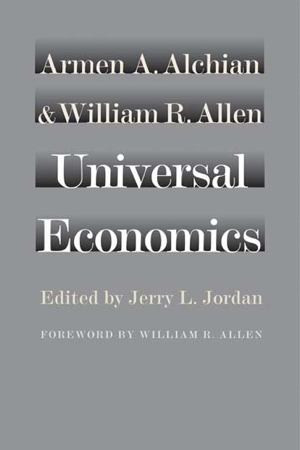
Note: The related pic is of Universal Economics, an update of the old Alchian and Allen text.
READER COMMENTS
David Seltzer
Aug 14 2025 at 12:37pm
David, the fourth problem; some able bodied individuals in the bottom 20% remain there because they are incentivized by substantial welfare benefits deriving from the redistributive state. A survey of services include; Health care provided by Medicaid, free clinics, and the Children’s Health Insurance Program Nourishment provided by food stamps, school lunches, school breakfasts, soup kitchens, food pantries, and the Women’s, Infants’ & Children’s program Housing and amenities provided through rent subsidies, utility assistance, and homeless shelters. Source, FFE, 8/30/2019. Then there is the problem of underreporting income and non-cash bennies. Assume an able bodied individual getting social services, receives benefits valued at $45k per year. Pre-tax earnings at 25% tax rate are $60k. About $33/hour. Apprentice plumbers and electricians in some states average about $25 an hour. The rational trade-off for the able bodied welfare recipient is to remain on taxpayer funded public assistance.
David Henderson
Aug 15 2025 at 1:42pm
Good point.
Although whether it’s rational also depends on preferences. For someone who values independence and doesn’t want to be on the dole, and values those things enough, the rational choice is to work.
Knut P. Heen
Aug 15 2025 at 8:01am
The grades many students receive in microeconomics and financial economics suggest that most of it is nontrivial. Most of it is also true.
David Henderson
Aug 15 2025 at 1:42pm
Good point.
Max Molden
Aug 15 2025 at 11:22am
One of my professors always pointed out the irony in this as Samuelson had not only famously attacked the Austrians and their stance on philosophy of economics but at times even painted their position as a shame to economics.
However, in this passage, Samuelson essentially takes the very same position: apparently, there is analytic knowledge, so a priori knowledge, about the economy.
David Henderson
Aug 15 2025 at 1:44pm
Hmm. Do you have cites to Samuelson saying that? I can believe it, but I just don’t know enough.
I do know that Samuelson was quite positive on some of the work by Austrian economist Bob Murphy, who has written a lot of article for Econlib.
Max Molden
Aug 16 2025 at 8:33am
It’s in Samuelson’s “Theory and Realism: A Reply.” I’m actually surprised that he took a liking in Murphy’s work!
Thomas L Hutcheson
Aug 18 2025 at 5:15pm
I think the Lerner Theorem is even more non-trivial.
Dave Smith
Aug 19 2025 at 12:53pm
I’ll add something to the income in the bottom income share question. It is also true that households are the typical economic unit, not individual workers. So the number of people in the bottom 20% might be falling. This could vastly overstate the income share loss that appears in the statistics.
Comments are closed.