
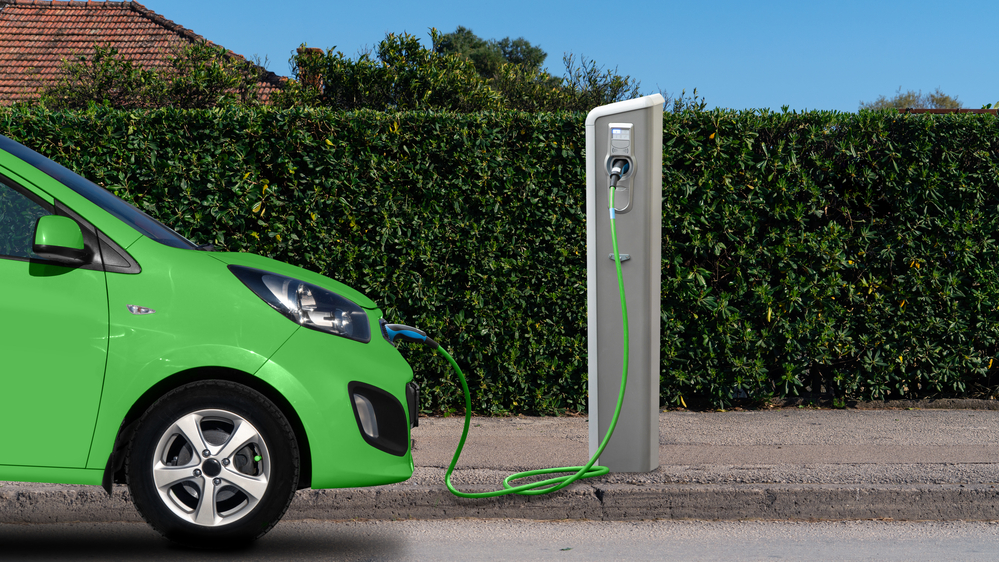
On June 6, 2024, the Wall Street Journal published my short op/ed online (but not in print) and titled it, “How Electric Vehicles Can Make Everyone Happy.” It wasn’t an ideal title. My article was how a few major changes in EV policy could make almost everyone happier than they are likely to be with current policy.
Here’s the whole op/ed:
How Electric Vehicles Can Make Everyone Happy
Ending subsidies, mandates and tariffs would expand use of EVs while letting people continue driving the cars they want.
By
David R. Henderson
June 6, 2024 at 5:48 pm ET
One of the first things you learn about in an economics course is the concept of trade-offs: You can’t have everything you want. This is relevant in the debate about electric vehicles. U.S. auto workers want to keep their jobs. Most U.S. drivers still prefer cars with internal combustion engines. Environmentalists want Americans to buy EVs. And free traders want, well, free trade. Something’s got to give.
Or does it? There’s a path that would enable each party to achieve many of its objectives. First, end mandates and subsidies for EVs. Second, eliminate President Biden’s 100% tariff on EVs from China and allow duty-free imports. Free trade would give lower- and middle-income Americans the chance to buy relatively cheap imported EVs. More people driving EVs would make environmentalists happy. And ending mandates and subsidies would allow U.S. automakers to do what they do best: make cars with internal combustion engines. That in turn would keep U.S. auto workers employed and able to continue using their specific skills.
If we stick to our current policy path, none of these goals is attainable. For one, environmentalists can’t achieve their aims. The Environmental Protection Agency estimates that 56% of new cars would need to be EVs by 2032 to meet the agency’s emissions goals. Even with subsidies and California-style mandates, meeting that benchmark is unrealistic. According to the Energy Department, EVs and hybrids combined made up only 9.1% of all light-duty vehicles sold last year. According to the Energy Information Administration, only 1.2% of light-duty vehicles on the road in 2022 were EVs or plug-in hybrids.
There are three reasons it’s unrealistic to expect more than half of new cars sold to be EVs. First, EVs are expensive. A new EV sold in the U.S. is priced, on average, at just over $50,000, more than most drivers are willing or able to pay. Second, people are rightly worried about driving an EV a long distance and being able to reach a charging station that recharges the car quickly. Third, when temperatures fall below freezing—which happens often in much of the U.S.—it takes significantly longer to charge an EV. [DRH note: I would have challenged the editor’s insert of “or able.” The majority of drivers are able to pay $50,000; it’s just that they would have to give up so much else. But I didn’t challenge because I was focused on other parts that I wanted her to get right, which she did.]
It’s unlikely that within the next 10 years EVs will make up more than 25% of all cars sold annually. But we could likely come much closer to hitting the 25% mark in a few years, with no subsidies or mandates, simply by pursuing free trade, which would lower the first of the three barriers: cost. BYD, a Chinese manufacturer, offers some EV models that cost less than $20,000—significantly cheaper than U.S.-made EVs.
If the U.S. makes EVs more accessible and affordable by welcoming duty-free imports, environmentalists will be closer to achieving their goal of getting more EVs on the road, consumers who want to buy EVs will be able to do so more easily, and automakers can focus on making cars with internal combustion engines, which would support auto workers’ jobs.
So let’s get rid of mandates, subsidies and tariffs. There’s no perfect trade-off, but some are better than others.
Mr. Henderson is a research fellow with Stanford University’s Hoover Institution. He was senior economist for energy with President Reagan’s Council of Economic Advisers.
READER COMMENTS
Craig
Jul 8 2024 at 6:00pm
“First, EVs are expensive. A new EV sold in the U.S. is priced, on average, at just over $50,000, more than most drivers are willing or able to pay. ”
To be fair the average price of a new car is between $48-$49k right now.
“f the U.S. makes EVs more accessible and affordable by welcoming duty-free imports”
Even with the 25% tariff BYD would still likely sell many. I’m seeing references to the Seagull being prices around $11k in China, obviously it would need to be shipped to the US, and being described as ‘an extinction level event’ for legacy car makers by Alliance for American Manufacturing. Indeed I believe the current administration is taking actions that would prevent an end run around the tariffs by building the cars in Mexico.
David Henderson
Jul 9 2024 at 9:02am
You write:
True, but that’s because of the targets for EV sales as a percent of sales that the auto companies must hit. To make sure they don’t sell “too many” ICE cars, they artificially raise the prices of those cars to choke back quantity demanded. So they’re actually charging more than the profit-maximizing prices for ICE cars.
We saw this in the late 1970s and 1980s with CAFE. To get to the CAFE targets, they priced small, high-MPG cars artificially low and large, low-MPG cars artificially high.
Craig
Jul 9 2024 at 10:34am
Just expounding on my comment RE: Mexican production of BYD cars and the potential to impose trade restrictions on cars potentially to be built by BYD in Mexico:
https://apnews.com/article/biden-tariffs-ev-china-mexico-tai-809b0e27339d38dcd3834d2cbb14e1d1
I’m not 100% sure what that would entail but it does seem they are contemplating the backdoor through Mexico and apparently BYD already sells vehicles there as well. I find the article a bit confusing actually.
As an aside BYD also makes ICE cars and a hybrid.
Roger McKinney
Jul 9 2024 at 11:01am
It’s not likely that EVs will reduce CO2 emissions for several reasons. The power to charge the batteries must come from burning natural gas. Renewable energy is too unreliable and nuclear is unpopular. But natgas has only about 60% of the BTUs of gasoline, so utilities would need to burn 40% more natgas to producetge same power.
Natgas generators are about 40% efficient at converting heat to electricity. Combined cycle are about 60% efficient but uncommon. Either way, utilities would burn more natgas to produce the same energy. About 10% of that energy is lost in the transmission lines. Finally, EVs are twice as heavy becauseof the batteries, so require twice the energy. All around, EVs produce a lot of CO2. That must be balanced against internal combustion engines being only about 25% efficient. EVs likely will generate greater amounts of CO2. Seems that the better option is to make internal combustion more efficient.
Matthias
Jul 9 2024 at 9:14pm
You are literally charging a battery. Batteries are exactly one of the solutions suggested to help turn intermittent energy sources into something reliable.
You are right that you still want peaker plants, for when even with (some) dynamic pricing and demand shifting (you can charge batteries later or earlier) and battery discharging your demand spikes above current supply.
But those peaker plants only kick in a few times a year typically. So while they might represent a big, seldom used capital investment, they don’t burn any natural gas when they are idle.
Roger McKinney
Jul 10 2024 at 7:58am
Those don’t change the physics that natgas has less BTUs and EVs are much heavier and that there is energy losses when converting energy to electricity then ti mechanical power.
Ron P
Jul 9 2024 at 9:29pm
So the $20K Chinese EVs will be produced in a country that uses mostly coal fired energy production to produce the cars. This whole thing is kind of silly.
Mike Turn
Jul 9 2024 at 11:34pm
Environmentalists’ goals are ALL cars be EVs, and then the next REAL goal is to have people not drive at all…..except for the important people – typically liberal politicians, their families and donors. Thus the environmentalists goals will never be reached as long as ICE vehicles are being sold and driven.
Gerald M Casey MD
Jul 10 2024 at 8:16pm
In my humble opinion I believe that the government should eliminate the subsidies, the regulations regarding mandatory requirements to reach a certain percentage of electric vehicles being sold or being on the road by a certain date, concentrate on producing and selling hybrids which do sell well and do provide a milder path to meeting climate goal needs. 1/2 a loaf is better than no loaf at all.
The present plan represents “ a dog that will never hunt “ . Go Nuclear and natural gas for electricity in addition to renewable sources and as little fossil fuels as we can honestly use
George J Kamburoff
Jul 11 2024 at 11:03am
Do you still have to pay for electricity and gasoline?
Not us, we invested in a solar system and electric cars and have lived and driven with free electricity for eight years now.
The PV solar system paid back in three years in gasoline savings alone.
Liberal Economics.
George J Kamburoff
Jul 11 2024 at 11:17am
Why do none of these complainers actually have an EV?
Richard A.
Jul 11 2024 at 10:43pm
We also have trade restrictions on solar panels that can be used to provide green energy for EVs.
Comments are closed.