
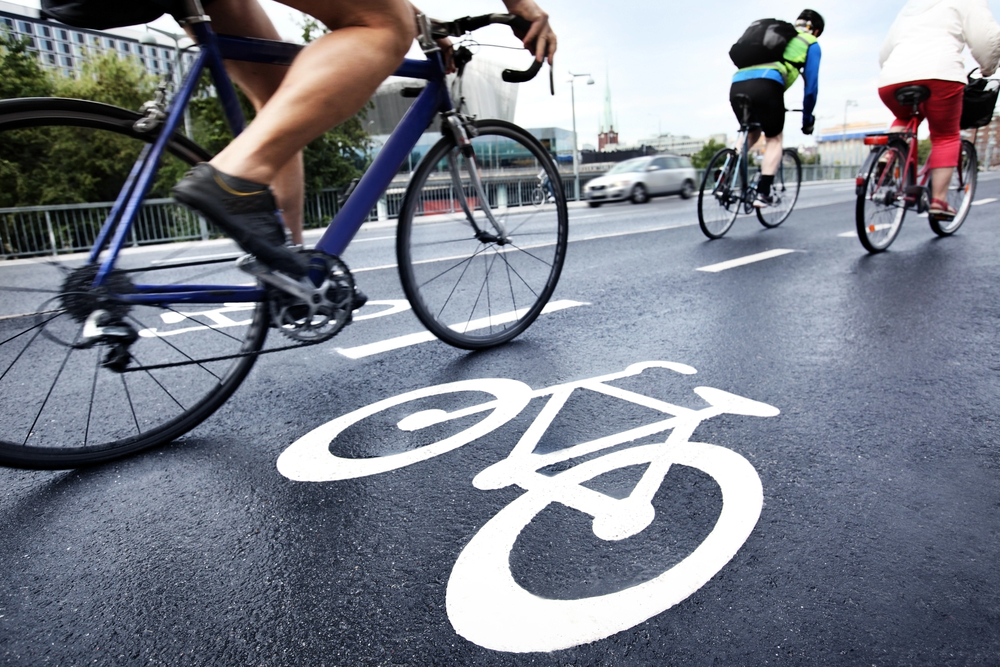
El Camino Real (ECR), State Highway 82, the main thoroughfare connecting San Jose with San Francisco, is sandwiched between Federal Highways 280 and 101. Maintenance and Rehabilitation is largely paid by the state with modest local government participation. Indeed, Caltrans can repave and redesign ECR even without city approval.
In 2024, Caltrans decided to repave ECR from Menlo Park southward through Palo Alto (which parallels Stanford University), Los Altos, Mountain View, to Sunnyvale. The work included upgrading curb ramps and sidewalks to comply with the Americans with Disabilities Act. It also added bicycle lanes. The work was largely completed by July 1, 2025.
Caltrans allocated $7,133,000 for the project, but did not explicitly list the cost of the soft white-posts-and-green-marker separated bike lanes. I would guesstimate no more than $2 million.
Restaurants and other commercial establishments complained about the loss of street parking and business before, during, and after the lane posts were installed. Patrons sometimes have to search for street parking in residential neighborhoods. It’s hard to know actual business losses, but I’ve watched some prospective customers give up and drive away.
What about bicyclists’ use of the new dedicated bike lanes since their completion? Every Sunday, my wife and I go out to lunch at a restaurant on ECR, or a side street off ECR. On average, I drive weekly to Safeway Pharmacy and Grocery Store in Menlo Park along ECR. My wife drives weekly along ECR to each of two big box stores and biweekly to Ranch 99 in Mountain View. That’s four trips a week and nine biweekly. On August 17, 2025, our 62nd anniversary, we went to our favorite Chinese restaurant on ECR. We arrived early and were seated next to a large window looking out at the street. And then, we remarked simultaneously, “Look, a bicyclist!” the first we saw using the new bike lane. I estimate that we had driven about a hundred miles between July 1 and August 17.

Several thousand students, staff, and faculty ride bicycles to Stanford each working day, having done so for years without dedicated bike lanes along ECR. Stanford’s internal bike lanes are simply demarcated with paint and words.
Are the new bike lanes worth the direct cost of installation and indirect cost of lost business? I think not, unless and until they are more heavily used, with fewer automobiles on the road unclogging traffic and reducing carbon emissions. Even if that occurs, businesses will continue to lose money. But, hey, this is California!
Alvin Rabushka is the David and Joan Traitel Senior Fellow, Emeritus at the Hoover Institution.
READER COMMENTS
Thomas L Hutcheson
Sep 15 2025 at 6:48pm
The loss of street parking can be mitigated by smart metering, setting rates by time of day if not dynamically so as to almost always retain an open space.
Dennis Senger
Sep 16 2025 at 9:53am
Optimizing the pricing for fewer spaces will still result in fewer people parking and fewer customers.
Speed
Sep 16 2025 at 7:52am
Bicycles are an unsafe means of transportation. From Microsoft Copilot …
🚗 Bicycle vs. Automobile/Truck Accidents
Fatalities: In 2023, 937 bicyclists died in motor-vehicle crashes. These account for about 2.6% of all traffic fatalities.
Injury Risk: Collisions with light trucks (SUVs, pickups, vans) are the most deadly, responsible for 46% of bicyclist fatalities.
Urban Danger Zones: Roughly 85% of fatal bike crashes happen in urban areas, often away from intersections where speeds are higher3.
Timing: Most fatal crashes occur during dusk or nighttime, especially between 6 p.m. and 9 p.m. on both weekdays and weekends.
Alcohol Involvement: About 37% of fatal bike crashes involve alcohol—either the driver, the cyclist, or both3.
Non-Vehicle-Related Bicycle Accidents
Fatalities: In 2023, 440 bicyclists died in incidents unrelated to motor vehicles—such as falls, collisions with fixed objects, or other environmental hazards.
Injuries: There were over 400,000 emergency department visits for nonfatal bicycle-related injuries in 2023, many from falls or equipment failures.
Demographics:
Children & Teens: Highest injury rates are among ages 10–14, often from solo crashes.
Adults 55–69: Highest death rates, often from more severe trauma.
Gender Split: Males account for 89% of all bicycle deaths and 4x the injury rate compared to females
If bicycles weren’t already a part of “growing up” and non-CO2 emitting transportation, publication/knowledge of the bicycle-related injury risk might mean that sales and use would be much smaller than they are now. Or maybe we would have many more physical barriers separating bicycles from cars and trucks.
Mark Brophy
Sep 26 2025 at 6:18pm
People wouldn’t wear helmets while riding a bicycle unless it was incredibly dangerous. They should drive cars, instead.
Dylan
Sep 16 2025 at 10:53am
A little bit of anecdotal experience from NYC. I started riding regularly in 2009, which is about the time that New York got started in earnest adding bike lanes. For a couple of years, the bike lanes felt mostly empty when I was commuting to work, but that slowly changed, and now the bike lanes are so full in Manhattan that we need multiple lanes to not get stuck behind a long line of traffic.
Obviously, Manhattan is not like much of the rest of the country. It’s dense, mostly flat, weather is decent most of the time, and traveling by car is expensive and inconvenient. So, I don’t want to suggest that the experience here is universal, just that you can’t’ extrapolate from one additional bike path a couple of months after it finishes. It takes a lot of connecting infrastructure and time for people to change habits.
Matthias
Sep 17 2025 at 11:05am
Check out the book The High Cor of Free Parking.
Street parking and mandatory meaning parking are pretty disruptive and destructive. I wish they’d remove street parking on my street, it would make the street much more inviting for pedestrians.
Parking should be provided like all other goods and services: by willing private businesses. Not forcible and not forcibly for free, and not by the tax payer for free to car owners.
Grand Rapids Mike
Sep 18 2025 at 4:50pm
Just a comment on the safety of bicyclists. I live in Chicago burbs. An observation or two is that they don’t obey traffic laws, including not stopping at stop signs, cutting across traffic with the overall goal of expecting car drivers job to avoid hitting them. This non safe behavior is magnified in evening when they don’t wear bright yellow or some type clothing identifying the bicyclist. So besides the non economic expansion of bike lanes there is bike rider behavior thought process of driving the bike with the expectation that the car driver is responsible for their safety, since the bicyclist is not using a carbon based transportation instrument.
The safety issue is now increased with increase in electric bikes, scoters and similar stuff. Some cities are now passing safety laws restricting their use.
Comments are closed.