
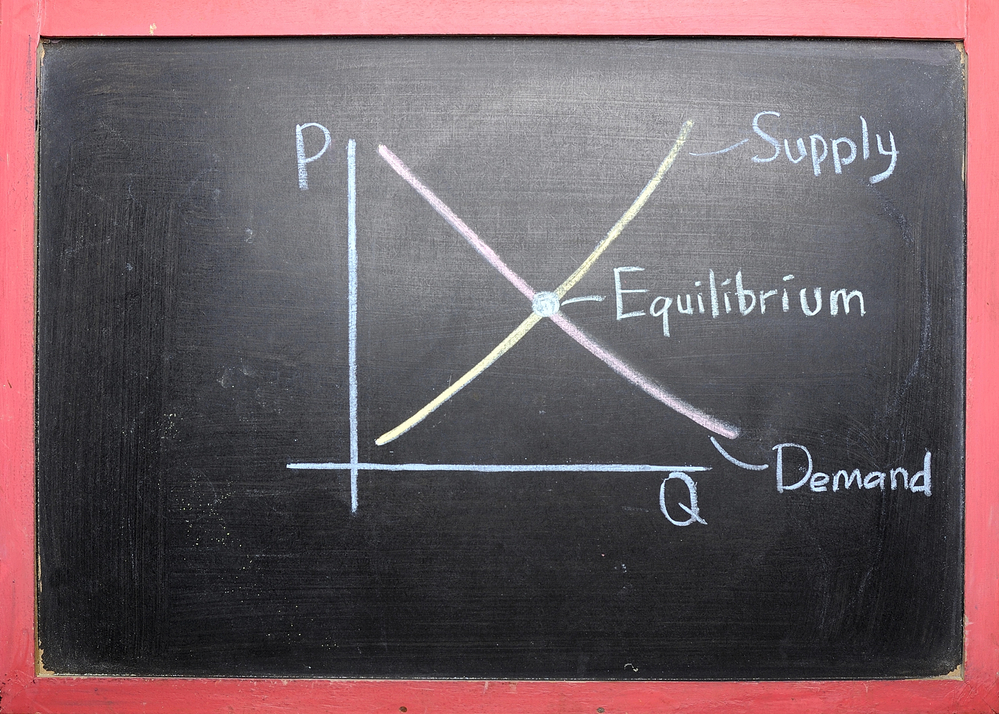
Each semester that I teach Principles of Microeconomics, I have some variation of this question on my exams:
- “Joe works at the local supermarket. One day, he says to you: ‘On Monday, we were selling oranges for $0.75 each and we sold 200 that day. On Friday, oranges were $1.00 and we sold 400 that day. The price went up, and so did the quantity demanded! The law of demand must be wrong!’ Evaluate Joe’s statement using the economic way of thinking. Is he right or wrong? Why?”
(If you would like to answer for yourself, Dear Reader, stop reading here and pick up with the next paragraph once you are done)
The answer I am looking for is something along these lines:
- “Joe’s statement is incorrect. The law of demand is a ceteris paribus statement. All else held equal, as prices rise, quantity demanded will fall. But what Joe witnesses can easily be explained by an increase in demand. That will cause both the price to rise and the quantity demanded to rise as the increase in demand means buyers are willing to pay more for the same quantity.”
The pedagogical lesson I want students to take away from this question is that whenever someone claims to overturn a scientific law, we should be skeptical. Existing theory can often explain the observed phenomenon. In this case, the law of demand is indeed a scientific law, the validity of which has been tested time and time again. And the incentives to find exceptions are quite strong. To quote George Stigler from his classic The Theory of Price:
In other words, to say that the law of demand doesn’t hold is an extraordinarily strong claim.
Of course, every once in a while, someone builds a theoretical model of a violation of the law of demand. Sometimes, they even include an investigation of one such good that seems to break the law of demand. But, upon further investigation, such examples break down, and the law of demand holds true. Strong evidence is needed for strong claims.
I think of this exam question whenever I read some economic commentator claiming that international trade has weakened America. Such an outcome would be unprecedented. Millennia of experience and evidence suggest trade strengthens nations and that turning away from it weakens them. This is explained by (and is evidence for) the law of comparative advantage. As with the law of demand, anyone who can provide robust and rigorous evidence overturning our understanding of trade will be guaranteed all sorts of professional and pecuniary honors. Despite these incentives, no evidence is forthcoming. Most of the claims that these well-established economic rules have been overturned are made in op-eds and are decidedly lacking in scientific merit.1
None of this is to say that a scientific law can never be overturned. Scientific knowledge is an ever-evolving thing. Miasma theory was backed by millennia of experience and evidence. Yet, it was eventually exposed as incorrect. And that is evidence of my argument. Those who overturned miasma theory are immortal names in the scientific world: John Snow, Louis Pasteur, and Robert Koch.
Could our understanding of international trade and the law of demand suffer the same fate as miasma theory? Of course. But those attempts to overturn the scientific laws need extraordinary evidentiary backing. Thus far, the evidentiary backing for overturning economic laws has been lackluster at best, and often outright false.
Footnotes
[1] Note: the claim “trade weakens a nation” is different from the claim “protectionism grows a nation.” The latter still argues that trade improves a nation, just that protectionism creates more prosperity.
READER COMMENTS
Mactoul
Nov 14 2025 at 10:57pm
Don’t the Austrians claim to derive all economics starting from their axioms?
Now, all else can never be equal, strictly speaking. So, we need to judge which difference is relevant and which cannot be relevant.
For example, color of oranges may or may not be relevant. But different observers may disagree.
Taking this view, the Austrian idea of deriving the law from axioms is on firmer foundation than regarding the law as empirical.
The case of law of conservation of energy in physics is suggestive. It is not simply empirical but it suggests when the things that seem to be equal are actually unequal. Many discoveries in physics have led from apparent violations of conservation laws.
Jon Murphy
Nov 14 2025 at 11:14pm
I’m not really sure where you’re going with all this.
Mactoul
Nov 15 2025 at 1:08am
The status of the law of supply and demand. Is it just an empirical observation or is it derivable from fundamental axioms?
Jon Murphy
Nov 15 2025 at 6:02am
Both.
Knut P. Heen
Nov 17 2025 at 5:27am
Decreasing marginal utility of a good implies a falling demand curve for each individual. The market demand curve is just the sum of each individual’s demand curves, thus it must also be falling. Stigler takes this as a hypothesis which potentially could be false. The Austrians claim it is like the laws of mathematics (true by definition).
The most relevant empirical examples here are the Giffen good and the Veblen good. I think both comes from an inappropriate definition of a good. It is easiest to see this with the Veblen good. This is the idea that you can signal that you are rich by paying a very high price for some fancy good. Lower the price and the status signal effect disappears. The point is that the most effective way to signal that you are rich is by violating the laws of economics. Hence, Veblen behavior is actually evidence in favor of a falling demand curve.
Jon Murphy
Nov 17 2025 at 6:18am
There’s some ambiguity in your comment. What’s the “this” and “it” you’re referring to?
Philip George
Nov 16 2025 at 2:57am
I have always wondered why all illustrations of the law of demand and supply involve agricultural commodities, oranges and orange juice, wine and vineyards in Samuelson’s ‘Economics’ and so on. It is because for industrial goods, as demand rises, price falls, both in the long run and in the short run.
Jon Murphy
Nov 16 2025 at 6:51am
Nope.
Ron Browning
Nov 16 2025 at 7:35am
As stated above: all else can never be held equal, but more importantly we can never know what exactly has changed. This is the great function of the price system in that it relieves us of the burden of figuring out all the changes that cause a particular price change. In cases where one or more unknown changes that tend to raise prices concurrent with one or more other changes that will tend to lower prices, the fact that prices in this particular case appear to adhere to the law of demand, does nothing to prove or disprove the Law, because the Law is smothered by the unknowns. As sure as one should be skeptical of attempts to disprove long held Laws, one should be skeptical of academics who allege that particular case prove a Law. Be skeptical of anyone who seems to lose sight of the unknowns.
Jon Murphy
Nov 16 2025 at 8:25am
There are various statistical methods that solve the “all else held equal” problem. So no, we should not adopt an extreme form of skepticism that leads to “As sure as one should be skeptical of attempts to disprove long held Laws, one should be skeptical of academics who allege that particular case prove a Law. Be skeptical of anyone who seems to lose sight of the unknowns.”
John R. Samborski
Nov 16 2025 at 8:05am
The demand for stocks seems to be greater when their prices are high and less when their prices are low. Also, it’s strange that anybody would want to buy a Rolex watch when there are lots of cheaper watches that would serve perfectly well, especially now that you can buy cheap watches that keep time perfectly.
Jon Murphy
Nov 16 2025 at 8:29am
Correct. An increase in demand leads to an increase in price (as noted in the post).
Preferences. Some people prefer other characteristics of a watch other than just keeping time. Consequently, the demand for Rolex for those people is higher than the demand for other watches. So long as the marginal benefit of the Rolex exceeds the cost, it is predictable that the individual will purchase the Rolex over the other watches. Willingness to pay and availability of substitutes affects the location and elasticity of the demand curve. It does not invert the demand curve.
john hare
Nov 16 2025 at 5:22pm
I also fail to understand the desire for a Rolex. Just as I fail to understand collectors paying millions for an antique or original painting. Perhaps it’s because I have never had serious amounts of excess funds.
I don’t dispute their right to buy, just fail to grasp the motivation.
Jon Murphy
Nov 16 2025 at 6:39pm
De gustibus non est disputandum and all that.
nobody.really
Nov 25 2025 at 1:58pm
When I was 18 I had a precious three weeks to tour Europe. Naturally I spent some of those precious hours waiting in line at the Louvre, and then some more of those hours standing in line to gaze upon the Mona Lisa–only to realize that it looked exactly like every picture of the Mona Lisa I’d ever seen. (Ok, maybe not exactly the same, since the real Mona Lisa must be observed through four inches of glass–whereas the photographs likely did not face that same impediment.)
What advantage did seeing the original Mona Lisa have over seeing a print? Perhaps it had some advantage to someone–but not to me. What a collosal waste of precious time!
Or was it? Because there were long stretches of those three weeks about which I can remember nothing. But I’ve been telling this Mona Lisa story for decades now; I trot it out when encouraging people to know themselves and be true to their own values rather than the public’s values.
Indeed, most of the memorable stories from that trip consist of events that, at the time, we regarded as screw-ups. So was my pilgrimage to the Mona Lisa really a waste of time–or was it some of the best-spent hours of my entire trip?
nobody.really
Nov 25 2025 at 1:43pm
As a matter of epistomology, do not ALL claims require strong evidence to be believed? Does it make sense to vary the amount of information we require to embrace a new insight? Does a rule that requires varying amount of evidence really boil down to a policy favoring conformation bias–embracing arguments that confirm our prior beliefs while rejecting equally sound arguments that run counter to our beliefs?
Perhaps so. And perhaps confirmation bias has adaptive qualities.
I wonder if the term “strong claims” carries some unstated weight here. Maybe our prior beliefs reflect something about accumulated insights–derived from our own observatations, or from our culture. An empirical claim that runs counter to that may well reflect sound observations and sound analysis–but it will be swamped by the (perhaps presumed) quantity of contrary observations and analyses. In this context, a “strong claim” means a claim that runs counter to other data and analysis. If one were to do a meta-analysis of all studies on the matter in question, the data supporting the “strong claim” would be swamped by (perhaps presumed) data running contrary to the claim.
Put in Baysian terms, we should consider our priors–and, as a rule of thumb, just stick with our priors. I expect this is an adaptive rule of thumb most of the time. But clearly not all of the time. And unless we actually DO the meta-analysis, we’ll never know how often the rule misleads us.
Comments are closed.