

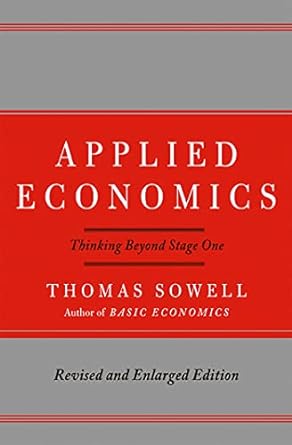
Thomas Sowell frequently emphasizes the importance of thinking beyond the immediate and obvious impact of some economic policy and thinking through the larger implications. He actually wrote an entire book dedicated to this idea – Applied Economics: Thinking Beyond Stage One. A similar and useful exercise to evaluate an idea is to really try to work out not what will unfold next, but what that idea, if true, should imply for the present situation. Here are two common examples where this would come in handy.
First, some people believe that all the value a business generates for consumers and stockholders is generated by the workers. Meanwhile, the owners of the business don’t create or contribute value – they merely siphon off the value created by the workers, while paying the workers less than the value they generate. If this was true, this has a pretty clear implication – business owners should be incentivized to hire as many workers as possible! After all, by this understanding, workers generate more value than they are paid, which means maximizing the size of your workforce is a surefire way to maximize the money you can make. The very last thing a greedy business owner would want to do is fire his workers – because if workers generate more value than they paid, cutting jobs means the business owner will necessarily lose more than he gains. Yet, we’re often told that cutting jobs is itself motivated by greedy business owners trying to increase their profits – which would be mathematically impossible in a world where all value is created by workers. The idea that greedy business owners pay workers less than the value they generate and the idea that greedy business owners cut jobs to increase their profits contradict each other – yet both ideas seem to fit comfortably into many heads at the same time.
Another common belief is that some particular groups of people are discriminated against when trying to get auto loans or mortgages. Sometimes this is buttressed with references to studies that say, in effect, “We used our data and controlled for these seventeen different confounding variables, and found that all else equal, freckled people with identical financial credentials were less likely to get approved for a mortgage than non-freckled people.” Does this mean that freckled people are being discriminated against? Maybe. Or maybe there are other relevant confounding variables the study fails to take into account. But if you hold the belief that freckled people are being discriminated against, there’s a clear implication for the present situation. We should expect to find that freckled people have unusually low rates of payment delinquency or default. After all, the claim is that freckled people need to be disproportionately financially secure compared to non-freckled people to be approved for equivalent loans, which necessarily means the loans granted to freckled people should be at a disproportionately low risk of delinquency. Meanwhile, if there’s a group that reliably has a disproportionately high risk of delinquency or default, that would imply getting approved for a loan is actually disproportionately easy for that group, all else equal. The idea that there are groups of people who must be disproportionately well-qualified to get a loan but are also at disproportionately high risk of default are also contradictory to each other. Yet these ideas, too, are often held in tandem by people.
What are some other examples you can think of?
READER COMMENTS
David Seltzer
Apr 23 2024 at 5:26pm
Kevin: I thought about this and came up with a personal example. A friend worked in Mergers and Acquisitions for Wall Street investment bank. He had information about a merger and told me. Of course I could have bought the shares but didn’t. The law is clear. Insider-trading is prohibited. While I didn’t trade on the info, I maintained a current rather large position and profits increased substantially. I non-traded on insider information by not selling part or all of the position.
Ahmed Fares
Apr 23 2024 at 8:56pm
‘Schrödinger’s immigrant’, a foreigner who lazes around on benefits while simultaneously stealing your job.
While I was searching for the best way this was worded, I noticed that David Henderson wrote an article with that title.
Schrodinger’s Immigrant
David Seltzer
Apr 24 2024 at 6:55pm
I heard this in the military. Hurry up and wait.
Thomas L Hutcheson
May 1 2024 at 7:00am
I do not see any contradiction in thinking that all the value of a firm is created by the workers, that all “surplus” should go to workers, profits of owners ought to be zero [I think that policies to achieve that would be bad, but some people’s preferences are some people’s preferences] AND knowing that profits are NOT zero and sometimes the way the dastardly owners increase them(!) is to reduce the number of workers.
Likewise I do not see a logical contradiction in thinking freckled people face discrimination in obtaining auto loans and that they have worse repayment histories. The discriminating variable may not be creditworthiness. If the dealer’s owners of employees just don’t like freckled people then some of the effort that might otherwise go into judging creditworthiness goes into sorting clients into freckled/non freckles bins. This might mean that in fact they make more credit-worthiness mistakes so the few freckled buyers DO have worse repayment histories.
Comments are closed.