
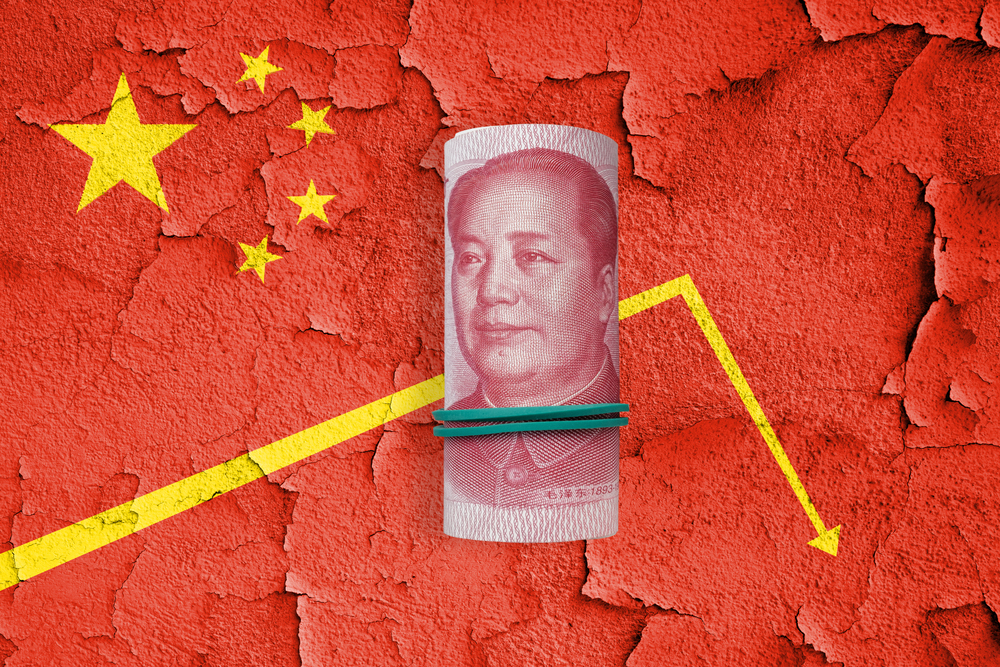
It won’t take long to answer this question. Therefore most of this post will be devoted to considering why this is even an issue.
Consider the following Bloomberg headline and subhead:
Who Thinks China’s Not an Economic Powerhouse? China
One of the hottest topics at the upcoming global climate conference is whether China should still be considered “developing.”
According to the IMF, China’s per capita GDP in 2024 is estimated at $13,136 well below the $85,373 figure for the US, and even below Mexico’s $15,246. In PPP terms, China’s GDP is $25,015, again, slightly below Mexico. China is clearly a developing country. So what’s going on here?
In recent years, the US government has adopted an adversarial relationship with China, and most of the media has fallen in line with this agenda. This attitude colors the way the media looks at all sorts of issues. Consider the following two examples:
1. When the Chinese government reports strong GDP growth, much of the media is immediately skeptical. Experts are cited who claim that the official Chinese figures are inflated. Studies using satellite data of nighttime illumination suggest that China is much poorer than it claims to be.
2. When China is viewed as a threat to the national security of the US, or when China is expected to contribute money to the fight against global warming, then China is viewed as an advanced economy, indeed a “powerhouse” economy.
There doesn’t seem to be any “fact of the matter” when it comes to China’s development status. Rather it is regarded either as a backward developing country or an advanced developed country according to whether that status advances a particular argument being made by powerful special interests.
If the goal is to show that China has a bad government, then obviously it is inconvenient to report stellar rates of economic growth. If your interest is convincing the public that China is a formidable competitor to the US, then obviously it is inconvenient to report that China is merely a developing country.
This is how I read the Bloomberg headline and subhead. At the moment, it is convenient for the US government to have China viewed as an economic powerhouse. But not always. If reports of rapid Chinese economic growth lead other developing countries to begin seeing China’s system as worth emulating, then it’s time to point out that the GDP figures are probably inflated and China’s economic system is actually quite inefficient. China is much poorer than its government claims.
I don’t hold either view, as I don’t have an agenda. I believe that China has grown very rapidly since Maoist economic policies were replaced with market reforms. I believe that China is every bit as rich as its government claims, probably even richer. (Richer than Mexico.) I trust my own eyes much more than I trust satellite models of an economy. But I do not believe that China is a fully developed economy. It still trails the US by a very wide margin, and will continue to trail the US for the foreseeable future. Indeed, China still trails other East Asian economies like Japan, South Korea, Taiwan, and Singapore, largely because its government remains too heavily involved in the economy.
In my view, China is not a threat to America’s almost complete dominance of the 21st century global economy. Indeed, with the rise of high tech that dominance is becoming ever more entrenched, with the US share of global stock market capitalization having recently risen to an astounding 61%. At the same time, I understand why some people have alternative views. China is a major player in many industries, especially manufacturing. But whatever your view, it is important to avoid motivated reasoning. Whether China is or is not a developed country does not depend on whether that fact advances an argument that you happen to be making at this moment in time.
READER COMMENTS
Ahmed Fares
Oct 22 2024 at 9:49pm
GDP in China is an input, not an output.
What Is GDP in China? —Michael Pettis
Personally, I think both productive and non-productive investment are important, the latter keeping people employed to prevent social strife. Seen from that perspective, putting up some extra apartment buildings and blowing them up again isn’t dumb after all.
Scott Sumner
Oct 22 2024 at 11:46pm
“Personally, I think both productive and non-productive investment are important, the latter keeping people employed to prevent social strife”
Have you ever read Bastiat?
Ahmed Fares
Oct 23 2024 at 1:29am
Yes. Bastiat was about two different chains of spending, the tailor preferred over the glazier.
Productive investment is obviously better than non-productive investment, but absent that, non-productive investment is better than social strife, which costs society more.
Urban Black Violence: The Effect of Male Joblessness and Family Disruption
New research examines the cost of crime in the U.S., estimated to be $2.6 trillion in a single year
Scott Sumner
Oct 23 2024 at 4:12am
Sorry, but I’m having trouble seeing what studies of black crime (most of which cannot be replicated) has to do with whether China is a developing country.
Lizard Man
Oct 22 2024 at 10:18pm
The main risk with China, from my point of view, is that if it can show it has a navy capable of defeating the US Navy, it will be able to credibly threaten blockades of other nations in Asia. It can then use the threat of a blockade to make countries choose between going to war with China or acquiescing to Chinese demands. This would allow the Chinese to set trade policy for South Korea, Japan, the Philippines, Indonesia, Australia and Vietnam. Of course they likely already have this power over Russia. That is an awfully large proportion of the global economy, and a larger proportion than the US economy, or I think of the North American economy. China could then use that power to set trade policy to get other countries to ally with China by promising them access to those markets, and by threatening to cut them off if they go against China’s wishes. The basic strategy would be to turn North America into an island that has little commerce with the outside world, and by doing so degrade its ability to manufacture goods and to stay at the cutting edge of technology.
Scott Sumner
Oct 22 2024 at 11:50pm
That seems like a rather fanciful theory. Russia has an order of magnitude more nuclear weapons than China–any thought of a Chinese attack on Russia seems pretty far fetched (as does the rest of your theory.)
Lizard Man
Oct 23 2024 at 8:01am
If China can successfully blockade Taiwan, what would prevent them from doing so against Vietnam or the Philippines? China doesn’t need to blockade Russia, they can just threaten to cut off trade with Russia and the Russian military would run out of supplies very fast, and their economy would shrink quite a bit.
Lizard Man
Oct 23 2024 at 8:18am
China is already prepared to blockade Taiwan. If they attempt this, maybe the Taiwanese themselves have a military capable of breaking the blockade without help. Maybe the US Navy (and Allies) fight and defeat the Chinese Navy and lift the blockade. Maybe the US Navy fights and loses. Maybe (especially if Trump is president) the US doesn’t fight at all and Taiwan is conquered. Perhaps if China successfully conquers Taiwan, everyone in the Pacific, including the US, dramatically increase their spending on naval power. But the problem if Taiwan falls, however it falls, is one of coordination. If the US doesn’t successfully defend Taiwan, regardless of the reason, why should a country like Vietnam or the Philippines trust the US (and the US led coalition) to come to their defense? And if they cannot trust the US, those countries have to make plans on how to face China’s Navy without support from other countries.
Jon Murphy
Oct 23 2024 at 8:59am
Logistics. It’s one thing to blockade a small island off your coast. It’s a whole other to blockade countries with large coastlines further away.
Probably not. These sorts of concerns factor heavily into political decisions, but the simple economics of the situation suggests that the political concerns are incorrect. Look at how quickly the sanctions against Russia when it invaded Ukraine became ineffective. Even in situtations where one country is the dominant supplier of a good, sanctions like that tend to be ineffective. For example, there was a situation about a decade ago where China and Japan were in dispute over some islands. China is the sole supplier of rare earths (a major component in the production of computer equipment, a major industry in Japan) to Japan. China cut off Japan from rare earths to force them to give up their claims. Japan just subsituted into rare earths from their own coast and other countries. China had to back down.
Matthias
Oct 23 2024 at 7:45am
It’s somewhat fun that you describe the big threat as China cutting the US off form trade; and then the usual American response to a perceived Chinese threat is to cut themselves off of trade (via tariffs).
Basically handing China what it’s supposed to be trying to achieve without them ever having to fire a single shot.
Craig
Oct 22 2024 at 10:34pm
Honestly I’d say China is both. In general coastal China is developed, in general western China is much poorer and would likely still be most properly classified as developing.
Scott Sumner
Oct 22 2024 at 11:57pm
Most middle income countries have some regions that are much richer than others. In China, the rural/urban split is at least as important as the western/coastal split. Big cities in western China are richer than rural areas near the coast. The northeast (Manchuria) is also depressed.
Kurt Schuler
Oct 22 2024 at 11:38pm
China is a middle-income country with great regional variations. Even the poorest parts are much better off than they were earlier in the life of a middle-aged or old Chinese. A middling income level multiplied by an enormous population results in great economic power and, given China’s level of military spending, great military power.
Scott, you write, “In recent years, the US government has adopted an adversarial relationship with China, and most of the media has fallen in line with this agenda.” The fault lies with China, which has tried to intimidate Taiwan; made unjustified territorial claims in the South China Sea and used military force to support them; broken its treaty promises to respect civil liberties in Hong Kong: propagandized historical narratives of grievance toward the West intended to bolster Chinese chauvinism; supported Russia’s murderous invasion of Ukraine; and continued to support North Korea, the worst government in the world, which would collapse without Chinese backing. All those things are apart from such more internal matters as persecuting Christians and practitioners of Falun Gong; herding Uyghurs into concentration camps; making China a surveillance state once again; and suppressing anything that might be a rival to the overweening power of the state.
Xi Jinping has centralized power in his own person to a greater degree than any Chinese dictator since Mao. Under his rule, China has become more bellicose, less free, and more of a danger to other countries.
Scott Sumner
Oct 22 2024 at 11:53pm
I agree that China’s development is uneven, as is true of other middle income countries. I also agree that China has engaged in a number of practices that have contributed to the problem, but that does not excuse the behavior of the US government.
Thomas L Hutcheson
Oct 23 2024 at 6:17am
I think it would be prudent for the US to encourage a relative shift of the world’s manufacturing capacity to Non-CCP run, non-CCP interdictable places with a ABC (Anybody but CCP run China) free trade area.
Most of the reasons one might want to _designate_ CCP run China as “developed” or not are not good reasons for designating any country as not “developed.” For example, China should have the same tax on CO2 emissions as the US or anyone else.
Andrew_FL
Oct 23 2024 at 9:10am
LMAO people who say this invariably have a sample selection bias in the evidence of their “eyes”. The China you have seen personally is a tiny fraction of the country, most of which is much poorer.
Scott Sumner
Oct 24 2024 at 3:33am
I have visited China 10 times, and been to almost all parts of the country, both rich and poor. What makes you think that you know anything about my knowledge of China?
MarkW
Oct 23 2024 at 4:03pm
Would it be sensible to ask if that the world as as whole is a ‘developing nation’? Probably the global average per-capita GDP would make it so. But obviously there are highly wealthy, industrialized nations within the worldwide developing nation level economy. And the same seems true of China. Parts of it (in total, larger than all but a few nations) are on par with wealthy countries, while other parts lag far behind. It’s most advanced regions appear to be well ahead of anything found in Mexico. Given this — how should other countries deal with China as a whole? The mean GDP per capita doesn’t seem to capture the level of China’s development very well at all.
Scott Sumner
Oct 24 2024 at 3:37am
“The mean GDP per capita doesn’t seem to capture the level of China’s development very well at all.”
I disagree, at least if you use PPP adjusted figures. I don’t think China’s development is more uneven than that of a place like Mexico or Brazil or Thailand, which also have modern big cities and poor rural areas. It’s a typical middle income country in terms of development.
Its size does make it different in the sense that it plays a bigger role in the global economy, and its top 1% is quantitatively larger than in a smaller country. But it’s clearly a developing country.
MarkW
Oct 24 2024 at 6:46am
But it’s not just the gleaming cities — you can find some of those in even desperately poor countries. What sets China apart from other nations of similar per-capita GDP is that it has highly advanced, home grown industries on par with anything found in fully developed countries. There’s no possibility of home-grown Mexican electronics industries becoming dominant, nor is anybody adopting huge tariffs against Mexican designed and manufactured EVs. And nobody thinks Mexico is going to produce a domestic space industry to rival SpaceX.
Warren Platts
Oct 24 2024 at 1:54pm
Pearl Buck couldn’t have said it better!
Ivan Tcholakov
Oct 27 2024 at 11:40pm
1. “Developing nation” is a status that implies some benefits. :-)2. And let me try to get away from GDP and to look at something tangible. Just count the military ships of China. If a nation was capable to build them, well, it is developed. We think about development as human well-being, but in China this is not necessarily the case.
Comments are closed.