
Charging extra for specific preferences, such as a seat selection on a flight, enables lower basic prices, increasing access to no-frills options for lower-income customers, while allowing businesses to customize their services to individual customers’ preferences. Airlines unbundle in-flight food and checked bags, for example, leading to more profit opportunities and lower base fares. Yes, “price discrimination”—charging various customers different amounts for the same product—can sometimes be harmful to customers on net. But banning such unbundling when consumers put wildly different values on certain services can price out poorer consumers and compel others to pay for services they neither want nor need.
Likewise, overdraft fees from banks help disincentivize costly behavior. Banks incur costs and face heightened risks when customers overdraw their accounts. Overdraft charges help deter this behavior in a well-targeted way, by imposing charges on those customers whose accounts become overdrawn. Capping or constraining overdraft fees doesn’t eliminate these costs and risks; it just means someone else must be charged for them in a different way. Banning overdraft charges thus means higher prices for some other subset of a bank’s customers.
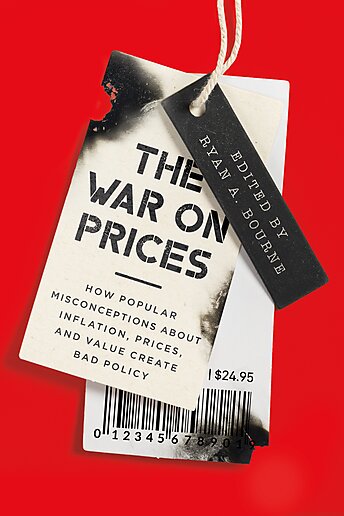
This is from Ryan Bourne, “Abolishing ‘Junk’ Fees Would Be Junk Policy,” in Ryan A. Bourne, The War on Prices: How Popular Misconceptions About Inflation, Value, and Prices Create Bad Policy, which was released this week. There’s actually some other content between these two paragraphs.
As I said in the blurb on the book this is one of my favorite chapters. Specifically, I wrote, “Particularly good are the chapters on rent controls, price controls on oil and natural gas, and so-called junk fees, which are really fees to solve problems that would exist without them.”
Bourne quotes President Biden’s attack on “junk fees.” I get the impression, given Joe Biden’s low or close to zero understanding of economics, that Biden thinks that eliminating junk fees won’t cause any prices to rise.
READER COMMENTS
David Seltzer
May 17 2024 at 6:31pm
David: From warren,senate.gov “Americans are facing sky-high food prices, caused by excessive price gouging by food and grocery giants.”
“The federal government should use every possible tool to lower food prices. We believe you can exercise your executive authority to take additional action to address rising food prices without congressional action.”
Nothing more need be said?
Matthias
May 17 2024 at 9:48pm
The way to lower fees that are truly ‘junk fees’ is by lowering barriers to entry, and in general discouraging competition less.
Matthias
May 17 2024 at 10:45pm
Overdraft fees are actually an interesting example:
When I was living in the UK around 2010, I could not find a bank that would just reject any transfers, payments or withdrawals that would put me in the red. Such a policy was the standard in Germany, if you don’t arrange for an overdraft.
In the UK, they typically approved such money moves, but charged you an overdraft fee.
The regulator had given the UK retail banking industry various fines etc over the years, to no avail.
When Monzo, a so called challenger bank, arrived on the scene a few years later, I could finally get an account that just refused to go into overdraft by declining payments, instead of forcing an overdraft facility on me that I didn’t want.
Dylan
May 17 2024 at 10:28pm
I have no problem with unbundling these fees, however I think often the motivation is to make price comparison harder. On flights in particular, it has gotten harder to use online travel agents to compare prices, since it is hard to know what you’re getting from one carrier to the next and one ticket class to the next.
I’m not in favor of regulating this, but the practice does make my life a little bit harder for little apparent benefit.
steve
May 18 2024 at 10:53am
If they are important why are they so often made obscure so that they are a last minute surprise or just hard to find? I agree that they can serve a good purpose but it would help if those costs were transparent.
Steve
Jon Murphy
May 18 2024 at 11:15am
Are they hard to find? In some cases, like bank and credit card fees, the law requires the firms to disclose those prices up front. Airlines post their prices and itemize everything. I’ve never had any trouble finding the total (non-tax) price for something I’ve wanted to buy.
Ironically, it’s the taxes that tend to catch most people by surprise.
steve
May 18 2024 at 11:58pm
Just went to Youtube and watched a bunch of airline ads. They didnt have the extra costs in those ads. I went to a couple of their sites and you can find them but you have to look for them. Given that it’s a recurring complaint I think there is some truth to them, probably from people who dont fly often.
Steve
Jon Murphy
May 19 2024 at 8:57am
I’m not sure Youtube ads are the best example. You can’t cram all information into a 15-30 second ad. I mean, if we’re going by that reasoning, then the price of Hokas are “junk fees” because they’re not mentioned in the ad that is playing as I write this. Yet the price is prominently displayed on their website.
I agree that people who don’t fly often wouldn’t necessarily know differences between airlines (eg Southwest has free bags while American has different class levels, etc). But that would imply that “junk fees” are subjective, not objective. It’s hard to justify legislation banning something based of some people’s subjective knowledge. To me, that would be like banning acetaminophen because some people don’t use it often enough or read the bottle to know that you can do serious damage to yourself if you take too much.
Jon Murphy
May 18 2024 at 11:22am
In addition to serving a purpose, removing them can have massive unintended consequences.
For example, removing (or even capping) bank overdraft fees could likely push banks into more risky lending to try and protect against the losses incurred by overdrafts. Or force banks to become more discriminatory in who they allow to open an account.
Beyond just junk fees, well-intended actions often have dire consequences:
I know this is ancedotal, but allow me to relay two conversations I have had with landlords in two seperate states (LA and NY). Both said that the eviction moratorium during COVID forced them to dramatically redo their leasing policies. Both went from having no credit check (just references) and a low security depost (about 1/4th month’s rent) to high credit standards, high reference standards, large security deposits, and administration fees. Consequently, this behavior tends to discriminate against lower-income or young tenants who do not have an established credit score.
David Seltzer
May 19 2024 at 5:01pm
Jon, nice post. as for more risky lending, TBTF bailouts have given bankers an incentive to make these loans. Ironic that TBTF engenders moral hazards
Comments are closed.