

The Economist has a recent article discussing a fascinating natural experiment:
History does nevertheless throw up “natural” experiments. In an earlier paper, Mr Brzezinski, Mr Palma and two co-authors exploited one source of variation in the money supply of early modern Spain: disasters at sea. Ships carrying treasure to Spain from the Americas would sometimes encounter hurricanes, privateers or the British navy. In 42 incidents from 1531 to 1810, they lost some or all of the precious metals that Spanish merchants had expected to receive. The losses averaged 4% of Spain’s money stock. Drawing on a variety of sources, including tax records and tallies of sheep, the authors showed the damage these losses inflicted on Spain’s economy. Credit became scarce, making it hard for merchants to buy supplies for weavers, and consumer prices were slow to adjust. A loss of 1% of the money stock could reduce real output by about 1% in the subsequent year. Sheep-flock sizes fell by 7%.
Although I like this finding, a word of caution. The statistical significance of the study seems rather low:
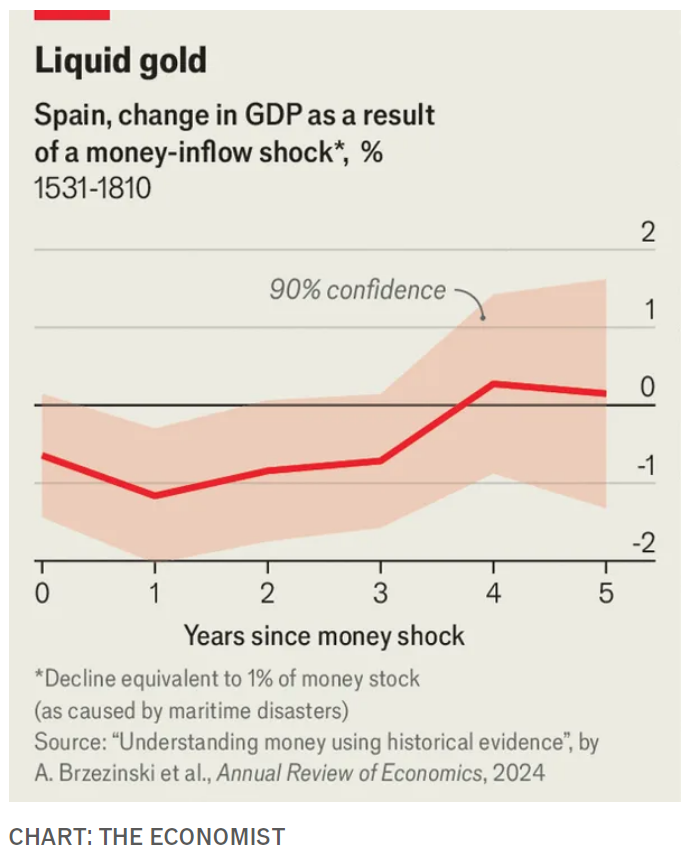
If this study did not agree with my preconceived ideas about monetary shocks, I’d be telling you that it was just barely significant at the 90% level, and that this could easily reflect the tendency of journals to prefer studies that find a positive effect over those that find no effect at all. (I guess I did tell you that. :))
But for the moment, let’s assume that the finding is true; a loss of gold really did hurt the Spanish labor market. After all, we’ve seen many modern examples of negative monetary shocks resulting in higher unemployment, notably following significant declines in the US monetary base during 1920-21 and 1929-30. Why would this effect occur?
There is no obvious reason why Spain being a bit poorer should make Spanish workers wish to work less hard. If anything, you’d expect extreme poverty to be a spur to work harder, if only to avoid starvation. The real problem is that negative monetary shocks act as a sort of price control, they push an important market price out of equilibrium.
We normally think of disequilibrium prices as being caused by things like price controls, rent controls and minimum wage laws. Ryan Bourne recently edited an excellent book on this problem, which contains numerous case studies. But price regulation is not always the problem. Monetary policy instability can cause a similar problem. So can irrational public attitudes, such as opposition to “price gouging”, or money illusion.
READER COMMENTS
Craig
Oct 18 2024 at 5:28pm
One of my favorite legal cases happens to be the case in federal court with respect to the disposition of the Mercedes, a Spanish galleon that went down with treasure being salvaged. Since the Mercedes was a warship, the silver and gold went to Spain (and maybe Peru, but not the salvage company). Equitably, at least in quantum meruit, the salvage company probably did deserve something, but I digress….
“Ships carrying treasure to Spain from the Americas would sometimes encounter hurricanes, privateers or the British navy. In 42 incidents from 1531 to 1810, they lost some or all of the precious metals that Spanish merchants had expected to receive. The losses averaged 4% of Spain’s money stock”
Argentina didn’t get its name from nowhere, the name alluding to the vast amounts of silver the Spanish found there. Making no pretense to the specifics of the Spanish money supply in Spain, my general understanding is that the Spanish found (or simply took) so much gold and silver in the New World that there was actually inflation in Spain and even beyond in the rest of Europe. So reading this my thought about the losses is that is this so much that the money supply DECREASED or that the money supply grew and it just grew by 4% less than it would have? Quick google telling me 1500-1650 money stock goes up fivefold? Perhaps you have a good source for that. 42 ships in 200+ years honestly doesn’t sound that bad to me though.
Craig
Oct 18 2024 at 5:33pm
Seeing article on Spanish price revolution where the additional specie caused prices to increase 3-4x or about 1-1.5% per annum which at that time was apparently somewhat significant.
Scott Sumner
Oct 18 2024 at 6:39pm
Yes, the discovery of America caused inflation that was viewed as notable at the time, but mild by modern standards. The gold spread from Spain to the rest of Europe, so the amount in Spain might have temporarily declined when the ships sank.
Richard W Fulmer
Oct 24 2024 at 11:11am
So over time, the Spanish economy had adjusted to the steady-ish influx of gold and silver from the new world, and when that flow was interrupted, the economy stalled while the adjustments were readjusted?
Matthias
Oct 18 2024 at 7:20pm
Keep in mind that the Spanish economy wasn’t particularly sophisticated at the time.
A wonder how the Dutch would have handled this? Amsterdam was the leading financial centre. Perhaps they would have sold cat bonds for their own silver fleet?
Craig
Oct 19 2024 at 1:43am
“wonder how the Dutch would have handled this?”
Used the silver as collateral to buy tulip bulbs?
Nevertheless the Dutch East India Company, the VOC was a very valuable company for its day.
1602 IPO: The VOC’s initial public offering (IPO) in August 1602 was the first of its kind in the world. The company issued stock with a total value of 6,429,588 guilders. 1610: The VOC paid out its first dividend. 1637: During the tulip craze, VOC shares traded around 270. 1720: During a speculative frenzy, VOC stock was briefly traded at around 1,200. This was the highest share price for the VOC. 1799: The VOC was abolished by the Dutch Government, which took over its debts and possessions
(google AI answer)
Andrew_FL
Oct 19 2024 at 9:10am
Pretty sure the references to gold should be to silver, Spain was on a silver standard during this time.
spencer
Oct 19 2024 at 9:23am
re: ” Why would this effect occur?”
In the US, the GD, the base was the object of 12 separate operating central banks until 1933. One could be expanding credit while another could be contracting credit. There was no coordination of efforts.
john
Oct 20 2024 at 2:11am
Depression or other stress-related disorder or just fatalism could be a reason they’d work less. They’re common enough to question why they’re evolved rather than if they evolved.
Thomas L Hutcheson
Oct 20 2024 at 9:33am
My comment on Substack:
https://thomaslhutcheson.substack.com/p/shipwrecks-and-money
Scott Sumner references an Economist. article showing that exogenous changes in the 16th Century Spanish money supply — shipwrecks or English privateers that interrupting an expected flow of silver – led to a fall in real economic activity. Sumner says these results although less than statistically bulletproof, agree with his preconceptions, as they do mine.
I’m not sure what kind of model Sumner’s preconceptions come from.
Mine come from the idea that relative prices have to constantly adjust to keep markets clearing and income maximization. If some prices cannot be adjusted downward, a decrease in the average rate of inflation caused by the negative monetary shock will cause some markets not to clear and real income will fall. https://thomaslhutcheson.substack.com/p/framework-for-monetary-policy-1
https://thomaslhutcheson.substack.com/p/framework-for-monetary-policy-2?r=8ylpe&utm_campaign=post&utm_medium=web
Sticky prices were not invented in the 20th Century, apparently. 🙂 And there was no Spanish central bank to keep inflation on target. This is the classic argument against a specie standard; inflation/deflation is governed by economic events and cannot be controlled for maximum real income.
AJN
Oct 23 2024 at 6:14pm
I’m a little skeptic. Under the gold standard (or silver etc), a country’s price level is not determined by the domestic nominal money supply. Given the fixed exchange rate, it is the international supply and demand for the underlying commodity that jointly determine the (equilibrium) price level. Since the Spanish money supply/gold stock was only a fraction of the aggregate (e.g. European, but of course bullion flowed to Asia too) money supply/gold stock, this “1%” shock is actually far smaller when it comes to the relevant international stock.
Comments are closed.