

A recent post argued that housing affordability is not so bad as it might appear when home prices are adjusted for all relevant factors, such as size, quality, and household income growth. While houses have become more expensive in dollars, they are also significantly bigger and nicer, and the average household has significantly more income.
We acknowledge, however, that there is a housing affordability problem, particularly for working- and middle-class people in certain metro areas. Bankrate found that the household income needed to afford a median-priced American home rose by 50% just since 2020, to $117,000.
The economics of housing affordability is very straightforward. If prices have gone up, either demand has shifted right, supply has shifted left, or some combination of the two. While supply constraints are the major culprit in the affordability problem, we want to acknowledge that buyers are partly responsible for the market shifts that we’ve seen—it takes two to tango. Housing is a normal good with a long-run income elasticity of demand close to one, meaning housing demand rises in tandem with household income growth.
To bring prices down, we need builders to shift the housing supply curve “out and right” by a larger factor than buyers are shifting the demand curve. Builders know exactly what this would take: less restrictive zoning (especially for multifamily units), easier licensing and permitting processes, less stringent building codes and energy standards, freer markets in labor and materials, and perhaps a consumer acceptance of smaller, simpler homes.
With our combined experience in home building and economic analysis, we see three major factors driving housing unaffordability: zoning, building codes, and home sizes.
Almost all U.S. jurisdictions impose zoning regulations that limit, sometimes severely, the number of homes that can be built. In the pursuit of safety and energy efficiency, ever-more-stringent building codes require costlier construction methods and materials. America’s builders have moved away from smaller, more austere starter homes to big, gaudy “McMansions.”
Zoning Prevents Affordable Housing
Economists have long recognized that zoning restrictions are one of the largest factors holding back housing supply growth. Urban-planner-turned-anti-zoning-crusader Nolan Gray wrote the authoritative critique of zoning, Arbitrary Lines (excellently reviewed by David Henderson). Gray spells out exactly how zoning raises housing costs:
The most obvious way is by blocking new housing altogether, whether by prohibiting affordable housing or through explicit rules restraining densities. This results in less housing being built, resulting in the supply-demand mismatches we see in most US cities today. A subtler way that zoning drives up housing costs is by forcing the housing that is built to be of a higher quality than residents might otherwise require, through policies such as minimum lot sizes or minimum parking requirements. Beyond these written prohibitions and mandates, zoning often raises housing costs simply by adding an onerous and unpredictable layer of review to the permitting process. (p. 52–53)
There’s plenty of evidence supporting the theory that zoning plays a major part in limiting housing supply and raising home prices. Exhibit A is Houston, the most famous example of a non-zoned large city, which, consequently, is one of the most affordable large cities in the United States. No zoning means Houston can easily add houses, particularly in response to even small price increases. As Gray notes, “Houston builds housing at nearly three times the per capita rate of cities like New York City and San Jose… in 2019, Houston built roughly the same number of apartments as Los Angeles, despite the latter being nearly twice as large.” (p. 144) This larger supply elasticity in Houston allows the housing stock to grow in tandem with demand and accordingly keeps price increases in check. For big cities, Houston is tops in affordability as measured by the ratio of median home prices to median household incomes.
Building Codes Raise Costs
Continuing a family tradition begun by Grandpa Watts in 1948, we built several spec homes in 2005–2006, raking in cash until we were derailed by the emergence of the subprime mortgage crisis.
Joel started building again after an almost 10-year hiatus, while Tyler headed off into academic economics. Touring one of Joel’s builds after the restart, Tyler noticed that all exterior walls were now constructed with 2×6 lumber, instead of 2x4s as had been standard practice since the advent of stick framing. Joel indicated this was due to changes in the building code, primarily for the purpose of adding more exterior insulation and making homes more energy efficient. This code upgrade was just one of the more noticeable examples of a steady trend of ever-more-stringent requirements, usually aimed at marginal improvements in safety and energy efficiency.
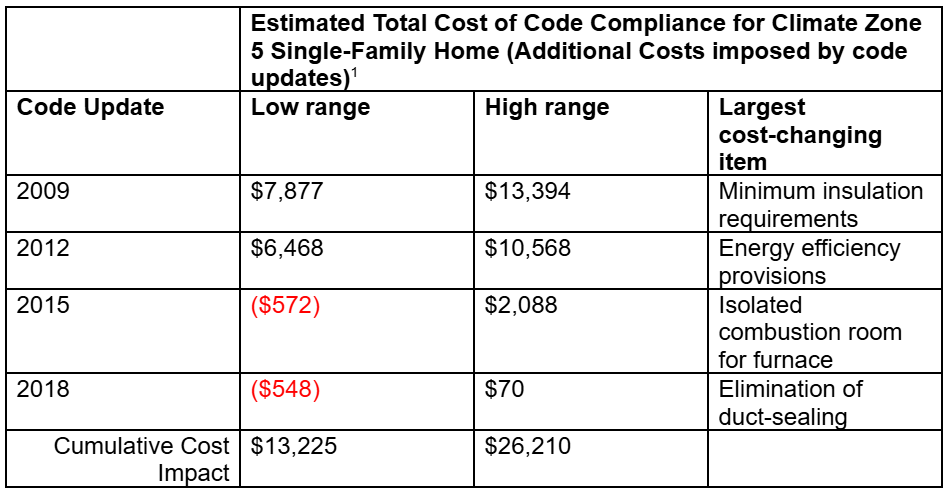
A series of studies commissioned by the National Association of Home Builders (NAHB) tracked the total cost impact, on a per-home basis, of specific changes in the International Residential Code (IRC). These studies found that, over the 2009–2018 IRC update cycles, code changes increased costs for construction of typical homes in Joel’s area by an estimated $13,225 to $26,210. With ongoing updates, IRC has the potential to continue ratcheting up costs indefinitely.
Another study by NAHB found that government regulations overall (zoning, building code, design, safety, etc.) accounted for nearly 24% of the sales price of a single-family home—$93,870 when applied to the median new home price in 2021.
Small + Simple = Affordable
Homes in the United States have gotten a lot bigger since the supposed golden age of home affordability in the 1950s and 1960s. Average home size grew from 1,500 square feet in 1960 to a peak of 2,700 in the mid-2010s. Currently, new homes in the United States average about 2,400 square feet, and builders appear to have largely abandoned construction of small starter homes.
Homes under 1,400 square feet, once the majority, have collapsed to well under 10% of new home starts—despite the fact that the per-household head count shrank significantly since 1960.

Any push for more affordability should emphasize smaller and simpler houses—true starter homes. At the 2024 national average construction cost of $195 per square foot (including everything except land), today’s 2,400 square foot home costs over $200,000 more to build than a 1,200 square foot starter home would cost. Take out expensive amenities such as granite counters, premium appliances, high-end trim, etc., and we reckon site-built homes in the 1,200 square foot range, even in the priciest metros, could be built and sold profitably for a full $100,000 less than today’s national median price of about $410,000.
So why don’t we see more builders producing smaller, more basic homes to meet the crying need for affordable housing? Put simply, the large cost burden of regulations—zoning and building codes in particular—makes starter homes relatively unappealing for both buyers and builders.
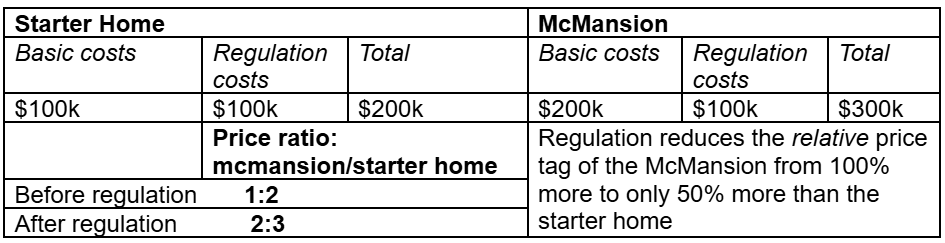
Allow us to illustrate by comparing the costs of a sample 1,200 square foot starter home against a high-end 2,400 square foot McMansion. We’ll assume the all-in costs of regulation add $100,000 per single-family home. Basic construction costs are, roughly speaking, directly proportional to home size and quality. Thus, in the absence of an extraneous regulatory cost burden, a 2,400 square foot home should run about double the cost-to-build of a 1,200 square foot home (land costs notwithstanding). The costs of a strict regulatory regime, however, are not proportionate to home size and amenities, but rather a roughly fixed amount for any size home. In other words, regulatory compliance adds almost the same amount of dollar outlay to the starter home as it does to the McMansion. The overall effect is to shrink the price gap between starter homes and McMansions, making the latter relatively less expensive compared to the former. Economists know this as the Alchian-Allen Effect.
In a less-regulated world, a starter home might be ½ the price of a McMansion, but once the regulatory burden is factored in, the starter home is instead 2/3 the price, and the larger the fixed cost of regulations, the smaller this relative price gap becomes. As the cost of regulations grows, the relative price of large, well-appointed houses declines. Unsurprisingly, builders and buyers increasingly eschew relatively more expensive starter homes.
Let there be “low quality” goods
The inimitable Walter Williams, our favorite econ teacher, used to say, “Low quality goods are part of the optimal stock of goods.” Of course—for how else could the material needs of poorer people be met? By this, Williams didn’t mean unsafe or non-functional, but rather made with cost in mind. In the case of homes, this would mean that they are smaller and simpler.
To ensure an abundance of lower-quality goods, governments must avoid burdensome taxes and regulations that make it unprofitable and unrealistic for entrepreneurs to operate in the low-end marketplace. Sadly, for many lower-income people looking for shelter, regulations have priced them out of the market.
To incentivize a reliable flow of affordable housing, we will need to see governments drastically peel back cost-prohibitive rules and restrictions imposed by zoning and/or building codes. “If you build it, they will come” rings true to us, but take our word for it: affordable homes won’t get built unless and until governments cut back this excessive regulatory cost burden.
Tyler Watts is a professor of economics at Ferris State University. His brother, Joel Watts, is a homebuilder.
Footnotes
[1] National Association of Homebuilders, “Estimated Costs of Building Code Changes.”
[2] US Census. Note: 1,400 s.f. cutoff interpolated from 1,200-1,599 s.f. bin data.
[3] Pew Research Center, “The state of affordable housing in the US.”
[4] United States Census Bureau, Historical Households Tables.
READER COMMENTS
David Henderson
Dec 2 2025 at 10:38am
Excellent post, and thanks for the shout-out.
Two things:
I hadn’t thought of the Alchian/Allen effect in this context. Nicely done. I learned it directly from the master: Armen Alchian. Of course, being a humble man, Alchian didn’t call it that. He didn’t give it a name. So we Ph.D. students at UCLA named it after the particular good he and Bill Allen used to illustrate the point: we called it the “oranges principle.”
I didn’t understand the red in the first table, presumably meaning negative. How does a new regulation cut costs?
Thomas L Hutcheson
Dec 2 2025 at 12:46pm
He may have in mind a regulation that requires the adoption of a cost-efffective innovation. Of course it’s an innovation that builders and house buyers migh weel hav hit on anyway, but on paper it could look like a cost-rreducing regulation.
Tyler A Watts
Dec 2 2025 at 11:27am
Thanks, David! I’ve seen your articles in which you refer to the “oranges principle.” I believe the oranges example was only in the earliest editions of University Economics; I was assigned Exchange and Production in Dr. Williams class, and I currently use Universal Economics in my intermediate micro class, and I cannot for the life of me find the “Alchian/Allen effect” reference in either of these books! Perhaps another reader can direct me to the chapter or page if it is indeed in either of them.
The red in that table does indeed indicate a negative, meaning that there is a possibility of the code being changed in a way that does actually reduce construction costs. What we typically see, though, is that the building code tends to add much more than it subtracts, hence the high-end estimate of the impact of the code changes is always a positive number (cost addition) in this data set.
In our frequent conversations over the years, Joel has routinely provided me with examples of code changes, usually imposed by his local building department–which can go above and beyond the IRC requirements–that add to construction costs in constant, annoying fashion. In the article I highlighted one that truly stuck in my mind (2×6 vs 2×4 walls) and I believe would be easiest for those not expertly versed in construction to appreciate.
David Henderson
Dec 5 2025 at 12:34pm
Thanks, Tyler.
BTW, your reference to my book review caused me to reread it for the first time in a couple of years. I still like it. 🙂
Thomas L Hutcheson
Dec 2 2025 at 12:30pm
Of course the especial discouragment of multi-story multi-family residences goes sharply against energy efficiency. Nor is there any externality that would justify regulating for energy efficinecy per se.
Robert EV
Dec 6 2025 at 8:22pm
Isn’t this externality one, or two, of the laws of thermodynamics? We all effectively share a system. Converting potential energy to kinetic energy increases the total energy of the system that we all share. And this increased energy, even with the system’s insulation remaining constant (which it isn’t, the insulation is increasing), can only radiate away so fast.
And that’s not even getting into planning for power plant and transmission maintenance and construction. Those things cost money, and depending on demand this cost can be non-linear.
So I see a thermodynamic externality and a cost-to-others externality.
Knut P. Heen
Dec 2 2025 at 1:28pm
I live in rural Norway and even here at least 50 percent of the price you pay for a “house” is the land underneath. On Manhattan, it must be 95 percent land and 5 percent house. Forget about house prices. Think about land prices.
The Alchian-Allen concept work with land as well. Increasing the land price makes it relatively cheaper to add a big house on top. It is just like travelling to the UK to watch football. If you have to pay for the plane and the hotel, you better also get expensive tickets to enjoy the match.
Tyler A Watts
Dec 3 2025 at 10:33am
There’s a fairly easy solution to high land prices in very desirable (high housing demand) metro areas: build up. Also, you can build more densely (i.e. larger building footprint, less yard). Glaeser and Gyourko have some excellent research on this, for instance this study looking at Manhattan. https://www.nber.org/system/files/working_papers/w10124/w10124.pdf
Houston, likewise, reformed some zoning-esque lot size/ coverage rules to allow Levittown-style suburbs to be razed and filled in with tightly packed townhomes (chronicled excellently in Nolan Gray’s Arbitrary Lines: https://www.amazon.com/Arbitrary-Lines-Zoning-Broke-American/dp/1642832545
Yes, land is very expensive in the cities, but the marginal cost of housing need not be because of high rises and other high density forms of housing development. If housing prices persist at levels well above construction costs (including normal profit for the developers), that’s a sign that zoning is too restrictive–which it is in most US cities with “affordability” problems.
Knut P. Heen
Dec 8 2025 at 12:17pm
I agree that zoning is important for land prices. The problem is that high land prices is good for current land owners and bad for potential newcomers. It is easier for current land owners to form a political coalition to continue zoning than it is for newcomers to form a coalition to abolish zoning. First of all, potential newcomers don’t even have the right to vote in local elections before moving there. Second, once you have bought a home and have the right to vote, you may have changed your mind about zoning (because abolishing it will lower the value of your newly acquired property).
My initial point was that I don’t think construction costs are an important part of the equation in areas where land prices are particularly high.
Tyler A Watts
Dec 9 2025 at 12:12pm
Thanks for your thoughtful comments. I think we’re in agreement that the bulk of the ahigh price problem in the big cities stems from zoning, as far as public policy plays a role in the affordability problem. To a certain extent, cities will always have higher land prices (rents) because they are attractive, valuable places to be–network externalities, agglomeration economies, and the like. Eliminating zoning would never make housing in Manhattan as low-priced as it is in my small town in northern lower Michigan.
That being said, I think that higher construction costs, partly resulting from zoning but mostly imposed by stringent building codes, do contribute significantly to higher home prices, especially in areas where zoning is not so restrictive. The rural area where I live _is_ zoned, but it’s not restrictive in practice because there is no need (no demand) for any kind of density in development (population density is 41 people/ square mile). I know from my own experience and research, however, that the county imposing the most current building code (vs. say one from the 1990s when I first started in construction) would add tens of thousands of dollars in construction costs for the same size home.
In summary, higher prices are attributable, in this order, to:
spatial concentration of demand
zoning restrictions on supply (density & building costs per s.f.)
building code impositions on cost per s.f.
I probably should have acknowledged item 1 in the article explicitly; since this is an econ blog I basically assume that the readers are aware of the fundamental composition of supply and demand, and thus I jump straight to the ceteris that are not paribus, i.e. the public policy-induced shifts in the market equilibrium.
john hare
Dec 2 2025 at 5:36pm
We just got our Certificate of Occupancy on our new house a couple of weeks back. Built 620 square feet for cash and sweat. A lot of problems with permitting and requirements. Managed to hold direct cash outlay to around $100,000.00. And a lot of sweat here in Florida.
Having a bit of engineering background and being in the concrete business, I designed a reinforced concrete house. Walls are 6″ reinforced concrete with 4″ foam integral with the concrete. Roof was 6″ reinforced concrete over 6″ foam. Beams integral with the roof slab. County did not like size. Turned down once for no truss drawings and didn’t like being told there were none. They didn’t want to accept the foam (R20 walls and R30 roof) as legitimate insulation, wanting to make me redesign around fiberglass batts.
Could have saved around two years and at least $20K with a rational approval process. With practice, I think we could get similar houses down to $90K and turn a profit except I don’t think we could find lots in areas without serious restrictions. Electric bills have been under $100.00 a month since power was turned on.
steve
Dec 3 2025 at 8:48am
Did a lot of the finish work on my house myself. Used to help uncles with their construction. Always been fascinated by idea of a concrete house. How did you run the electricity and the ducting for air conditioning/heating? Also, when we lived in Tampa (Brandon) and we looked at investment properties in Destin land was not cheap.
Steve
john hare
Dec 3 2025 at 8:18pm
Interior walls are wood frame and drywall. Air handler in attic above bedroom on ceiling joists. 6/12 pitch leaves room. Cathedral ceiling in living room gives impression of space. Last reply more detailed but couldn’t get it to accept.
steve
Dec 4 2025 at 2:08pm
Thanks. Kind of what I thought but I wondered if you found some cheaper way to do interior. I did the wood framing and drywall in my basement against our concrete and that’s not especially difficult but I kept thinking that there must be some cheaper easier way to do it. Was also kind fo wondering if you went with a ductless heat pump. I have sometimes thought that might be the way to go with small homes but have never priced it out.
Steve
steve
Dec 3 2025 at 8:56am
I have long been supportive of the YIMBY movement but seeing the immediate effects I am having some second thoughts. Nephew lives in a row home in Philly. Essentially all homes in the area are row homes. Some of them were bought, knocked down and turned into large apartment complexes close to him. The 19 apartment complex has no parking and the 76 apartment complex has 20 spots. The result is that they now sometimes have to park 5-7 blocks away after cruising around for 10-15 minutes looking for a spot. They avoid leaving the house if they get a space close to home. I think the economist’s POV is that eventually some solution will present itself. However, in the meantime it’s making for a poor lifestyle for those who lived in the area before the apartments arrived and there’s not much of an answer for them in the intervening years.
Steve
Richard Ober Hammer
Dec 3 2025 at 11:17pm
Between 1990 and 1995 I worked as a house builder. Doing much of the work with my own hands, I built four houses in Orange County, North Carolina, the last three being spec houses on lots that I bought, houses that I designed myself for those lots. With that experience I offer a somewhat different explanation for the regulation-induced shortage of modest sized houses.
Suppose: a builder can get a lot and a building permit (permission from the government to build a new house there), and the builder can choose to build either a modest house or the largest house allowed on that lot. That is, for $100k build a house that could sell for $180k, or for $200k build a house that could sell for $350k. If demand in the market gives the builder confidence that the larger house will sell, of course he goes big.
There is a lot of satisfaction in building a house one stick at a time. But I reflected that I was working, not in a charmed profession, but in a niche created by regulation. Without regulation the price of housing would drop while quality would probably improve, as with other mass-produced manufactured goods (TV sets, computers, shoes). Houses could be manufactured in China and dropped in one piece onto lots.
Robert EV
Dec 6 2025 at 8:34pm
I’ve read that AI and robotics are just now starting to make advances in pre-fab in North America. I’d personally prefer a pre-fab house built by a company that could be readily taken to court if something bad happened.
Made in China and shipped to the US has a lot to recover from after the toxic drywall that was shipped to the US that was itself banned from use in China.
I also read a Reddit comment a few hours ago by a person saying they had lived for a year in a Chinese apartment that had taken 6 months to build. This person said they had to scrape mold off of the concrete walls with a credit card (water seeped through the walls).
I know you can get quality in China, but it would take pretty good evidence for me to trust it on such an important purchase.
john hare
Dec 8 2025 at 6:07pm
The all concrete house we just built could evolve into automated construction. Not 3D printing which is a joke. Shotcrete with automated QC.
Robert EV
Dec 6 2025 at 8:34pm
Used a commercial word and got caught in the filter.
Comments are closed.