
Over winter break, I was back in Massachusetts visiting family for the holidays. The conversation turned toward the difference in cost of living between my home state (Massachusetts) and my adopted state (Louisiana).
The difference is quite stark. According to the World Population Review’s Cost of Living Index, the overall cost of living in Massachusetts is roughly 1.5x greater than in Louisiana. The difference in housing costs is even greater, with housing in Massachusetts about 2.3x more expensive than in Louisiana. To provide a concrete example of what this looks like, I bought my 1,200 sq ft, 2 bed 1.5 bath condo for $142,000 in August. A similar condo in Worcester, Massachusetts sold for just under $400,000 this past fall. The cost of living in Massachusetts is so high they have a net outflow of about 30,000 residents leaving for other states.
I am a major proponent of free markets and YIMBY (Yes In My Back Yard, a movement to increase housing availability/reduce building restrictions). My position is that Massachusetts should “build, baby, build.” My aunt objected, pointing out that there is a ton of building going on in Massachusetts. And she is right; some 90,000 units are under construction in the state. My response was “It’s still not enough housing.”
In that response, I made an Econ 101 error: I was reasoning from a quantity change. Reasoning from a quantity change is the companion problem to a problem my former co-blogger Scott Sumner often writes about, reasoning from a price change.
In reasoning from a price change, one makes a determination about the direction of quantity given a change in price. For example, guessing that the quantity demanded in the market will fall because prices are rising. Reasoning from a price change is mistaken because one needs to understand why prices rose in order to make a determination about what will happen to the equilibrium quantity.
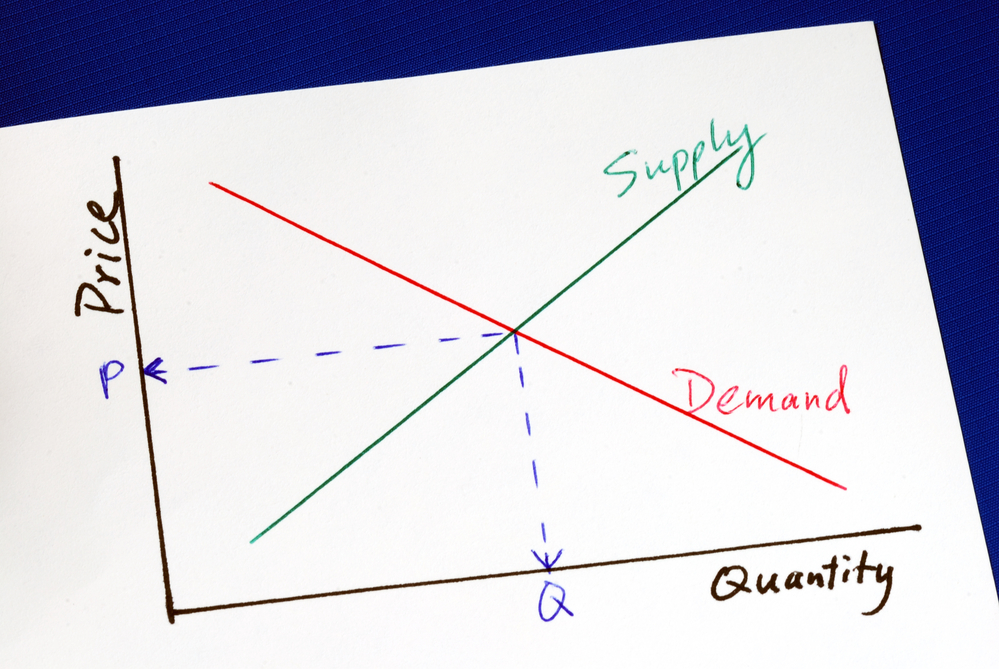
Without understanding the why, one cannot make a reasonable determination about the what. Prices can rise for two reasons: an increase in demand or a decrease in supply. Depending on which event happened, the effect on quantity will differ. If prices rose because of a decrease in supply, then the market quantity will fall because each supplier will now be willing to sell fewer units at any given price. However, if prices rose because of an increase in demand, then the market quantity will increase because buyers as a group are willing to buy more at any given price.
The same problem applies when reasoning from a quantity change. Just as with reasoning from a price change, in which a change in price does not tell us what a change in quantity to expect would be, a change in quantity does not tell us what the change in price will be.
Changes in quantity also come about from shifts in supply and demand. If demand falls, the quantity exchanged in the market falls, too, because the price is lower. People are willing to buy fewer units at any given price, so producers cut production to lower marginal costs and protect profits. If supply falls, prices rise as it becomes more costly for firms to produce and production falls because it is more costly to produce the marginal unit.
In the Massachusetts example, there are two explanations for the change in the quantity of housing (that is, all the building): an increase in demand or an increase in supply.
If housing demand in Massachusetts is increasing, then the price homebuyers are willing to pay for housing is rising, too. Suppliers might be building more just to reach a quantity supplied that matches those rising prices on the shifted demand curve. They see that wannabe homeowners in Massachusetts are willing and able to pay more for housing and are simply providing at those desired prices.
In contrast, if new homes are being built because supply is increasing, then prices will fall as more homes are constructed. Builders will lower the prices they charge for homes in order to lure buyers to their homes. (Which factors are driving the Massachusetts housing market is not something I am going to speculate on as it is unrelated to this post).
It is possible to temporarily reduce prices by simply increasing the quantity supplied. If quantity supplied exceeds quantity demanded, then the market has a surplus. In that case, firms (and sellers) will lower prices as they look to move the unsold inventory. But the resulting decline in housing prices would only continue until the market reaches equilibrium. The equilibrium price still won’t fall as it would if supply, and not only the quantity supplied, were increasing.
And so, what I said to my aunt was incorrect. I wish I had said: “If we want to make housing affordable, we need to reduce the costs of building homes in Massachusetts to increase the number of homes that will be supplied if all marketable homes are built. Simply building more won’t make housing more affordable if the demand for housing is rising along with the quantity supplied. One must look at barriers to affordable housing, like the permitting process, zoning, and other construction regulations. Making it less costly to build [that is, increasing supply] is the only sustainable way to reduce housing costs.”
READER COMMENTS
Gene Laber
Mar 5 2026 at 11:11am
You write,
“In contrast, if new homes are being built because supply is increasing,….”
Isn’t that a tautology?
Jon Murphy
Mar 5 2026 at 3:45pm
No. Supply refers to how much suppliers are willing to produce at different prices. The supply is increasing (the curve shifts to the right) and, consequently, the quantity supplied (the number of houses produced at the market price) also increases.
Richard W Fulmer
Mar 5 2026 at 7:44pm
But you haven’t explained why supply is increasing. You’ve ruled out a price rise, so why is supply increasing?
Jon Murphy
Mar 6 2026 at 12:56pm
Price never affects supply. Only quantity supplied.
Because it doesn’t matter for the hypothetical.
Richard W Fulmer
Mar 7 2026 at 9:32am
You stated that: “We observe more building. This could be explained by (A) rising demand, or (B) increasing supply.” While you offered them as two parallel alternative explanations, they’re not parallel at all.
In case (A), you gave a complete causal story: demand rises → prices rise → suppliers respond by building more. There’s a clear external driver (demand) that explains the observed building.
In case (B), you just restate the observation in different language. “Supply is increasing” is just a more technical way of saying “more homes are being built.” You haven’t identified any external driver that would cause the supply curve to shift.
Your argument that that price affects quantity supplied, and not supply, is technically correct, but it’s not a response. I wasn’t asking whether price shifts the curve. I was asking what does shift the curve. Your reply that it’s hypothetical isn’t an answer.
Jon Murphy
Mar 10 2026 at 11:39am
No. An increase in supply is not the same as an increase in quantity supplied. An increase in supply would lead to an increase in quantity supplied, but only if all else is held equal.
Max Molden
Mar 5 2026 at 3:00pm
Liked that article very much and learned a new point from it! Thanks, Jon!
Craig
Mar 7 2026 at 2:16pm
One of the nice things about rural TN is that one can see how ‘cheap’ it is to build the physical home. Of course fewer people want to live there and so overall the cost of housing + land is very affordable. Indeed one can see this even as between North Jersey and NE PA where home prices come down quite dramatically. I’d suggest the core problem is land and a general affinity for the current level of suburban density. So in North Jersey that is the quintessential bilevel on a 1/4 acre plot. But yes, today one CAN build a 2000 sq ft home in the US for under $200k, the issue is the land. If you stick it on a parcel that costs $10k then the home is $210k, if you stick it on a parcel worth $500k, then its $700k.
Grand Rapids Mike
Mar 8 2026 at 11:01pm
For the supply function of housing, how about looking at it in 2 parts: the land cost per 1/4 acre for example and the cost to build the house. As identified the land cost depends on population densities, permit cost and local ordinances that include cost for drainage ponds associated with a development for example. The cost to build covers not only labor cost, which include union versus not union labor, but also ordinances, like piping for electrical ie conduit etc. A final thing on cost to build is how fancy to you want it, i.e. counter top material, etc. , however this might be more related to the demand function.
So just to get back to the difference in cost between MASS. versus LU. for housing, each element of the supply curve function would seem to be a whole lot different. All in all the institutional barriers or components in Mass are fixed and not likely to change. Will LU has I guess much less in the way of institutional barriers so housing in LU will always be cheaper.
A final thought on the demand side, would suggest this is shaped by whether a guy is just buying or a guy and his wife are the buyers As any married man will know the women is the deciding factor and shapes the demand function.
Comments are closed.