

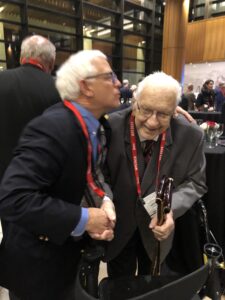
“Triangle Man” is now 100 years old.
Long-time University of Chicago economist Arnold Harberger turned 100 years old today. Unless I am mistaken, he is still going relatively strong, even in the classroom.
The Wikipedia article on some of Harberger’s accomplishments is actually quite good and so I won’t try to restate them.
Rather, I’ll tell 3 stories about my interactions with, and observations of, Al.
Number one: I first met Al at a cocktail party at the home of my colleague Ron Hansen in the late 1970s when I was a young assistant professor of economics at the University of Rochester’s Graduate School of Management (now the Simon School.) To me he was already a god because of ability to use basic price theory to reach important conclusions. But he didn’t act like a god. He was a normal and very welcoming human being.
Number two: When I was at the Cato Institute in 1979, Al helped me with data for an article that my friend Roy Childs was writing. Here are the details.
Number three: While the Chatham House rule applies to proceedings at the Mont Pelerin Society meetings, I can hue to the spirit of the rule in telling this story without naming names. At one of the events at the MPS meetings at the Hoover Institution in January 2020, there was a breakfast, if I recall correctly, at which Al spoke; he talked about what was going on in Chile. In the 1970s and later, Harberger had been very important, much more important than Milton Friedman, in helping move Chile’s economy in a free-market direction. I discuss his role very briefly in my review of Sebastian Edwards’ excellent 2023 book, The Chile Project: The Story of the Chicago Boys and the Downfall of Economic Liberalism. (I would guess that his support of the Chicago Boys, even though he didn’t support Pinochet, is one reason he never was awarded the Nobel Prize in economics.) He had a long and tender relationship with various “Chicago Boys” from at least two generations and it was apparent in the way they questioned him and, to put it bluntly, showed their love for him.
If you’re wondering why I call him “Triangle Man,” check out this link. It’s a nice extensive and understandable treatment of Harberger’s classic 1954 article in the American Economic Review, “Monopoly and Resource Allocation.” Economists had been stating for decades that monopoly caused deadweight loss but he was the first to try to estimate the size of the deadweight loss. Harberger found that, for U.S. manufacturing, it was unlikely to be above 0.1 percent of GNP. (Gross National Product was the conventional measure of the size of an economy at the time.) There are, to be sure, various criticisms of his argument and estimate. The point is that he did it and no one before him had done so. The deadweight loss from monopoly is typically measured by a triangle. Thus the nickname, one which was used in various skits put on by University of Chicago students and one that he wore proudly.
Note: The pic above is of Al Harberger and me after his breakfast talk.
READER COMMENTS
Scott Sumner
Jul 27 2024 at 11:09pm
Thanks for doing this post. I took several courses from Harberger back in the late 1970s. He was one of my favorite professors at Chicago. I took a prelim in Public Finance, which was his area of expertise. Glad to hear he is still going strong.
Andrea Mays
Jul 27 2024 at 11:19pm
Thank you for this post! I last saw Harberger at Armen Alchian’s memorial— a fun and uplifting event! Harberger was doing well and sharp as ever. I had the good fortune to know and learn from a few of the Chilean imports he attracted to UCLA— Sebastian Edwards and his wife Alejandra among them. Happy Birthday to a man who has had such influence!
Thomas L Hutcheson
Jul 28 2024 at 8:52am
I notice that Libertarians tend to be much more interested in the small Harbergerian deadweight losses from monopoly than from the small deadweight losses from a Pigou tax on net emissions of CO2.
I met him 🙂 briefly in Colombia where I was an advisor and he made wonderful neoliberal points in a presentation in the Planning Office against import substitution.
Daniel Merilatt
Jul 28 2024 at 9:43am
I’m not sure this story is true but I have always hoped it was. At Chicago between 1976 and 1978, I was given to understand that nobody had been able to pass the mathematical econ prelim. Those wanting that specialization apparently complained to the department. Mr. Harberger, who was known to all of us as triangle man, consented to attempt that prelim. As these exams are graded blind, this seemed to the complainers a fair test. He, it was said, passed it easily.
So, his teaching of ideas using triangles of consumers’ and producers’ surplus does not presuppose an inability to present them with much more complicated math–a fact demonstrated nicely in his ‘three basic postulates’ article.
David Levey
Jul 28 2024 at 10:14am
Like Scott, I took a course with him when, as a senior in the College at Chicago (1961-62), several of us undergraduate econ majors were allowed to take graduate-level courses. (I was fortunate to also take Friedman’s Price Theory course). Harberger was an excellent teacher, clear and concise. Later, in the mid-1980s, when I was working as head of country risk review at Wells Fargo Bank in SF, he came to talk to us about the Latin American debt crisis and its aftermath. Happy 100th to a great economist and thanks, David, for this comment on his distinguished career.
Manfred
Jul 29 2024 at 3:39pm
Unfortunately, I never had Prof Harberger as a teacher myself. But students of his taught me the triangle in Uruguay. I was always enthralled by it, and still am.
By the way, let us not forget that Harberger is the father of the incidence of the Corporation Income Tax, a paper that in itself should have given him the Nobel long time ago. This paper generated a long literature of the incidence of this and other taxes.
Comments are closed.