
Many libertarians and classical liberals consider the 19th century in the West as the most liberal epoch in history. We can certainly see stains, notably slavery and later Jim Crow, as well as colonialism (think about the control of trade from the colonies, which Adam Smith criticized in his 1776 Wealth of Nations). In many countries, moreover, the liberal century started late (in France, for example) or ended early (in Germany). Even in the UK, the Corn Laws were only abolished in the middle of the century, and British libertarians were pessimistic as the end of the century approached (see Matt Zwolinski and John Tomasi’s The Individualists, which I reviewed in Regulation).
Yet, for Anthony de Jasay, whose thought is strongly anchored in the “private forteresses” of private property, the 19th century was clearly the era of liberalism, even if fleeting. In his book Against Politics (see my Econlib review), he wrote:
It is to history taking its time that we owe thanks for the brilliant but passing nineteenth-century interlude in Western Civilization, with limited government and assured-looking private sovereignty of everybody’s own decisions over crucial domains of economic and social life.
The UK was among the countries where the advance of liberalism was most promising. In his English History 1914–1945 (Oxford University Press, 1965), historian, journalist and broadcaster A.J.P. Taylor described his country on the onset of World War I. Was he influenced by similar observations in John Maynard Keynes’s 1919 book The Economic Consequences of the Peace? In any event, the opening paragraph of Taylor’s book is memorable and worth quoting nearly in extenso; it suggests that the promises of liberalism have been seriously betrayed:
Until August 1914, a sensible, law-abiding Englishman could pass through life and hardly notice the existence of the state beyond the post office and the policeman. He could live where he liked and as he liked. He had no official number or identity card. He could travel abroad or leave his country for ever without a passport or any sort of official permission. He could exchange his money for any other currency without restriction or limit. He could buy goods from any country in the world on the same terms as he bought goods at home. For that matter, a foreigner could spend his life in this country without permit and without informing the police. Unlike the countries of the European continent, the state did not require its citizens to perform military service. … Only those helped the state who wished to do so. The Englishman paid taxes on a modest scale … rather less than 8 per cent. of national income.
The rest of the paragraph shows both the emergence of an interventionist trend and that the British were still generally freer than nearly everybody in the West—and even than everybody now. The interventionist trend was not so much apparent in elementary public education and in last-resort social assistance as in the fact that some adults (mainly women) were deemed incapable of liberty in certain areas of life:
The state intervened to prevent the citizen from eating adulterated food or contracting certain infectious diseases. It imposed safety rules in factories, and prevented women, and adult males in some industries, from working excessive hours. The state saw to it that children received education up to the age of 13. Since 1 January 1909, it provided a meagre pension for the needy over the age of 70. Since 1911, it helped to ensure certain classes of workers against sickness and unemployment. This tendency towards more state action was increasing. Expenditure on social services had roughly doubled since the Liberals took office in 1905. Still, broadly speaking, the state acted only to help those who could not help themselves. It left the adult citizen alone.
Taylor is a controversial figure. He had shortly been a member of the British Communist Party in his youth and remained a lifelong socialist. But is it possible that the quote above mainly reflects something that we still observe? I mean that socialists don’t understand that individual liberty is impossible without economic freedom, just as conservatives have problems understanding that economic freedom is inseparable from individual liberty.
According to David Pryce-Jones writing in The New Criterion, though, it’s worse than that: Taylor was also a fellow-traveler of the Soviet regime and a Nazi sympathizer—anything but the opposite of individual sovereignty! He seems to have gone through a whole palette of collectivist ideologies. So, his description of English liberty before WWI was probably an incrimination.
In any event, we can read his description as close to what individual liberty should be against all forms of authoritarianism on the right or on the left.
******************************

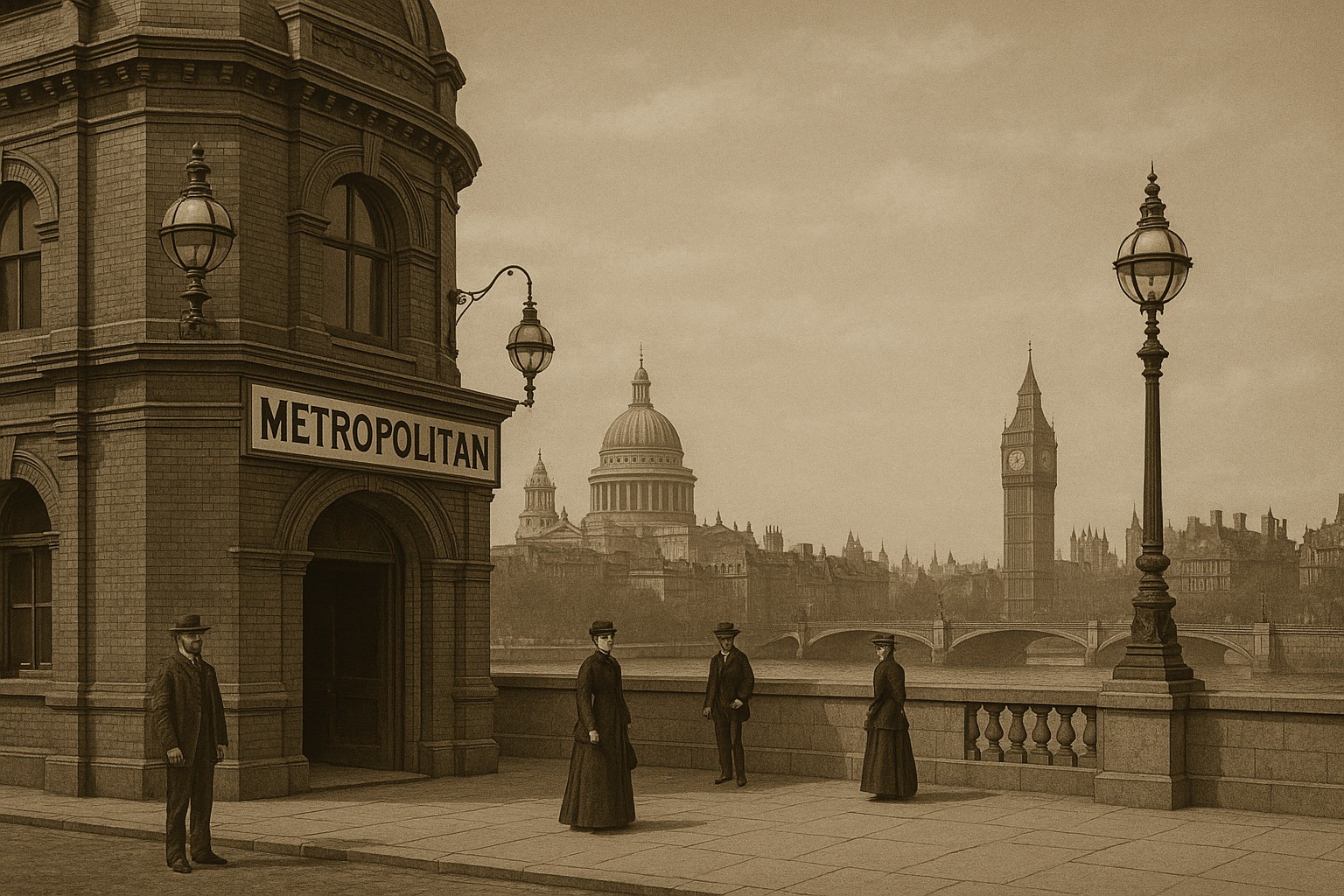
A London Underground station in the late 19th century, as viewed by ChatGPT
READER COMMENTS
David Seltzer
Sep 23 2025 at 10:28am
Pierre: Your clear rendering makes Hayek’s TRTS ever more important.. In 1944, 30 years post 1914 liberal Britain, Hayek’s predictions about the consequences of intervention and collectivism exceed the hypothetical and are today’s realities. His dedication of the book “To the Socialists of all Parties” is an appeal for them to consider the ultimate dangers of their political philosophy.
James H
Sep 23 2025 at 1:25pm
The reason that the late 1800s was known as the time of liberalism was not because of anything that was going on in Congress. It was from a bottom-up effort in the states to put constitutional and judicial restraints on the ability of governments to engage in favoritism. And it lead to some very classically liberal ideas being practice.
Outlawing Favoritism: The Economics, History, and Law of Anti-Aid Provisions in State Constitutions | Mercatus Center
Craig
Sep 23 2025 at 3:33pm
Hard not to at least note colonialism, but the death of slavery was huge.
“But is it possible that the quote above mainly reflects something that we still observe?”
The quote countenances welfare based on genuine necessity imposed by poverty/sickness where today we seem to be further along towards a comprehensove cradle to grave welfare state.
“I mean that socialists don’t understand that individual liberty is impossible without economic freedom”
No, they don’t view it that way of course, theory view is that your exercise of economic freedom needs to be judged as to whether its exploitive or consuming ever greater pieces of the pizza pie reflecting a ‘capital is fixed’ mindset.
Pierre Lemieux
Sep 23 2025 at 6:24pm
Craig: You write:
You take “they” to refer to socialists. But how does this differ from the people now in power in the White House? Is it simply that their “your” points to a different group?
Craig
Sep 23 2025 at 8:19pm
“Now it is true that I believe this country is following a dangerous trend when it permits too great a degree of centralization of governmental functions. I oppose this–in some instances the fight is a rather desperate one. But to attain any success it is quite clear that the Federal government cannot avoid or escape responsibilities which the mass of the people firmly believe should be undertaken by it. The political processes of our country are such that if a rule of reason is not applied in this effort, we will lose everything–even to a possible and drastic change in the Constitution. This is what I mean by my constant insistence upon “moderation” in government. Should any political party attempt to abolish social security, unemployment insurance, and eliminate labor laws and farm programs, you would not hear of that party again in our political history. There is a tiny splinter group, of course, that believes you can do these things. Among them are H. L. Hunt (you possibly know his background), a few other Texas oil millionaires, and an occasional politician or business man from other areas.4 Their number is negligible and they are stupid.” <–Eisenhower letter to his brother.
The Republicans lost that fight to FDR’s New Deal era administration and to move forward the Republicans effectively had to concede its existence to remain politically viable. Trump got a repeal of Obamacare to within one vote but McCain voted it down, right?
Trump of course is no ideologue, indeed I’d even say he’s a relatively vacuous flip-flopper and whatever inertia he had coming off the election at this point the administration now appears to be driftless.
“But how does this differ from the people now in power in the White House?”
The issue of course is one of degree.
“Is it simply that their “your” points to a different group?”
Well, for sure, right? I mean everybody is perfect and nobody wants to admit their tribalism, I’ll at least be a bit honest here about my biases. I do realize I have them, but that is the product of a lived experience too? Indeed, like Eisenhower who seems to yield to his pragmatism over an implied more conservative ideology, in my case you won’t find that many who would support a smaller federal government, indeed I support the complete abolition of the federal government, but I can’t wave a magic wand because I don’t have one and no matter how rapidly I click the mouse here, it doesn’t seem to have any impact on world events!
Mactoul
Sep 23 2025 at 9:56pm
Imposition of modern American categories on 19c England, though popular among classical liberals pining for lost glory, is apt to mislead.
Libertarianism is an American doctrine virtually defined by its view of the State as the Great Oppressor. This view, I am confident, not generally shared by 19c English liberals. They were the party of bigger, if not big government. They were behind various Factory Acts, Education Acts, Food Acts, child labor regulations etc etc, and each new expansion of government being opposed by Tories, the English conservatives.
Pierre Lemieux
Sep 24 2025 at 12:02am
Mactoul: Read Zwolinski and Tomasi’s The Individualists on libertarians in America and the UK in the 19th century.
Matthias
Sep 24 2025 at 9:05am
It’s rather the other way around:
Because modern American politics has claimed the label ‘liberal’ for the centre left, we needed to come up with a new term, and applied it retroactively.
Mactoul
Sep 25 2025 at 12:15am
I submit that, in 19c England, there existed no significant body of opinion, that corresponds to 20c American libertarianism, whose essential feature is its view of State as the Great Oppressor.
On the difference between libertarianism and traditional American belief in limited govt, the essay of Russell Kirk Libertarians: The Chirping Sectaries is good.
Kirk wrote Roots of American Order, an alternative and I must say more based account of evolution of American order than spontaneous order based speculations.
Mactoul
Sep 23 2025 at 11:55pm
The English liberties, infringement of which was pretext offered by American revolutionaries in 1776, long predated classical liberalism. Even before Adam Smith wrote a single word, Englishmen were hardly serfs who required passport to travel from London to Manchester.
19C liberalism was animated, not as much as by limited government, but by the spirit of Reform. For the governments everywhere, even in Mughal India and Tsarist Russia, were quite limited, at least compared with our modern governments. But there was an absolute avalanche of Reform in 19c, in all possible fields, and generally tending to and requiring bigger government. The Free Trade is merely one facet of Reform.
There is a big difference between Free Trade because it is good for a country and its prosperity and Free Trade because it is a moral imperative. A libertarian could say that it is unjust to deprive a man from trading with whomsoever he wishes to trade with, and a Manchester liberal would have it a injustice for a government to discriminate between a citizen and a foreigner.
But, I doubt many were persuaded to Free Trade by these moral exhortations and rather to the argument of prudence and national prosperity. Now a classical liberal in good standing can speak of national prosperity for he merely follows Adam Smith. But anything qualified by the “national” must be an ideological anathema to a libertarian.
Jon Murphy
Sep 24 2025 at 7:26am
You keep making this assertion but never once justified it. In its face, the assertion that governments which considered people within its borders as property, had rigid case systems, and claimed absolute authority over all aspects of life were “limited” is quite unbelievable.
Pierre Lemieux
Sep 24 2025 at 11:33am
Good point, Jon!
Mactoul
Sep 24 2025 at 10:31pm
Which 19c government had OSHA, EPA, zoning, SS NASA, NOAA, CIA, FBI– and other myriad of alphabets that govern us today?
Did any 19c govt consume as much fraction of GDP as any liberal govt today?
As for ownership of man, it was the revolutionary govt of France based upon enlightenment principles, that introduced mass levy on permanent footing.
And what has caste system to do with anything? Do you think caste system which is Hindu social system was maintained by Moslem emperors?
john hare
Sep 25 2025 at 3:45am
Which modern country has DROIT DU SEIGNEUR?
The agencies you mention are mostly a problem, but would you put that on a level with Samurai lopping off your head to test a sword edge?
Or debtors prisons?
Mactoul
Sep 25 2025 at 7:42am
I make a limited point merely that the government began to grow in 19c under the reformist impulses, predominantly felt by individuals of liberal tendency.
I do not claim perfection for any government, present or past.
This claim seems trivial enough. For instance, Moslem rulers of India never thought of interfering in the personal laws of the Hindu majority. But the post-independence liberal democratic government keeps on liberally interfering with the personal laws. Again under the reformist impulses which were let loose upon mankind at Enlightenment.
Jon Murphy
Sep 25 2025 at 8:24am
No, you didn’t. You made a broad claim that “For the governments everywhere, even in Mughal India and Tsarist Russia, were quite limited, at least compared with our modern governments.”
You’ve been tasked with supporting that claim. You have not. You made a vague appeal to the alphabet soup of agencies, apparently unaware that Tsarist Russia and Mughal India also had their own soups of agencies.
Jon Murphy
Sep 25 2025 at 8:28am
It’s also worth pointing out that your limited claim (“I make a limited point merely that the government began to grow in 19c under the reformist impulses, predominantly felt by individuals of liberal tendency”) is factually incorrect. The increasing government reforms of the 19th and 20th centuries were explicitly illiberal in nature; they were in response to the liberalizing effects of liberalism. In addition to the sources Pierre cites above, I’d add Illiberal Reformers by Thomas Leonard.
Ghost
Sep 24 2025 at 3:47am
ChatGPT seems to be hallucinating…
The sketch of London shows both St Paul’s and Big Ben across the river i.e. it is a view from the south bank of the Thames. But in that case St Paul’s, being further east, should be to the right rather than the left of Big Ben; and in any case there are no Metropolitan Line stations south of the Thames…
Craig
Sep 24 2025 at 7:07am
Hey, just be happy Mt Fuji isn’t in the pic.
Pierre Lemieux
Sep 24 2025 at 11:39am
Ghost: You are right. After ChatGPT had done the image (one of a series to get closer to what I wanted), it explained to me that it was a symbolic image. The silicon being didn’t say this, but it is standard imagery. A Paris postcard could show the Moulin Rouge near Notre-Dame and nobody would be overly surprised.
steve
Sep 24 2025 at 5:58pm
In cases like this I wish you would use the measures of liberty that CATO uses ie economic vs personal liberty. The 19th century may have had more economic liberty than we do now but it had way less personal liberty. Yes, laud the UK for freeing slaves but minorities in the UK were still largely treated poorly and coverture still existed most of the century and most of the professions were off limits to women. Through a big chunk of that century you could be killed for being gay and once they eliminated hanging it was a long prison sentence. Again, compared to other countries the UK may have been better but the claim here, as I understand it is that the 19th century embodied by the UK is the all time leader in liberty/freedom.
Steve
Pierre Lemieux
Sep 25 2025 at 11:38am
Steve: I agree with most of your points: they were meant to be covered by my “We can certainly see stains, notably…” The distinction between “personal” and “economic” liberty is, at the very least, very rough. For example, it is because women did not have standard property and contractual rights that they can be said to have less “personal” liberty. But my main point is that the momentum was in the right direction. John Stuart Mill forcefully argued for equal liberal rights for women: it’s worth reading his 1869 book The Subjection of Women. Indeed, many (if not most of) the formal limitations of women’s rights were in the process of disappearing at the end of the century.
Roger McKinney
Sep 24 2025 at 8:01pm
Excellent points! As Hayek wrote, conservatives compromised with socialists for a century giving away property rights. Then conservativescare shocked to learn they have given away the other rights they value.
TMC
Sep 30 2025 at 1:26pm
No, that’s a poor assertion. ‘ economic freedom is inseparable from individual liberty’ is exactly what conservatives believe in.
Jose Pablo
Sep 24 2025 at 8:13pm
We can certainly see stains, notably slavery and later Jim Crow,
Funny you should mention this. I’ve recently been struck by the similarities between the Fugitive Slave Act of 1850 and today’s anti-immigration enforcement.
In both cases we see an expansion of federal power, compelling private citizens and local authorities to take part in enforcing a controversial “anti-something illegal that attempts against individual human dignity” law, whether anti-runaway-slaves or anti-immigrants.
The denial of jury trials and even the right to testify in their own defense for alleged fugitives bears a strong resemblance to the “expedited” deportation proceedings we are witnessing today.
And perhaps, a hundred years from now, when some brilliant intellectuals of the twenty-second century flip through the dusty records of our age, they will shake their heads and wonder how a nation that claimed to worship liberty could so enthusiastically embrace its opposite. They may even decide that this campaign against the “illegal immigrant” qualifies as the most antiliberal moment in twenty-first-century America.
Maybe, after all, history does repeat itself.
Mactoul
Sep 25 2025 at 12:22am
How many millions do you want? India alone has more people who would not mind shifting than the entire American population.
Jose Pablo
Sep 25 2025 at 1:30pm
That’s a pretty lazy example of the magnitude fallacy. Most people don’t want to leave their home country, and for good reasons. After all, most Americans don’t want to migrate despite living with terrible food and tens of thousands of gun killings every year, mostly out of petty disputes or pure mental derangement.
But let’s assume you’re right. Then why didn’t all those millions come under the previous immigration policy, which was in place until less than a year ago?
The notion that immigration law needed to be overhauled to prevent something that wasn’t even happening is not only intellectually lazy, it’s frankly substandard.
Jose Pablo
Sep 25 2025 at 2:39pm
“How many slaves do you want to be free? If you allow them to escape their owners, all of them will do it, and it will be an economic disaster.”
That, in fact, was an argument back then. Can you see the parallel now? Funny how bad arguments never really go out of fashion.
Mactoul
Sep 25 2025 at 10:35pm
Indians, though poor, are not slaves, but a free people, free enough to emigrate anywhere they choose to, and I doubt that even the humblest of them will appreciate you calling him so.
Mactoul
Sep 26 2025 at 9:13pm
Jose Pablo,
I apologize.
Mactoul
Sep 25 2025 at 12:02am
Tocqueville, who tends not to be cited by liberals, predicted the rise of democratic despotism, based upon analysis of American liberalism, more than a century before Hayek:
And why do minute rules cover the land? Because of untiring liberals, who seek to reform and improve all things; they are never content with the way things are, like conservatives, but seek endless reforms.
One can see precisely the same liberal mind at work even at present, when the society has been reformed out of all shape, they still see grave injustices and inefficiencies every nook and still seek to remake the society to quench their endless discontent.
The process was beginning in 19c and that’s why 19c liberals were the party of bigger govt and their opponents, the conservatives, were party of smaller govt.
Jon Murphy
Sep 26 2025 at 9:08am
Uh…two things:
First: Tocqueville is cited often by liberals. Not sure why you think otherwise.
Second: democratic despotism is not liberal. It is explicitly illiberal.
Mactoul
Sep 25 2025 at 10:31pm
Joe Murphy,
Apparently we have been seriously misled and had not realized that the Mughal empire was a marvel of scientific administration, capable of minutely tabulating every peasant in its ever-shifting boundaries. A pity indeed that none of the bureaucratic records managed to survive and indeed again that even the locations of these great bureaucratic agencies have been utterly forgotten in the Mughal capitals.
Your posts on investigation of Mughal administrative agencies
Jon Murphy
Sep 26 2025 at 9:09am
No, just you. That’s why I am able to provide citations for my arguments and you rely on factually incorrect assertions.
Let’s see your evidence.
Mactoul
Sep 26 2025 at 12:09am
Joe Murphy,
But the topic was 19c heyday of liberalism, when the contest was between liberals and conservatives, the assorted socialists being yet politically insignificant. You take great acts such as 1833 Factory Act that limited child labor, enacted by Whig govt or 1847 Ten-hour act (Whig govt) and 1848 Public Health Act, again enacted by Whig govt which established local health boards.
Are these not fledgling and hesitant towards modern administrative state? Do they not lead to a bigger govt?
Other examples are 1870 Education Act which established state education enacted by Liberal govt, 1871 Trade Union Act that legalized trade unions, enacted by liberal govt.,
Jon Murphy
Sep 26 2025 at 9:06am
Correct. Enacted with explicitly illiberal goals.
Mactoul
Sep 26 2025 at 9:57pm
Does that make Tory opponents of these legislations the real liberals?
It is said that 19c liberalism morphed into 20c progressivism ( in America) and Fabianism (in Britain).
Won’t it be simpler to say that while the classical liberal and progressive tendencies are quite disjoint and are hardly to be found together in any body of men, in 19c liberals were impelled by both classical liberal and progressive, humanitarian impulses.
Mactoul
Sep 26 2025 at 11:24pm
Interlude of limited government implies that the government was not limited previously. Which is very questionable. Was British government bigger in scope and ambitions anytime in 18c , leaving aside the Napoleonic wars?
Did the liberty of Englishmen came into full flower only in 19c?
Mactoul
Sep 27 2025 at 5:36am
Why is colonialism objectionable from classical liberal/libertarian perspective?
If it results in replacement of a local despotism by a relatively enlightened and liberal empire, integration into a global economy, cessation of domestic strife, all of these tending to prosperity and happiness of the natives, then why does the fact that it is the foreigners that are ruling bother a libertarian?
As a matter of fact, leading 19c liberals such as Lord Macaulay, the great Whig historian and colonial administrator were very clear about the blessings they were bringing onto the benighted lands and were not at all apologetic about it at all.
Pierre Lemieux
Sep 28 2025 at 10:43am
Mactoul: You ask:
That’s a good question. It’s clear to me that it shouldn’t, except for one consideration, which we find in The Wealth of Nations: the state being as it is and working as it is will naturally exploit the colonized and, in the process, many of its own “citizens.”
There are welcome exceptions to this consideration: Hong Kong is an obvious one. British colonialism, at least under John Cowperthwaite, saved millions of people from dire poverty and degradation–until the Chinese state took over.
Comments are closed.