
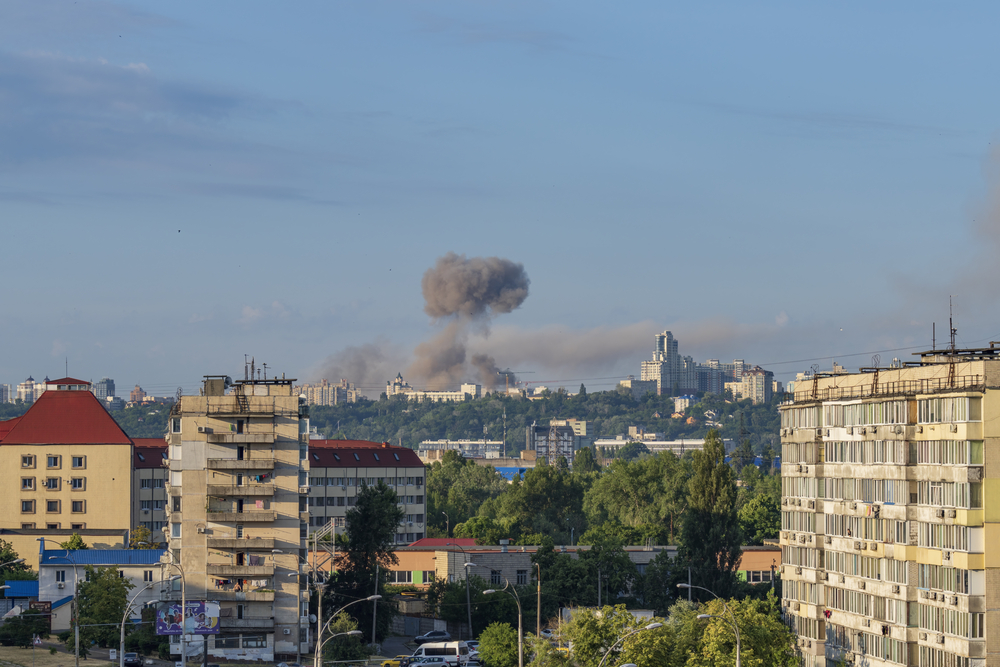
We know that, other things equal, war should be avoided because blowing up things and people is not the way to prosperity and liberty. By “we,” I mean those who have reflected on this issue with the benefit of some economic knowledge. The negative impact on (individual) liberty, besides the direct effects of war violence, works through the increased power that the state, victorious or not, grabs during a war and generally maintains afterwards, active or dormant. We can see this not only in Russia but also, as the war continues, on the Ukrainian side.
Besides that, it seems to me that the war in Ukraine should have taught us two basic lessons. By “us,” I mean libertarians and classical liberals. One lesson is that, except if prevented by force or the threat of force, foreign tyrants will wage wars to grab resources and extend their dominion. Hence, if one lives in a somewhat free society, one should want it to be defended against these foreign tyrants. As Adam Smith said, “defence … is of much more importance than opulence”—if only because tyranny prevents opulence.
It is not without reason that Anthony de Jasay, a liberal or perhaps conservative anarchist, sees the main problem of anarchy as the protection against foreign states. It is also a problem, although not necessarily the main one, for our current more or less free societies.
In my opinion, it is a lame argument that foreign tyrants only show their teeth when states of (more or less) free societies organize or strengthen their defense capabilities; they would never attack doves. Not only history illustrates the contrary, but economic theory suggests that foreign tyrannical regimes will have less incentive to attack the more costly it is likely to be for them (just as would-be tyrants in our own societies will attack our liberties less if their expected costs of doing so are higher). Raising war disincentives for foreign tyrants quite certainly requires not to wait until one is at our shores or has conquered part of the world: alliances and treaties can be be a less costly way.
Of course, if our society becomes as unfree as those who live under foreign tyrants, there will be no point fighting them.
Another basic lesson of the war in Ukraine is that the distinction between soldiers and civilians has continued to shrink, despite the pronouncements of international law and Bertrand de Jouvenel’s fears. And this is truer the freer and the more prosperous a society is: as we have seen in Ukraine, for the enemy, every civilian with a cell phone can be, and can be presumed to be, an enemy combatant. An occupier in the United States would have still another reason to consider any individual as a combatant: the guns he has at home or is carrying. (In other more or less free countries, civilians have been disarmed by their own governments.)
READER COMMENTS
Craig
Aug 17 2022 at 1:02pm
“Another basic lesson of the war in Ukraine is that the distinction between soldiers and civilians has continued to shrink, despite the pronouncements of international law and Bertrand de Jouvenel‘s fears. And this is truer the freer and the more prosperous a society is: as we have seen in Ukraine, for the enemy, every civilian with a cell phone can be, and can be presumed to be, an enemy combatant.”
I think Ukraine shows a new model of limited warfare returning. The Ukraine can’t hit Russia, Russia can’t hit the water or electrical and has to allow grain shipments, etc.
“for the enemy, every civilian with a cell phone can be, and can be presumed to be, an enemy combatant.”
International law imposes a duty on combatants to target their enemy with distinction and proportionality. I’d suggest that if the Russian army can look at any civilian and presume that individual to be an enemy combatant — the cell phone makes them all potentially scouts/spotters for the other side, then actually that would give license to the Russian army to target and kill essentially anybody, ie if what you write is true, “….and can be presumed to be, an enemy combatant” then those individuals are legitimate military targets.
And no, I don’t think your intent is to give license to the Russian army to target and kill cell-phone wielding civilians.
David Seltzer
Aug 17 2022 at 1:42pm
Craig, Putin’s forces targeted mothers and babies in the bombing of a hospital in Mariupol, according to several news outlets. It seems Putin took license. I am hard pressed to think of infants as combatants with cell phones.
Mark Brady
Aug 17 2022 at 2:55pm
And bombing hospitals didn’t begin with the current conflict in Ukraine.
“On 3 October 2015, a United States Air Force AC-130U gunship attacked the Kunduz Trauma Centre operated by Médecins Sans Frontières (MSF, or Doctors Without Borders) in the city of Kunduz, in the province of the same name in northern Afghanistan. 42 people were killed and over 30 were injured. Médecins Sans Frontières condemned the incident, calling it a deliberate breach of international humanitarian law and a war crime. It further stated that all warring parties had been notified about the hospital and its operations well in advance.” (Wikipedia entry on the Kunduz hospital airstrike)
David Seltzer
Aug 17 2022 at 3:01pm
Mark, that is terrible. When I returned from service in Southeast Asia, 1962 to 1964, a person asked, “what happens in war?” I said we lose our humanity. I have spent the balance of my life trying to reclaim it.
Pierre Lemieux
Aug 17 2022 at 3:53pm
Mark: I agree with your indignation and with David’s comment. However, any acceptable ethics would distinguish between killing civilians by mistake and deliberately targeting them. One criterion for granting more credibility to one side than the other is the capacity the former to acknowledge mistakes as opposed to the continuous lies of the other. From the Wall Street Journal of August 6, 2021:
Craig
Aug 17 2022 at 5:05pm
“However, any acceptable ethics would distinguish between killing civilians by mistake and deliberately targeting them.”
I agree generally, as to degree, but the Pentagon is actually a bit off in its analysis. “The Pentagon concluded the service members hadn’t committed war crimes because they struck the hospital unintentionally”
“Unintentionally” isn’t actually enough and its a skin deep analysis. The duty imposed by international law is that one must target the enemy with distinction AND proportionality.
If your defense is that, “Oh, schucks, we messed up” well that’s a distinction problem. It means one is not adequately distinguishing between combatants and non-combatants. The latter goes to collateral damage which, by definition, is always unintended. “Loss of life and damage to property incidental to attacks must not be excessive in relation to the concrete and direct military advantage expected to be gained.” That’s a pretty grim calculation right there.
“One criterion for granting more credibility to one side than the other is the capacity the former to acknowledge mistakes as opposed to the continuous lies of the other.”
Perhaps the US government can’t not admit this mistake so instead of denying the undeniable it claims they simply didn’t do it on purpose. I surely hope they didn’t. Nevertheless, let’s not forget that the first casualty of war is truth.
Craig
Aug 17 2022 at 5:22pm
As an aside, I am not sure why Doctors without Borders has a credibility issue.
“Médecins Sans Frontières condemned the incident, calling it a deliberate breach of international humanitarian law and a war crime. It further stated that all warring parties had been notified about the hospital and its operations well in advance”
They’re not the Taliban, right?
Juan Manuel Perez Porrua Perez
Aug 18 2022 at 12:27pm
There has been some kind of “Law of Inverse Relevance” operating with respect to international law, war and diplomacy, humanitarian law, international institutions, and even international institutions that sustain economic liberalization: in their scope, their teeth, their enforceability, the severity of the sanctions that can theoretically be applied to violators, the dependence of the actual implementation of these sanctions on the good will of participating States and Superpowers and their being undermined by non-participating States, how relatively easy it is to get around them, etc. This was already present in 1989 and even since 1945 itself.
One the one hand people exaggerate the actual power of these institutions (legal and political) to actually get States to change their behavior, on the other every successive conflict, up to and including Russia’s invasions, subversion and bullying its of neighboring states (and not so neighboring states) after the end of Communism (but that is by no means the only case). Somehow this does not seem to have (at least that is the impression I have) deflated the rhetorical exaltation of these institutions or the lamentations for the death of the liberal international order, nor dimished the surprise people have when these institutions don’t work, nor has caused much in the way of implementing reforms that would actually work to deter bad behavior from States, compel the reversal and/or redress of violations, etc.
It is not only in the large/powerful, determined scofflaws like Russia or Iran or China or North Korea, but even rinky dink regimes and tinpot dictatorships one would think would be no match for coordinated international actions like Cuba or Venezuela or Iraq (under Saddam Hussein), or the so-called “Palestinian” Authority, or the Taliban, against which international instutions and the foreign policy measures (such as economic sanctions) have proven ineffective after the fall of the Berlin Wall.
When I heard about the Biden administration’s sanctions plan against Russia, I couldn’t help but think that 2022 is the 60th anniversary of the Cuban Embargo, that were it not for the combination of the Communist regime’s economically isolationist philosophy and the embargo itself, the island Cuba would be, economically if not politically and culturally speaking, a part (and not even a big part) of the United States (as was the case before the embargo), and that there is no other regime (I think) that is theoretically more ideal than Cube for economic sanctions to work, but that have and still haven’t worked in getting Cuba to abandon Communism (not that there aren’t reasons to abandon Communism independent of the embargo). Same thing could be said, mutatis mutandis, for Communist North Korea, which arose pretty much at the same time as Communist Cuba.
I also thought (reflecting on Vladimir Putin), about how it took actually invading Iraq, physically chasing Saddam Hussein around Iraq, in order to be able to capture, try, execute him and end his dictatorship. This only after ten wasted years of economic sanctions (they were always being violated by “friends” and foes alike), three different US presidents from both parties, successive failed diplomatic efforts, two military defeats on the part of Saddam Hussein (in his invasion of Iran and another in his invasion and occupation of Kuwait). None of which prevented Saddam Hussein from tyrannizing Iraq and committing all manner of atrocities against Iraqis who opposed him during those post-First Gulf War but pre-Second Gulf War years.
There is something seriously wrong with the international order (there was something wrong with it since it was established), and everyone is either unwilling to implement changes that would actually bring reality closer to our professed intentions, unwilling to revise our objectives for the international order (maybe because it was too ambitious) and revise its implementation accordingly, and a determination to continue to exalt the international order (in theory only). All of this has lead to a gradual loss of respect from everyone to the rules that do exist.
I apologize for the rant.
Richard W Fulmer
Aug 22 2022 at 11:19pm
We have no moral obligation to go, in John Quincy Adams’ words, “abroad in search of monsters to destroy.” We do, however, have a moral obligation not to support monsters.
Juan Manuel Perez Porrua Perez
Aug 30 2022 at 8:22pm
That’s a fair objection and actually I agree with the moral concerns and reasons behind it.
However, I would argue that if such are the overriding concerns, then the policy of economic sanctions and/or diplomatic non-engagement with States such as Putin’s Russia or the Castros’ Cuba should be presented to the public and argued for in public, not as an effective means to change the policy of theses States, but as a policy that follows from the moral commitments that any free country that is worthy of the name would follow in light of the nature of the regimes that govern those countries, such as the Communist regime that governs Cuba, and/or the actions of those States, such as Russia’s atrocious conduct in Ukraine.
That would be a perfectly acceptable, principled stance in favor of sanctions and for breaking diplomatic relations (at least to me) and would also have the additional benefit of being honest.
Comments are closed.